
Speech Personality Recognition: Why Less is More in Subjective Modeling
Speech Personality Recognition Based on Annotation Classification Using Log-Likelihood Distance and Extraction of Essential Audio Features
This paper introduces a speech personality recognition framework that utilizes the BIRCH clustering algorithm based on log-likelihood distance for unsupervised annotation classification, combined with a minimalistic triple-feature extraction method (Power Roll-off, Pitch, and Pause Rate). Tested on the SSPNet dataset, the method achieves state-of-the-art accuracy using only 5 features, matching or exceeding typical performance of high-dimensional feature sets.
TL;DR
Current speech personality recognition is bogged down by "feature bloat" and the subjective messiness of human labels. This paper introduces a streamlined approach: use BIRCH clustering to intelligently group noisy annotations and a tiny set of only three essential audio features (Pitch, Power, Pause) to achieve SOTA-level accuracy. The result is a model that generalizes better across genders and environments without the complexity of traditional high-dimensional sets.
The Subjectivity Trap & Feature Bloat
In the realm of Affective Computing, personality is typically measured via the Big Five (OCEAN) model. However, researchers face two massive hurdles:
- The "Soft Boundary" Problem: Most people aren't extreme introverts or extroverts; they fall near the middle. Using a "Split-at-Mean" (SAM) approach to create binary labels (High vs. Low) for training data creates a hard cut at the most populous, ambiguous point of the distribution.
- The Curse of Dimensionality: Many SOTA models use thousands of features (like the Interspeech 2012 baseline with 6,125 features). While they perform well on specific datasets, they often fail to generalize when the speaker's domain (e.g., gender or role) changes.
Methodology: Intelligence through Clustering
The authors argue that rather than finding more features, we need to find better labels.
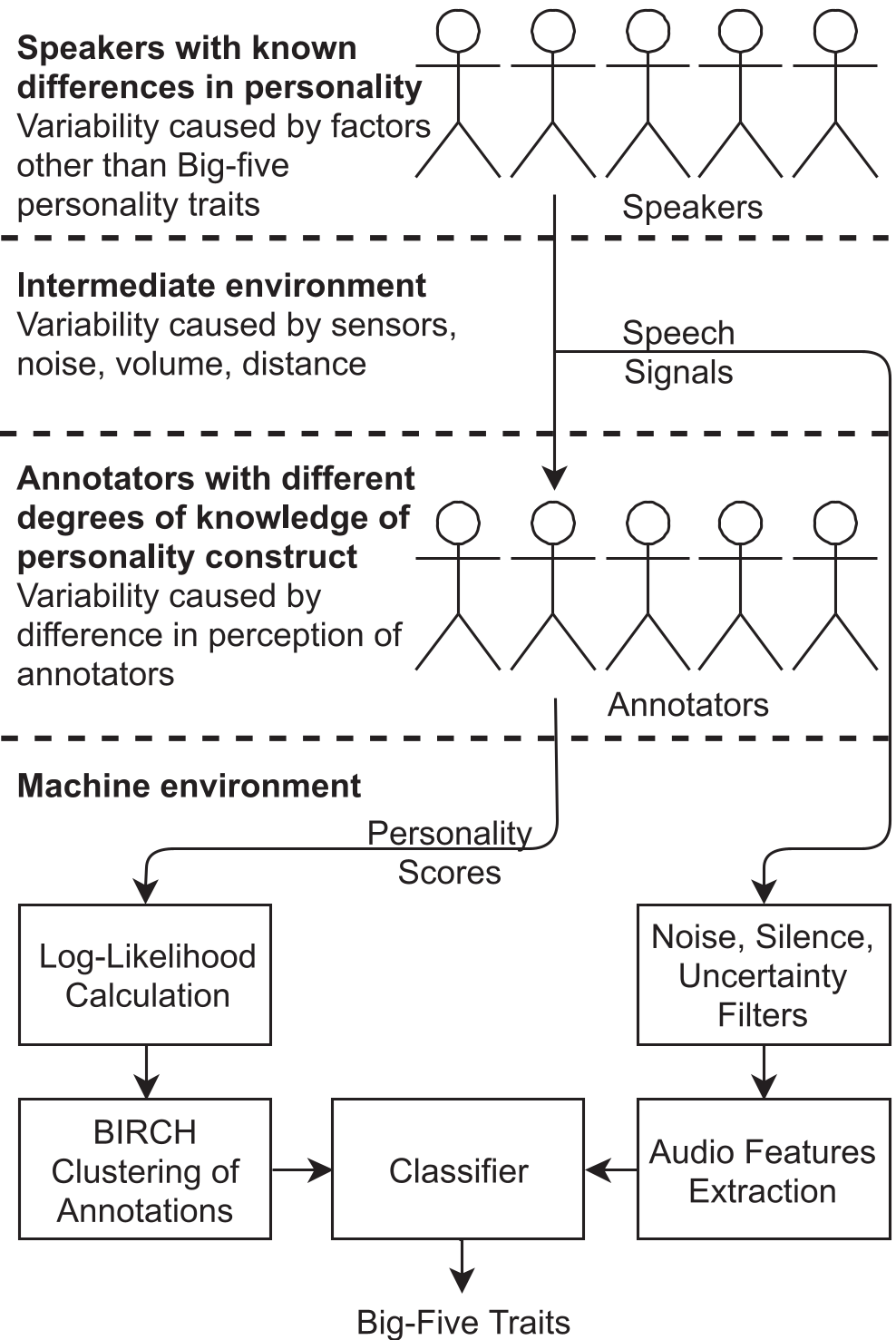
1. BIRCH Clustering of Annotations
Instead of splitting data at the average, the authors use BIRCH (Balanced Iterative Reducing and Clustering using Hierarchies). By applying a log-likelihood distance function, the algorithm groups rater scores into clusters based on probability density. This treats the "neutral" middle-ground as a zone of overlap rather than a rigid cliff, significantly reducing misclassification during the training of SVMs or KNNs.
2. The "Essential" Feature Trio
To combat domain-specific overfitting, the paper proposes a "Essential Feature Set":
- Power Roll-off: Measures differential changes in loudness.
- Pitch (Fundamental Frequency): Extracted using a robust tracking algorithm that rejects uncertain segments (low SNR).
- Pause Rate: Calculates the frequency of silences, a known marker for traits like Extraversion.

Experimental Evidence
Testing on the standard SSPNet Speaker Personality Corpus, the results were striking. By replacing SAM with BIRCH, accuracy across all five traits improved by a relative 4%.
The "Essential 5" feature set (using means and standard deviations of the trio) achieved an average accuracy of 66.96%. While some high-dimensional sets scored slightly higher, they showed high variance—performing well on males but poorly on females. The Essential set remained consistent, proving its resilience as a domain-independent representation.
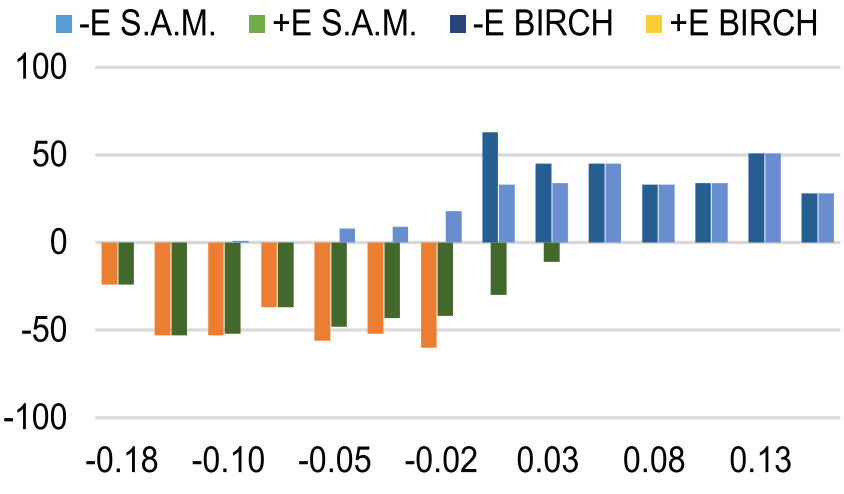 Figure: The gap between High and Low classes is significantly wider under BIRCH (top/bottom) than SAM, particularly for the "Openness" trait.
Deep Insight: The Value of Domain-Independent Logic
The true contribution of this work isn't just a 4% accuracy bump; it's the demonstration that acoustic physics (Pitch/Power) is more stable than statistical brute-force (6000+ features). By refining the "ground truth" through log-likelihood distances, the model respects the natural uncertainty of human ratings.
Critical Analysis
- Reliability: The paper honestly notes that for the "Openness" trait, rater reliability (Cronbach's alpha) was very low (0.18), making any results for that specific trait scientifically soft.
- Efficiency: The computational cost of running an SVM with 5 features versus 6,125 is orders of magnitude lower, making this approach ideal for real-time HCI on edge devices.
Conclusion & Future Outlook
This research signals a move away from "black-box" feature engineering toward a more nuanced understanding of signal processing and label psychology. Future systems in human-robot interaction or empathetic virtual agents will likely adopt these sparse but "essential" feature sets to ensure they understand users regardless of their gender or background.
Senior Editor's Note: This paper is a masterclass in "Occam's Razor" applied to machine learning. It reminds us that often, the bottleneck in AI isn't the model's capacity, but the quality of the signal we provide and the logic of the labels we expect it to learn.