
Elevating Healthcare and Accessibility: The Strategic Integration of Speech Recognition Technology
15517_Speech-recognition technology in health care and special-needs assistance [Life Sciences].
This paper provides a comprehensive overview of Automatic Speech Recognition (ASR) applications within the healthcare and special-needs sectors. It focuses on four primary domains—medical transcription, closed-captioning for the hearing impaired, conversational AI assistants, and robotic command-and-control—leveraging statistical modeling to bridge the gap between human and machine comprehension.
TL;DR
The integration of Automatic Speech Recognition (ASR) is no longer a futuristic concept but a vital pillar of modern healthcare efficiency and assistive technology. By addressing the bottlenecks in medical reporting, real-time captioning for the hearing impaired, and robotic control for motor disabilities, ASR is streamlining clinical workflows and fostering independence. While challenges in spontaneous speech remain, the shift toward ASR-enabled systems is projected to save billions while significantly boosting clinician productivity.
Problem & Motivation: The Clinical and Social Gap
For decades, the healthcare industry has been bogged down by the "transcription bottleneck." Radiologists and physicians spend an inordinate amount of time hand-typing or waiting for manual transcription services, delaying patient care. Simultaneously, the hearing-impaired population—comprising 10% of the global population—faces systematic exclusion from live media and telemedicine consultations.
The technical challenge lies in the robustness of recognition. While ASR excels at "clearly read" text, real-world clinical environments are messy: they involve spontaneous dialogue, professional jargon, varying dialects, and background noise. The motivation behind this research is to move ASR from a generic tool to a specialized healthcare asset through adaptation and "Human-in-the-loop" architectures.
Methodology: Bridging Logic and Linguistics
The paper highlights several sophisticated workflows designed to mitigate ASR limitations:
- Back-end vs. Front-end Recognition: Radiologists dictate to a server (Back-end) where the system adapts to their specific phonetic patterns over time, later proofread by medical transcriptionists (MTs).
- The "Respeaking" Method: To handle noisy or spontaneous audio in broadcasting, a trained operator "revoices" the content into a clear, read-style format that the machine can accurately transcribe with low latency.
- Telemedicine Captioning Pipeline: A unique prototype was developed to separate doctor and patient speech streams, applying confidence scores to words to alert the speaker of potential errors.
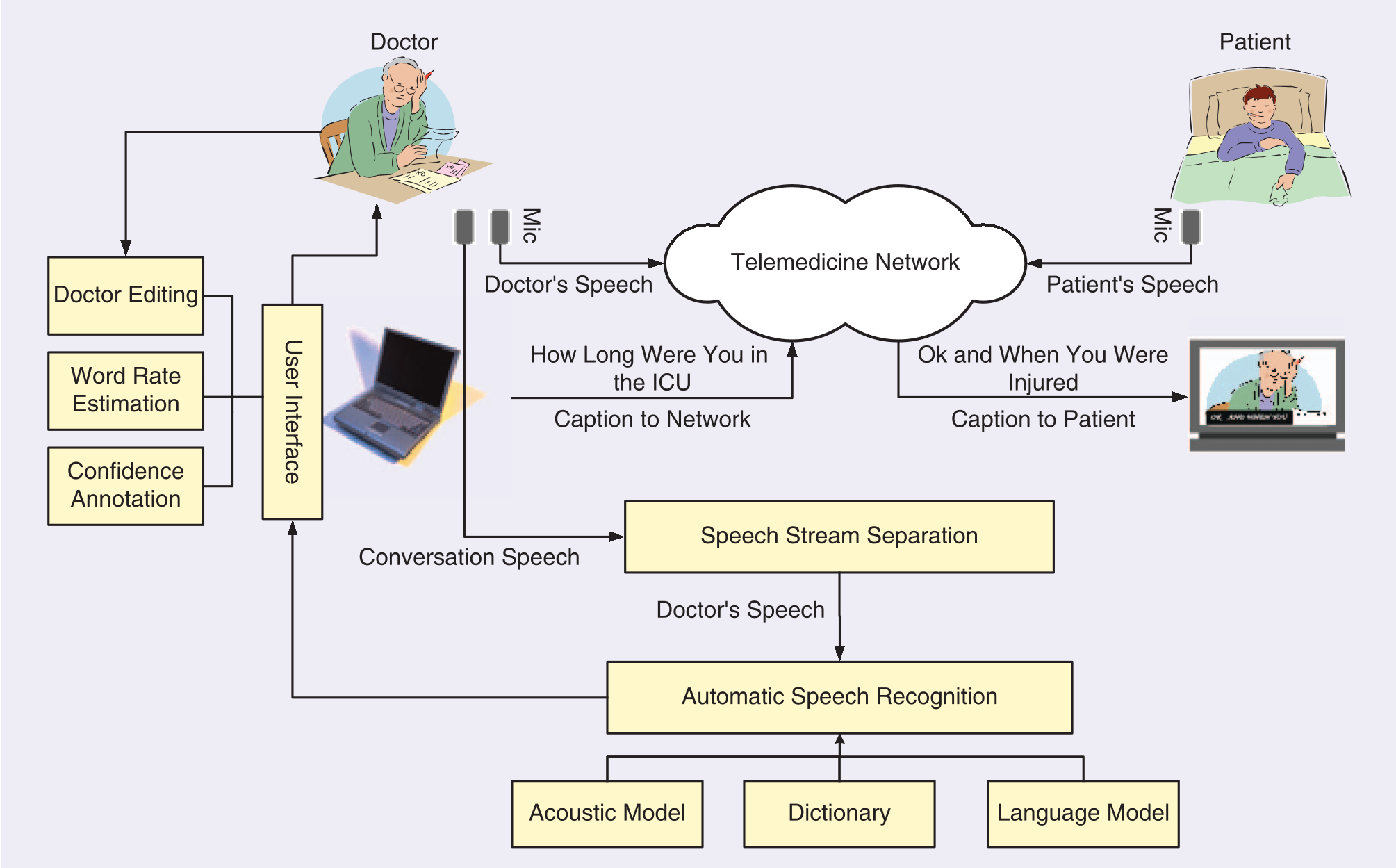 Figure 1: The architecture of a prototype telemedicine captioning system, highlighting the flow from acoustic recording to a user interface with pen-edit capabilities.
Experiments & Results: Quantifying the Impact
The impact of these technologies is measured through productivity and cost-efficiency:
- Productivity Gains: For clinicians with English as a second language, moving from "typing from scratch" to "editing ASR output" typically doubles productivity.
- Economic Forecast: The shift toward ASR in health care is predicted to save billions of dollars in North America by reducing reliance on manual transcription services.
- Accessibility Milestone: Systems like CapTel and WebCapTel have successfully enabled real-time telephone communication for the hearing impaired by combining ASR with quick error-correction by human operators.
Critical Analysis & Conclusion
Takeaway
The core contribution of this work is the demonstration that ASR is most effective when integrated into specialized workflows (like Radiology PACS) rather than treated as a "one-size-fits-all" solution. The "Human-in-the-loop" model—where professionals act as editors rather than creators—is the current Gold Standard for high-stakes medical data.
Limitations & Future Work
The primary hurdle remains spontaneous speech. Errors frequently occur during repetitions, repairs, or filled pauses (e.g., "uhm," "ah"). Most clinicians outside of radiology remain reluctant to adopt front-end ASR because the "learning curve" for model adaptation is steep.
However, as a younger, "computer-savvy" generation enters the medical field and Electronic Medical Records (EMR) become mandatory, the friction of adoption will decrease. Future research should focus on unsupervised adaptation, allowing systems to learn a clinician's voice without manual intervention, and advancing Natural Language Processing (NLP) to better handle the semantic intent behind spontaneous medical inquiries.