
DLM: Bridging the Gap Between Human Speech and Robot Motion via Diffusion Policies
Speech-to-Trajectory: Learning Human-Like Verbal Guidance for Robot Motion
The paper introduces the Directive Language Model (DLM), a speech-to-trajectory framework that maps natural verbal commands directly to low-level robot motion trajectories. By combining Behavior Cloning, BERT-based semantic embeddings, and Diffusion Policies, DLM achieves a state-of-the-art success rate of 95.6% in interpreting human-like guidance across various robotic embodiments.
TL;DR
The Directive Language Model (DLM) is a novel framework that skips high-level planning to map verbal commands directly onto executable robot trajectories. By training on human-driven demonstrations and using Diffusion Policies for trajectory generation, DLM provides a more "natural" and robust navigation experience than traditional LLM-based systems, achieving over 95% success in reaching targets from unformatted speech.
Motivation: Why Robots Don't Speak Our Language
In traditional robotics, a command like "Move a bit to the left" usually needs to be translated into a specific API call. If the user says "Slide left slightly" instead, the system might fail if that exact phrase wasn't programmed.
While Large Language Models (LLMs) like GPT-4 have improved understanding, they are:
- Computationally Heavy: Too slow for millisecond-level trajectory adjustments.
- Unpredictable: Stochastic text outputs don't always translate to safe or smooth physical motion.
- Prompt-Dependent: They require "expert" prompt crafting to generate the right control codes.
DLM addresses this by learning the physical intuition of human guidance through Behavior Cloning (BC) in simulation.
Methodology: From Words to Waypoints
The DLM framework operates through a sophisticated pipeline that ensures both linguistic flexibility and motion precision.
1. Semantic Grounding
Instead of just mapping the string "move forward" to a vector, DLM uses BERT's bidirectional embeddings. This allows the model to understand context and subtle nuances. To ensure it doesn't overfit to specific words, the authors used GPT-4 to generate 30+ paraphrases for every training trajectory, teaching the model that "Advance 5 meters" and "March 5 meters forward" mean exactly the same thing in physical space.
2. The Diffusion Policy Core
The "magic" of the movement lies in the Diffusion Policy. Traditional models might output a single deterministic path. Diffusion models, however, learn to "denoise" a random set of points into a valid trajectory conditioned on the text embedding. This allows for:
- Human-like smoothness: Learned from real human-driven demonstrations.
- Adaptivity: The model can generate multiple valid paths for the same command.
 Fig 2: The DLM pipeline, showing the path from speech to BERT embeddings to the Diffusion-based trajectory generator.
3. Adaptive Trajectory Length Determination (ATLD)
One problem with generating trajectories is knowing when to stop. DLM introduces ATLD, which monitors terminal dynamics—essentially "feeling" when the robot has fulfilled the intent of the command and then cutting the trajectory.
Performance: Crushing the Baselines
The researchers compared DLM against heavyweight competitors like PaLM-E (multimodal LLM) and VIMA.
| Model | Success Rate (SR) | RMSE (cm) | Inference Time (ms) |
|---|---|---|---|
| PaLM-E | 85.7% | 37.0 | 138 |
| DLM (Ours) | 95.6% | 9.0 | 88 |
The results show that DLM isn't just more accurate (9cm error vs 37cm for PaLM-E), but also faster, making it suitable for real-time interaction.
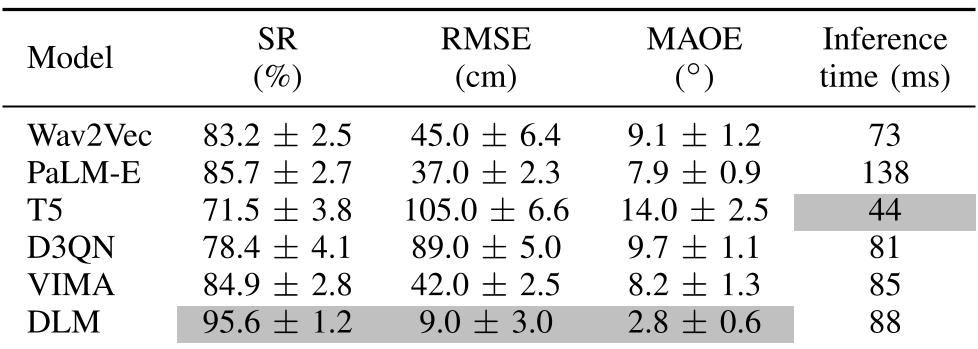 Table II: Comparative performance highlights DLM's superior accuracy and efficiency.
Real-World Deployment: Quadruped Navigation
DLM was tested on a Unitree Go2 quadruped robot. One of the most impressive feats was its ability to handle implicit directives. When a user said, "I am standing 3 meters behind you," the robot inferred it should turn around and navigate to that relative position, even though no explicit instruction to "move" was given.
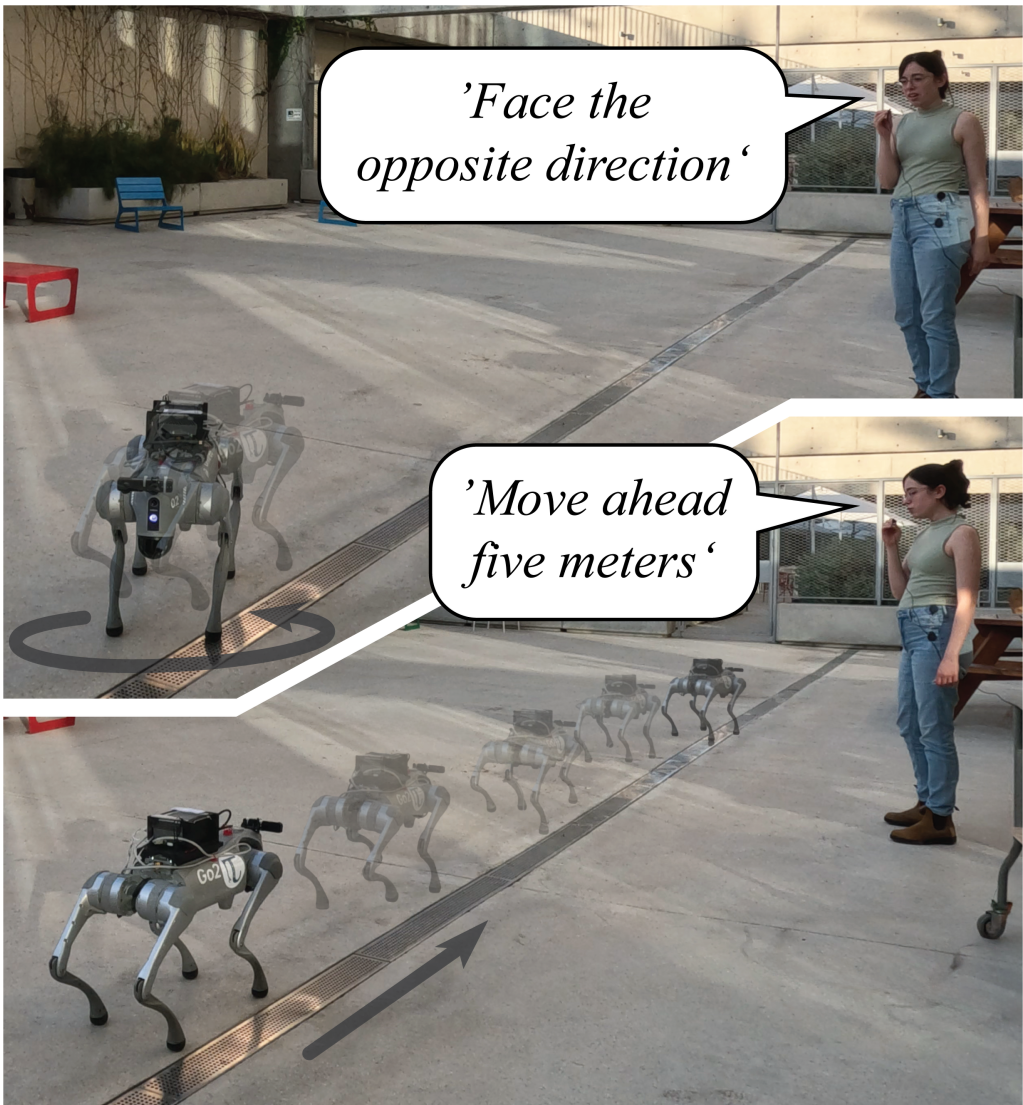 Fig 1: A user guiding a quadruped robot using DLM.
Conclusion & Critical Analysis
DLM proves that low-level motion grounding is just as important as high-level linguistic reasoning. By focusing on how humans actually guide robots in 2D space, the authors created a system that feels more intuitive than an LLM following a script.
Limitations: Currently, the system is "blind" (it doesn't use visual perception for obstacles during trajectory generation, although the training data included obstacles). Future iterations incorporating vision would allow for complex obstacle avoidance that is context-aware (e.g., "Go around the chair").
Final Takeaway: For robotics developers, this paper suggests that the future of UI isn't necessarily a smarter chatbot, but a tighter coupling between semantic embeddings and generative motion policies.