
FLC: Accelerating Social Network Visualization via Community-Based Force-Directed Layouts
Speed Up Graph Drawing for Social Network Visualization
The paper introduces Force-directed Layout for Communities (FLC), a community-based approach to accelerate graph drawing for social networks. By decomposes the layout process into internal community placement and external community-to-community positioning, it achieves significant speedups compared to classical force-directed algorithms.
TL;DR
Drawing massive social networks is notoriously slow due to the complexity of classical force-directed algorithms. This paper introduces FLC (Force-directed Layout for Communities), a method that breaks the graph into communities before applying forces. By calculating layouts locally and then globally at the community level, it achieves a 100%+ speedup without sacrificing aesthetic quality.
Background Positioning: This work bridges the gap between high-quality (but slow) force-directed methods and the need for real-time online visualization in social network analysis.
The Scalability Bottleneck in Graph Drawing
Traditional force-directed algorithms treat every vertex as a physical body subject to forces (like gravity or spring tension) from every other vertex. While this creates intuitive, symmetric layouts, it is computationally ruinous for large datasets. As social networks grow to millions of edges, the "all-pairs" force calculation becomes a hard wall.
The authors' core insight is simple yet profound: In a social network, a node’s position is primarily influenced by its immediate community. Why calculate the repulsive force between two researchers in completely different fields with the same precision as co-authors in the same lab?
Methodology: The Two-Stage Layout
The proposed FLC algorithm replaces global iteration with a hierarchical approach:
- Local Layout: Each community is treated as a standalone small network. The classical algorithm determines the relative coordinates of vertices within these clusters.
- Global Layout: Communities are abstracted as single "super-nodes." A second force-directed pass is run where these super-nodes are positioned relative to each other.
Redefining Physics for Communities
Unlike point-mass vertices, communities have physical area. To handle this, the authors introduced two critical mathematical adjustments:
- Border Distance: Instead of center-to-center distance, the "spring" force is calculated based on the distance between the boundaries of community circles to prevent unsightly overlaps.
- Dynamic Mass: The "mass" of a community is calculated as a function of its vertex/edge density (), ensuring that denser clusters exert appropriate "gravity" in the layout.
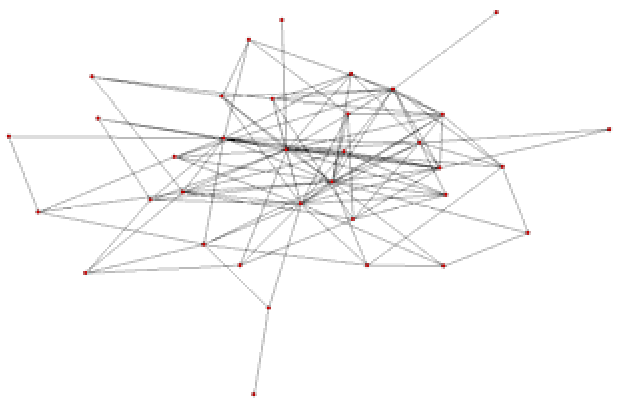 Fig 1: A typical co-authorship network showing the natural emergence of communities.
Experimental Validation
The authors tested FLC against the classical Force-directed Layout (FL) using two datasets: Coauthor (CA) and Author Citation (AC).
Performance Metrics
The results proved that the hierarchical approach is significantly more efficient:
- AC Graph: Iterations dropped from 14,436 to 6,098. Running time slashed from 5.94s to 2.81s.
- CA Graph: Efficiency improved by roughly 70%.
Readability & Aesthetics
Surprisingly, FLC didn't just maintain quality; it occasionally improved it. For the AC graph, FLC reduced the number of edge crossings from 11,538 to 10,229.
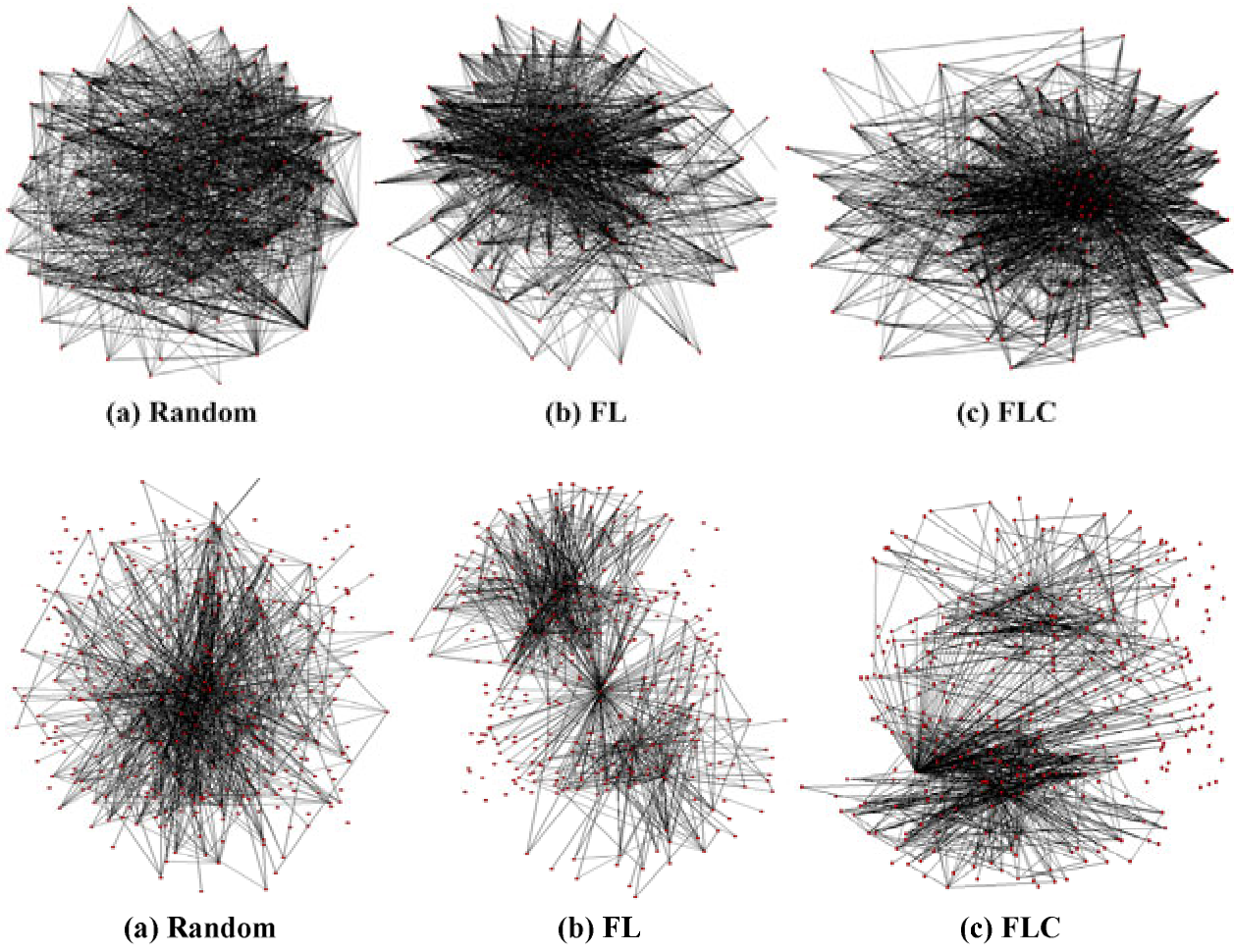 Fig 3: Comparison between FL (Classical) and FLC (Proposed). Both preserve the community structure, but FLC finishes in half the time.
Critical Analysis & Future Outlook
Takeaway: The FLC algorithm is a pragmatic solution for production environments. By assuming that community detection can be performed offline, the online drawing phase becomes much more tolerable for end-users.
Limitations:
- The current model assumes flat community structures. In reality, social networks are often nested hierarchies (e.g., a sub-field within a department within a university).
- The paper manually assigned community labels for the experiment; in a real-world pipeline, the performance of the community detection algorithm (like Louvain or Infomap) would be a critical factor.
Future Work: The authors aim to extend this to hierarchical-structure communities, which would likely allow for even further optimizations in massive, deeply nested social graphs.