
Accelerating Influence: How Pruning Algorithms Make Real-Time Social Network Analysis Feasible
Speeding-up node influence computation for huge social networks
The paper proposes a highly efficient framework for estimating the influence degree of all nodes simultaneously in large-scale social networks under the SIR (Susceptible-Infective-Recovered) diffusion model. By building upon the bond percolation (BP) method, the authors introduce two novel pruning techniques—Redundant-Edge Pruning (REP) and Marginal-Component Pruning (MCP)—to achieve an order of magnitude speedup over existing BP methods and four orders of magnitude over direct Monte Carlo simulations.
TL;DR
Quantifying how far a "rumor" spreads in a network is notoriously hard. This paper introduces the REP and MCP pruning techniques, boosting the speed of node influence estimation by an order of magnitude. By refining the Bond Percolation (BP) framework, the authors enable simultaneous influence calculation for every node in a million-user network like Twitter in a fraction of previous times.
Problem & Motivation: Beyond Graph Topology
Standard centrality measures—like Degree, PageRank, or Betweenness—are purely topological. They tell you who is "central" based on the static map of the network. However, Influence Degree is dynamic; it depends on how information actually flows (the SIR model).
The bottleneck? Influence is the expected number of infected nodes, requiring thousands of stochastic simulations. While the Bond Percolation (BP) method previously improved this by three orders of magnitude over Monte Carlo, it still struggled with "huge" networks where high diffusion probabilities create massive exploration paths.
Methodology: The Art of Pruning
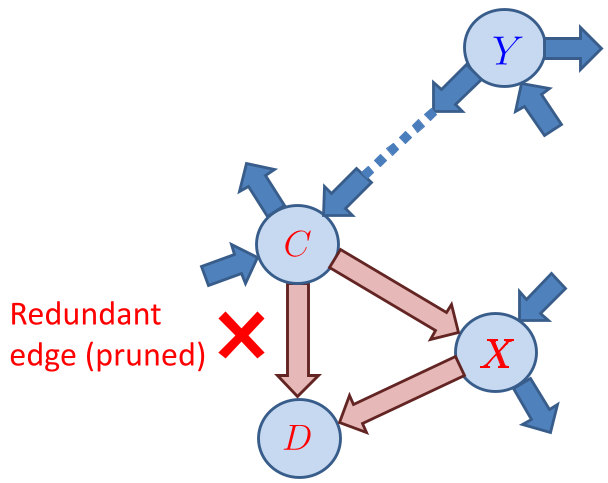
The authors' core insight is that much of the work in reachability analysis is redundant. They operate on a Quotient Graph (a Directed Acyclic Graph formed by collapsing Strongly Connected Components).
1. Redundant-Edge Pruning (REP)
In a DAG, if node A can reach C through B (), then a direct edge is a "shortcut" that adds no new information for reachability. REP identifies these "feedforward motifs" and prunes the shortcut.
2. Marginal-Component Pruning (MCP)
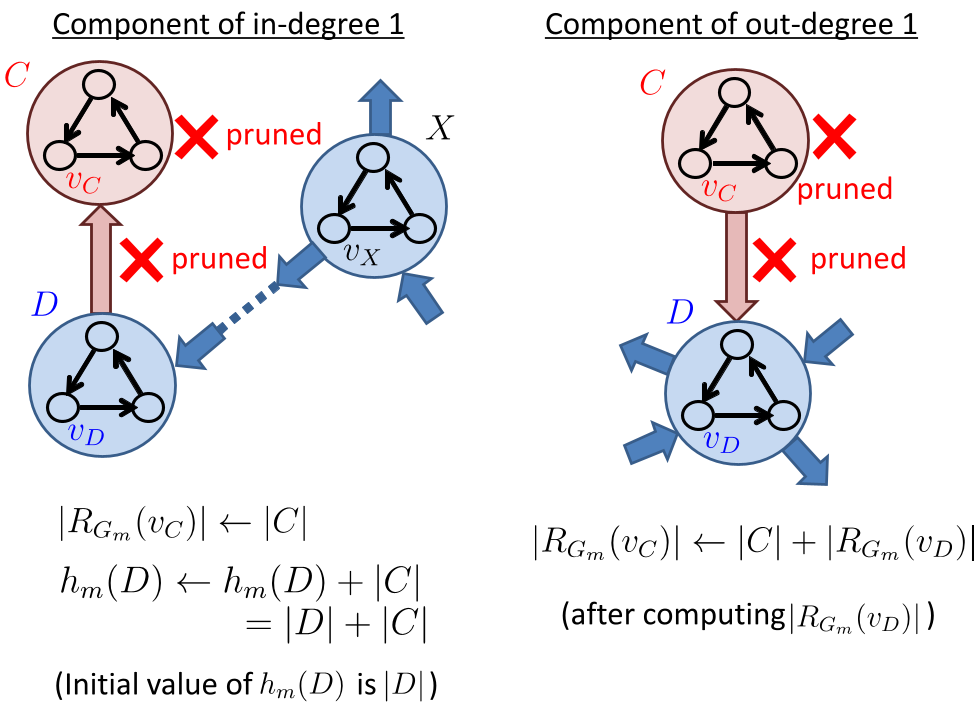
This is the "heavy lifter." If a component has an in-degree or out-degree of 1, its contribution to the reachability of its neighbors is deterministic. By recursively pruning these "marginal" components and updating a running count (), the algorithm shrinks the graph significantly before the main search begins.
Experiments: Twitter at Scale
The authors tested their approach on two major datasets:
- Cosme: 45K nodes, 351K links.
- Twitter: 1.08M nodes, 157M links.
Performance Gains
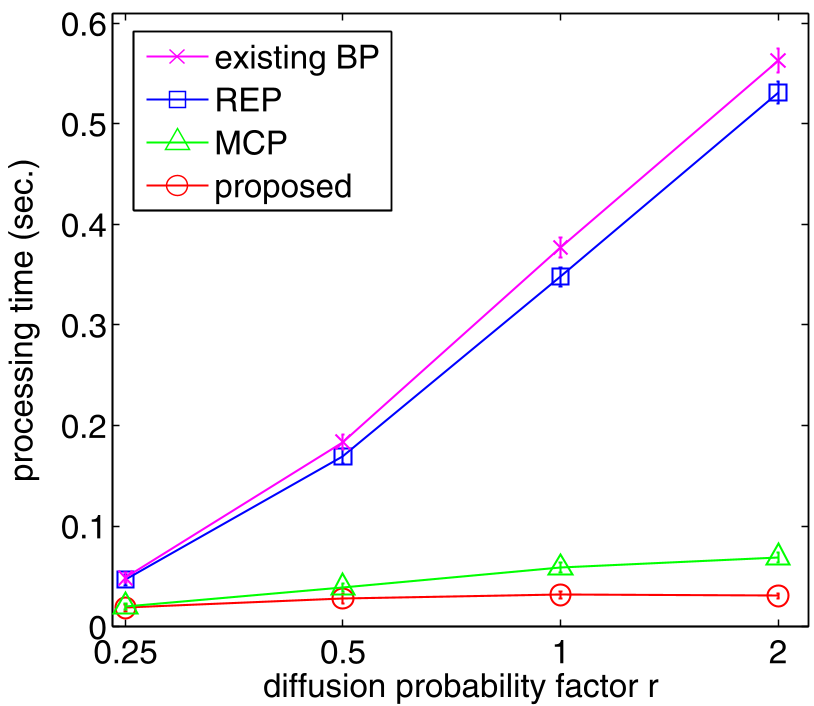
The proposed method consistently outperformed the existing BP method. In the Twitter dataset with a high diffusion factor (), the existing BP method would take nearly 14 days to compute influence for all nodes. The proposed method completed the task in 36 hours.
Unique Insights
The research confirms that Influence Centrality is a distinct beast. In the Twitter rankings (Table 1 & 2), users like "utadahikaru" (a famous singer) appeared as top influencers under high diffusion scenarios, despite not appearing in the top 10 for Degree or Betweenness. This suggests that some nodes are "dormant" influencers who only become critical when the "virus" of information is potent enough.
Summary & Future Outlook
The beauty of this approach lies in its lossless nature. Unlike other speed-up techniques, REP and MCP do not rely on approximations or limited-path assumptions; they provide the exact same accuracy as the standard BP method, just much faster.
Limitations: The algorithm's efficiency is sensitive to network structure. While it performs exceptionally well on "Connecting Nearest-Neighbors" (CNN) graphs due to high motif density, its REP component is less effective on Barabási-Albert (BA) power-law graphs.
Future Work: The framework is ripe for extension into SIS (Susceptible-Infective-Susceptible) models, where nodes can be reinfected, further expanding its utility in modeling continuous viral marketing and persistent diseases.