
Spend Less, Fit Better: Rethinking Scaling Law Fitting as Active Experimental Design
Spend Less, Fit Better: Budget-Efficient Scaling Law Fitting via Active Experiment Selection
The paper introduces a "budget-aware sequential experimental design" framework for fitting scaling laws in Large Language Models (LLMs). It proposes an uncertainty-aware method that selectively runs pilot experiments based on their expected utility in reducing extrapolation error in high-cost target regions, achieving SOTA accuracy with only ~10% of the typical training budget.
TL;DR
Scaling laws are the blueprints for multi-million dollar LLM training runs, yet the "pilot runs" required to fit these laws have themselves become prohibitively expensive. This paper introduces a sequential, uncertainty-aware selection strategy that picks the most informative pilot experiments to run. The result? You can achieve 90% of the scaling law accuracy using only 10% of the traditional compute budget.
Academic Context: This work shifts scaling-law research from a "modeling" problem (finding the right formula) to an "optimization" problem (finding the right data points to measure).
The "Million-Dollar" Bottleneck
To predict how a 100B parameter model will behave, we usually train dozens of smaller models. When these "small" models start reaching the 7B or 13B scale, the pilot phase itself enters the million-dollar regime.
The core difficulty lies in extrapolation. We aren't trying to fit the points we already have; we are trying to predict a "target region" (the massive model scale) that is far outside our current data. Traditional heuristics—like training a random set of small models—often miss the critical data points that resolve ambiguity in the high-compute regime.
Methodology: The Geometry of Uncertainty
The authors propose that the Scaling Law landscape isn't a simple smooth curve but a complex surface with multiple "basins"—different parameter sets that all seem to explain the current small-scale data but diverge wildly when predicting large-scale models.
1. Modeling the "Basins"
Instead of a single "best fit," the method maintains a Mixture of Gaussians over the parameters. This allows the system to track multiple "plausible" scaling laws simultaneously.
2. The Target-Aware Objective
The acquisition function scores potential experiments by asking: "If I run this specific training setup, how much will it reduce my prediction error in the high-cost target region?"
This is calculated via two terms:
- Intra-basin Utility: Refining the accuracy of the current most likely law.
- Inter-basin Utility: Picking a point that specifically proves some "candidate laws" wrong and others right.
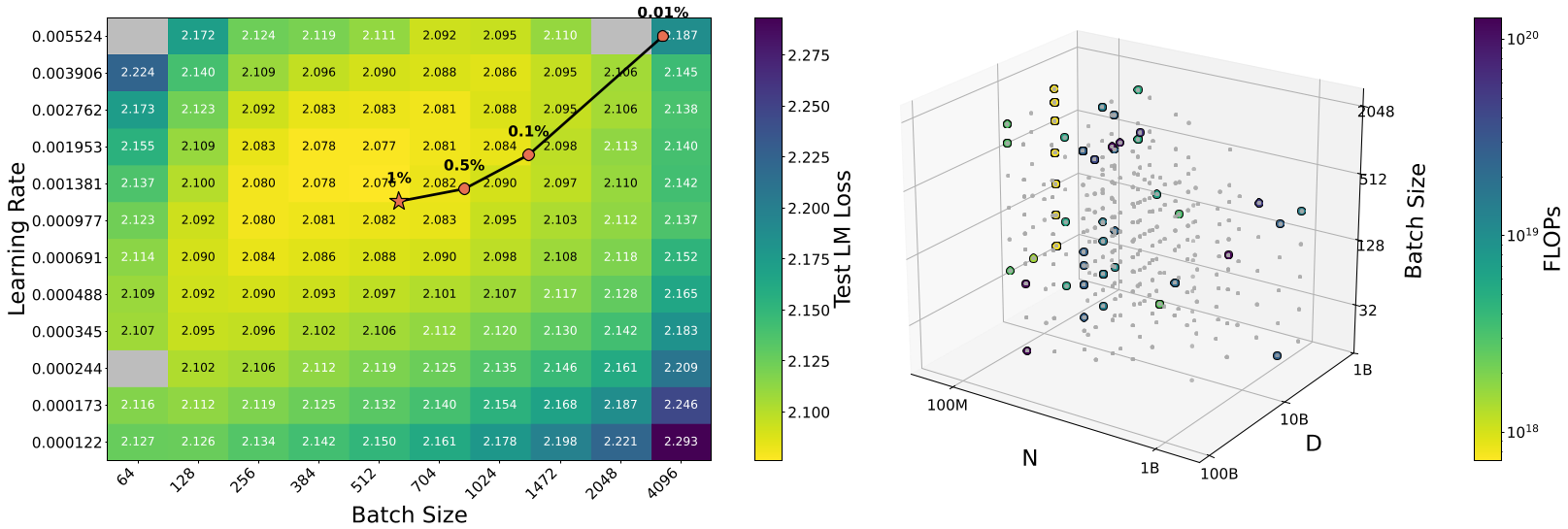 Figure 1: The method identifies the extrapolation optimum early. On the left, we see the trajectory toward the true optimum using only 1% of the budget. On the right, the sparse selection of points in the design space.
Experimental Battleground
The authors tested their method against 8 diverse tasks, ranging from Mixture-of-Experts (MoE) scaling to Vocabulary size scaling.
Performance Highlights:
- Compute Efficiency: On the
lr&bsztask (Learning Rate and Batch Size), the method reached the "low-loss" region of the target scale using 1% of the budget. - Robustness: In many cases, the method's extrapolation was better than the "All Data" baseline. Why? Because fitting a law to all available (mostly small) points can prioritize small-scale noise, whereas this method specifically seeks points that align with high-scale trends.
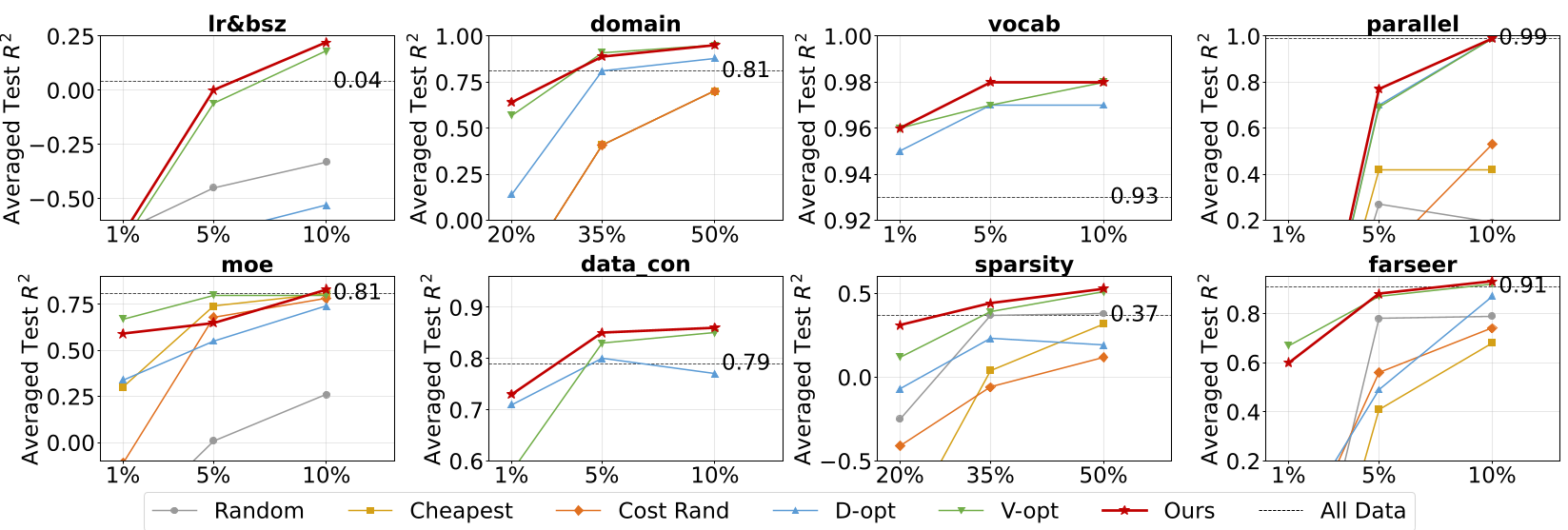 Figure 2: R² accuracy vs. Budget. Across parallel, moe, and and data_con tasks, the active selection method (green line) reaches near-peak performance long before random or cheapest-first strategies.
Critical Insight: The "Why"
Why does this work better than classical D-optimality (which reduces overall parameter uncertainty)?
Classical OED tries to learn the entire model perfectly. This paper argues that we don't care about the whole model—we only care about the Target Region. By focusing uncertainty reduction on the large-scale extrapolation, the algorithm effectively ignores low-cost experiments that don't provide information about how models behave when they get huge.
Conclusion & Future Directions
This research marks a significant step toward "Automated Scaling Law Science." As we move toward more complex architectures like Mixture-of-Depths or heterogeneous data-mixing, manual experiment design will become impossible.
Limitations: The method relies on the assumption that the "true" scaling law belongs to the family of functions being fitted. If the underlying physics of LLM training changes (a "phase change"), even the best active selection cannot predict the future.
Takeaway for Practitioners: Don't just run a grid search for your pilot runs. Use a budget-aware acquisition score to decide your next training configuration. It could save you 90% of your pre-training compute cost.