
Spheres of Influence: Toward More Reliable and Effective Viral Marketing
Spheres of Influence for More Effective Viral Marketing
This paper introduces the concept of the "Sphere of Influence" (Typical Cascade) for social network nodes using a probabilistic contagion model. By formalizing this as a Jaccard Median problem, the authors propose a novel approach to Influence Maximization (IM) that focuses on targeting reliable individuals rather than just "super-star" influentials.
TL;DR
Viral marketing often fails because "influentials" are unpredictable. This paper moves beyond the standard Influence Maximization (IM) objective of maximizing expected spread. Instead, it introduces Typical Cascades (Spheres of Influence)—the most representative set of nodes a source will likely infect. By optimizing for these stable sets, the authors outperform the "theoretically optimal" greedy algorithms as seed sets grow, proving that reliability is just as important as reach.
The "Influentials Hypothesis" vs. Reality
For over a decade, the academic consensus on viral marketing followed the Independent Cascade (IC) model, where the goal is to find nodes to maximize the expected number of activated users.
However, as noted by Duncan Watts, this "Influentials Hypothesis" ignores a crucial factor: Unpredictability. A node might have a massive expected reach only because it has a 1% chance of reaching 1,000,000 people, but a 99% chance of reaching zero. In a one-shot marketing campaign, such an "influential" is a gamble. This paper asks: What is the most likely, stable set of nodes that will actually be infected?
Methodology: The Typical Cascade Problem
The authors define the Sphere of Influence of a node as the set that minimizes the Expected Jaccard Distance to all possible random cascades from :
Technical Challenges & Insights
- Complexity: Computing this cost is #P-hard.
- Sampling Efficiency: The authors provide a surprising theoretical breakthrough—they prove that you only need a constant number of samples (independent of the graph size ) to get a multiplicative approximation of the median.
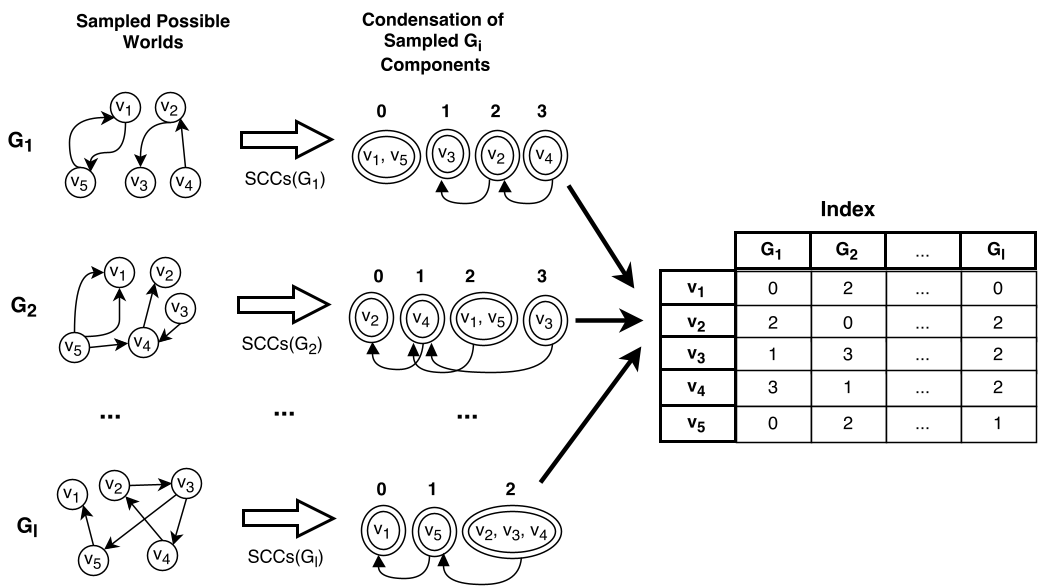
- Indexing: To make this practical, they utilize Strongly Connected Components (SCCs) and transitive reductions to build an index that speeds up cascade simulation across thousands of possible worlds.
Influence Maximization via Maximum Cover
Instead of the standard submodular optimization of the spread function , the authors treat IM as a Maximum Set Cover problem over the pre-computed Typical Cascades.
The intuition is powerful:
- Reliability Selection: By picking nodes with large "typical" cascades, we naturally select nodes whose influence is consistent across different "possible worlds."
- Saturation Avoidance: Standard greedy algorithms reach a "saturation point" where they can't distinguish between the marginal gains of different nodes. By looking at sets (Typical Cascades) rather than just scalar expected values, this new method remains discriminative even for large seed sets.
Experimental Validation
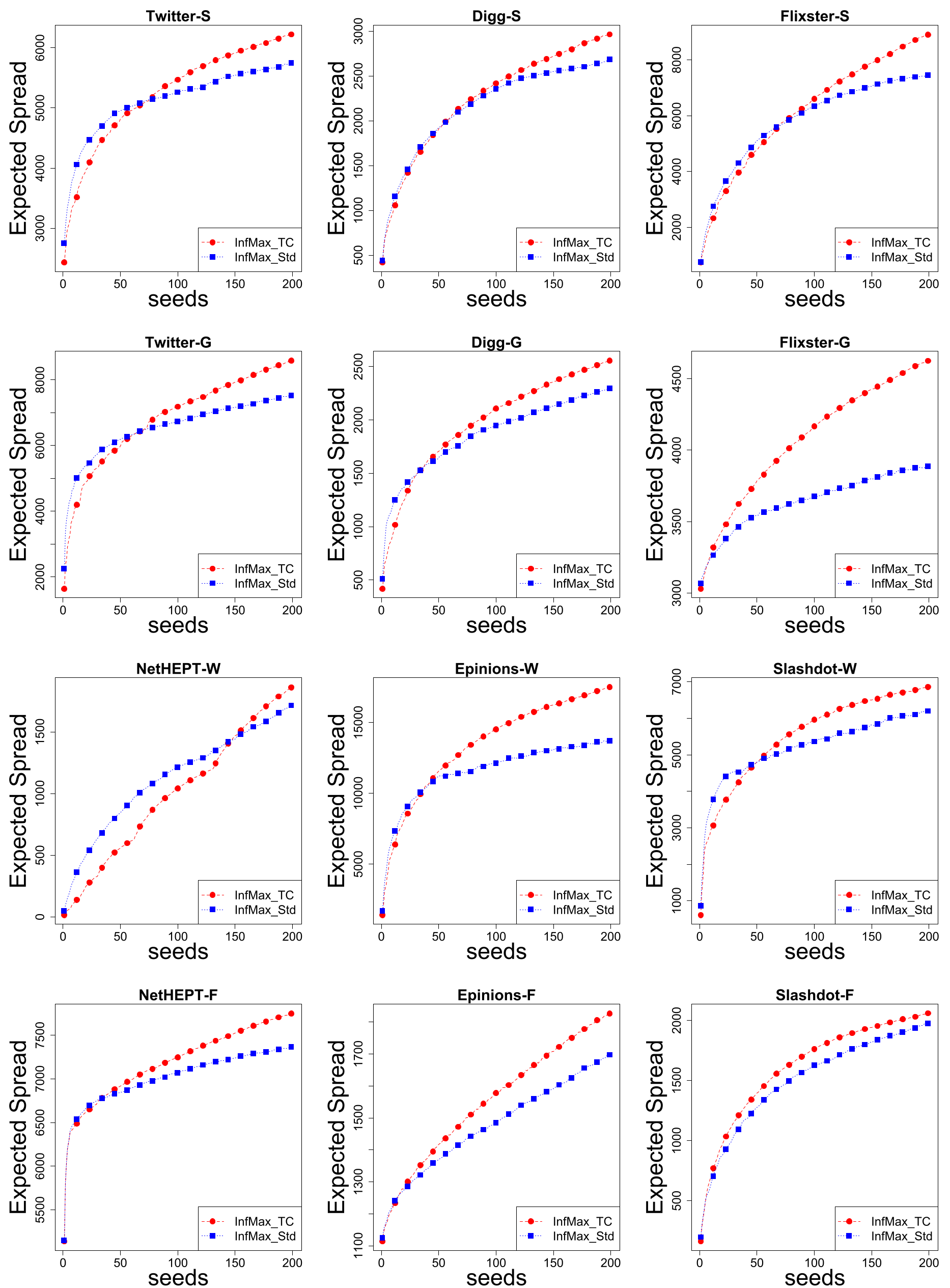
The authors tested their approach (InfMax TC) against the standard greedy algorithm (InfMax std) across 12 settings, including Twitter and Digg networks.
Key Result: The Crossing Point
As the seed set size increases, InfMax TC eventually overtakes the standard method in quality.
Stability Analysis
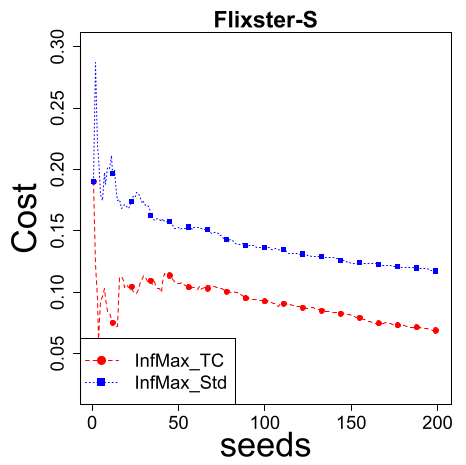
The "Expected Cost" of the seed sets found by InfMax TC is significantly lower, meaning the resulting marketing campaign is much more likely to behave as predicted.
Critical Insight & Conclusion
This work represents a paradigm shift. It suggests that if you are planning a large campaign (targeting hundreds of seeds), you should stop worrying about "expected value" and start worrying about "typical outcomes."
Limitations & Future Work
While the quality is superior for large , the standard algorithm is still better for very small seed sets. A hybrid approach that balances spread and stability could be the next frontier. Furthermore, the application of "Spheres of Influence" to epidemic quarantine or financial contagion remains an exciting, unexplored territory.