
Spiking Analog VLSI: Harnessing Thermal Noise to Solve NP-Hard Constraints
Spiking analog VLSI neuron assemblies as constraint satisfaction problem solvers
This paper presents a novel Spiking Neural Network (SNN) based solver for Constraint Satisfaction Problems (CSPs), implemented on analog VLSI hardware. By mapping CSPs to a Boltzmann-like distribution and utilizing intrinsic thermal noise for stochasticity, the system achieves efficient Markov Chain Monte Carlo (MCMC) sampling to find global optima.
TL;DR
Solving Constraint Satisfaction Problems (CSPs) like Sudoku is computationally expensive. This paper introduces a neuromorphic approach that uses analog VLSI neurons to solve CSPs via stochastic sampling. Unlike previous models requiring digital random number generators, this system exploits intrinsic thermal noise within the hardware to generate stochasticity, allowing the network to "jump" out of local minima and find global solutions with extreme power efficiency.
Problem & Motivation: The Randomness Bottleneck
Traditional CSP solvers often rely on complex heuristics to navigate exponentially large search spaces. While Recurrent Neural Networks (like Boltzmann Machines) can solve these via MCMC sampling, implementing them in spiking hardware usually requires an explicit source of randomness for every single neuron.
In the world of microelectronics, building thousands of independent, high-quality Random Number Generators (RNGs) is a nightmare of silicon area and power. The authors asked a radical question: Instead of fighting the inherent noise of analog circuits, can we use it as a computational resource?
Methodology: Stochasticity from Jitter
The core innovation lies in the interaction between the Refractory Period () and the Post-Synaptic Potential ().
- The Mechanism: In a deterministic Integrate-and-Fire neuron, these durations are fixed. However, in analog VLSI, thermal fluctuations cause these pulses to "jitter" slightly.
- Noise Amplification: When , the system becomes highly sensitive to these micro-fluctuations. A tiny bit of noise can determine whether a neuron spikes again or remains inhibited, effectively turning a deterministic circuit into a probabilistic sampler.
- Temperature Control: The authors discovered that the duration of the refractory period behaves exactly like the temperature parameter in simulated annealing. A longer encourages exploration (higher temperature), while a shorter one lets the network settle into low-energy states (lower temperature).
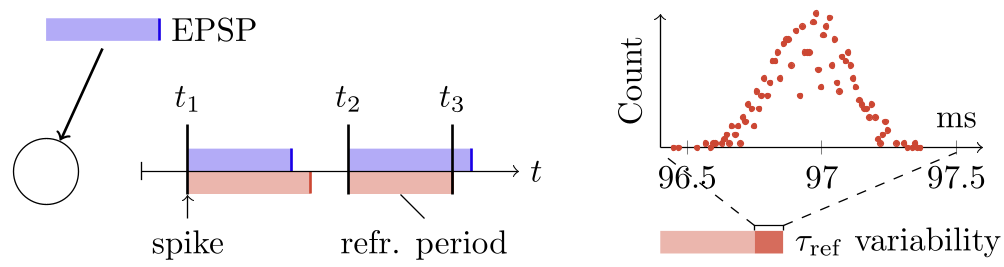 Fig 1: The abstract model shows how pulse width jitter creates stochastic state transitions.
Solving Sudoku on Silicon
To prove the concept, the team mapped a 4x4 Sudoku onto a neuromorphic chip. Each cell's possible value is represented by a neuron in a "one-hot" encoding. Constraints (e.g., "no two 3s in a row") are implemented as inhibitory connections between neurons.
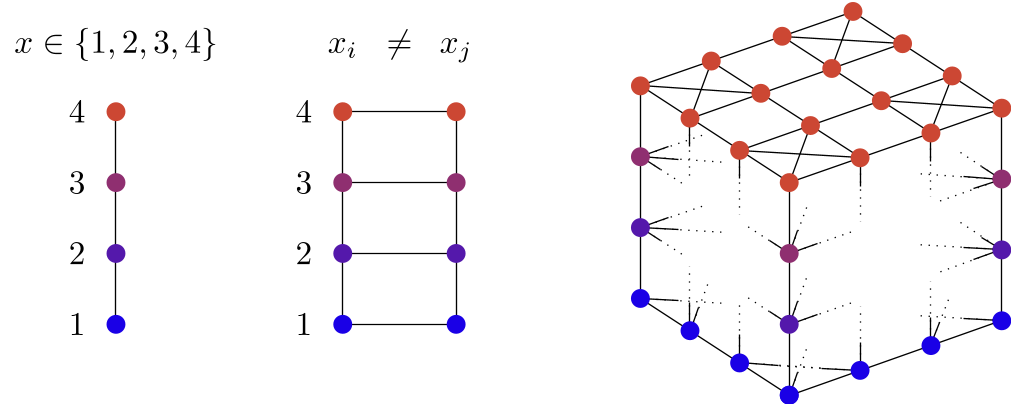 Fig 2: Network motifs for Sudoku: Variable representation (left) and constraint implementation (middle/right).
Key Experimental Findings
- Dynamic Trajectories: The hardware does not just find one solution and stop; it continuously samples the space. It spends the majority of its time in states with zero or very few constraint violations.
- Energy Distributions: By adjusting the "hardware temperature" (), the authors showed they could control the sampling quality. At optimal settings, the distribution of visited states follows a double-exponential curve favoring the lowest energy solutions (valid Sudoku grids).
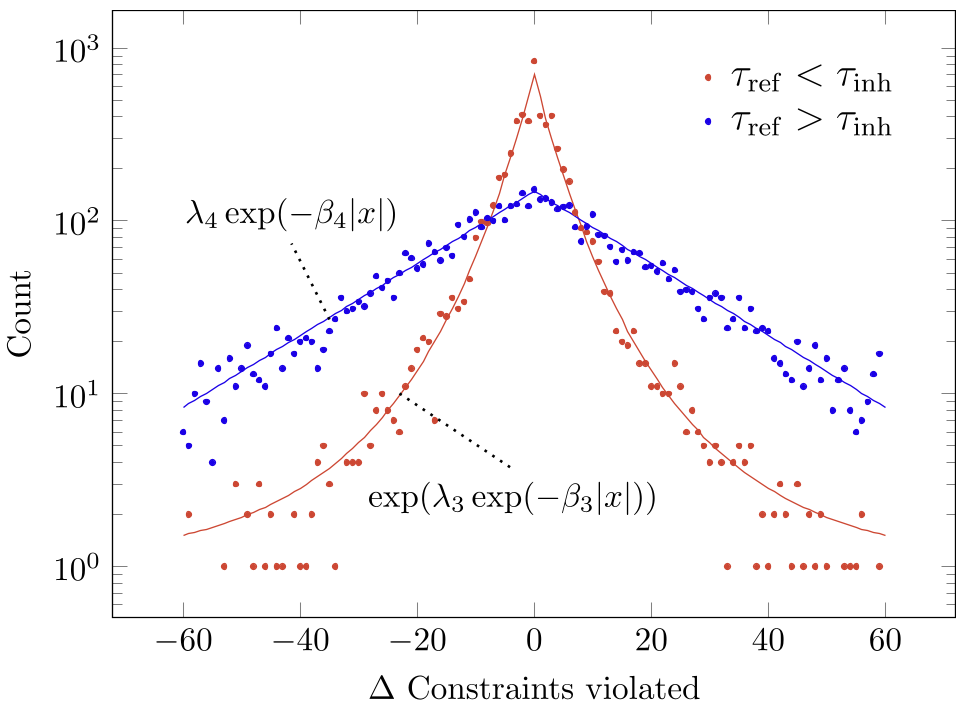 Fig 3: Empirical histograms showing the number of constraints violated across different refractory settings (Red vs. Blue).
Critical Analysis & Conclusion
Takeaway
This paper is a significant milestone in Neuromorphic Computing. It bridges the gap between high-level MCMC sampling theory and low-level analog circuit realities. By treating thermal noise as a "feature" rather than a "bug," it enables massive parallelism without the overhead of digital randomness.
Limitations & Future Work
- Scalability: The 4x4 Sudoku (64 neurons) is a toy problem. Moving to a 9x9 Sudoku requires 729 neurons, which challenges the connectivity limits of current neuromorphic chips.
- Precision: Hardware mismatch (fabrication variance) can bias the sampler. While the authors argue thermal noise can override this, larger-scale problems might require calibration steps to ensure "fair" sampling.
Ultimately, this research paves the way for a new class of analog optimization accelerators that could outperform digital counterparts in speed-per-watt for specific combinatorial tasks.