
SPIN: Mastering the Complexity of Placement-Sensitive BSP Job Scheduling
SPIN: BSP Job Scheduling With Placement-Sensitive Execution
The paper introduces SPIN, a novel scheduling framework specifically designed for Bulk Synchronous Parallel (BSP) jobs, such as distributed machine learning and graph computation. SPIN jointly optimizes job placement and gang-scheduling while remaining robust to inaccurate execution time estimations, ultimately providing provable approximation guarantees.
TL;DR
Distributed machine learning and graph processing rely on the Bulk Synchronous Parallel (BSP) model. Unlike traditional big-data tasks, BSP jobs are "gang-scheduled" (all-or-nothing) and their performance fluctuates wildly based on GPU placement. This paper presents SPIN, the first scheduling algorithm that provides a theoretical approximation guarantee for placement-sensitive BSP jobs while remaining immune to inaccurate execution time estimates.
The "Blind Spot" in Modern Schedulers
Most cluster managers (like those used in Spark or Hadoop) treat jobs as a collection of independent tasks. However, BSP jobs—the backbone of modern AI—have two unique traits that break traditional logic:
- Gang Scheduling: If you have 4 workers and only 3 GPUs, the job doesn't just run slower; it deadlocks or cannot start.
- Placement Sensitivity: A VGG16 model trained on 4 GPUs within a single PCIe switch runs significantly faster than the same model spread across two servers.
Existing schedulers either ignore the communication topology or assume they perfectly know how long a job will take. In reality, performance jitter is constant, and "greedy" placement often leads to fragmented clusters where high-performance workers are stranded.
Methodology: The SPIN Approach
The authors prove that finding an optimal schedule for these jobs is NP-hard within a very tight factor. To solve this, SPIN uses a two-stage strategy:
1. Robust LP Relaxation
Instead of solving the hard integer problem directly, SPIN solves a Linear Programming (LP) relaxation. Crucially, it uses "aggressive estimation" in its constraints, utilizing the lower bounds of execution time to ensure the schedule remains feasible even if the actual runtime is longer than predicted. This makes the scheduler robust to noise.
2. Randomized Rounding for Gang-Scheduling
The LP gives "fractional" placement suggestions (e.g., job A should be 60% on Server 1 and 40% on Server 2). SPIN uses a randomized rounding algorithm to turn these fractions into actual start times and placement decisions. This prevents the "greedy trap" where the scheduler occupies a sub-optimal resource just because it is available right now.
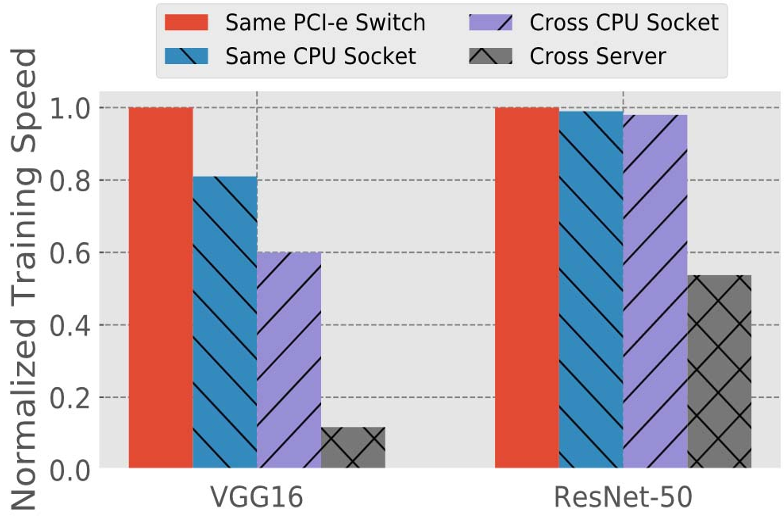 Fig 1. The BSP paradigm showing the iterative calculation and synchronization phases.
Why It Works: The Intuition
The secret of SPIN lies in Lemma 3 of the paper: The "Idle Time" on any server is bounded. Because it jointly optimizes for the entire batch of jobs, it might force a job to wait in the queue so it can eventually land on a high-bandwidth internal PCIe link, rather than starting it immediately on a slow network link. The math proves that the makespan (the time to finish all jobs) is at most times the maximum load, providing a rigorous safety net for cluster operators.
Experimental Results
The researchers implemented SPIN on Kubernetes and tested it against Microsoft production traces on a 40-GPU cluster.
Performance Gains
- Makespan: Reduced by 3x compared to Tetris-Makespan.
- Average JCT: Reduced by 4.68x.
- Efficiency: SPIN creates "free resources" earlier by avoiding sub-optimal placements, creating a virtuous cycle where later jobs start faster.
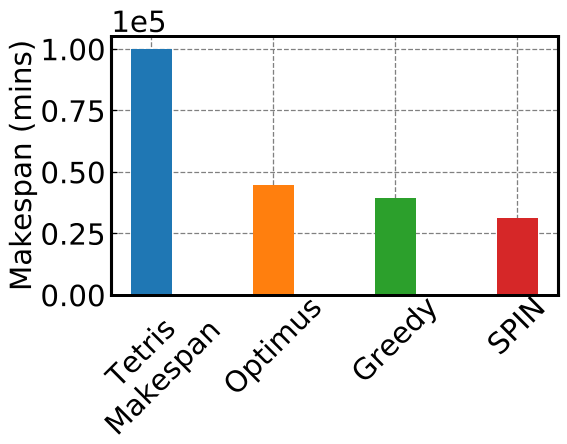 Fig 2. Performance comparison showing SPIN's superior JCT and Makespan reduction.
Resilience to Error
A standout feature is SPIN's robustness. When the researchers introduced a 50% error in the execution time estimation, SPIN's performance barely degraded, whereas greedy heuristics saw a massive increase in job completion times.
Critical Insight & Future Outlook
SPIN shifts the focus from "packing density" to "communication topology." In the era of LLMs (Large Language Models), where communication costs are the primary bottleneck, SPIN's approach to placement-sensitivity is vital.
However, the current version of SPIN is optimized for long-running batches. For extremely short tasks (like inference requests lasting seconds), the 1.2-second scheduling overhead per job might be significant. Future extensions involving low-overhead job migration (as seen in Gandiva) could further refine the performance for dynamic workloads.
Conclusion
SPIN provides the theoretical bridge between the rigid requirements of BSP jobs and the messy reality of production clusters. By mathematically balancing queuing delay against placement quality, it unlocks a level of cluster efficiency that simple heuristics cannot reach.