
SPIRAL: Redefining RL for the Full Inference Pipeline
SPIRAL: Learning to Search and Aggregate
The paper introduces SPIRAL (Sequential-Parallel-Aggregative Reinforcement Learning), a framework designed to optimize Large Language Models (LLMs) across three inference compute primitives: sequential reasoning, parallel exploration, and aggregative synthesis. By utilizing Set Reinforcement Learning alongside standard RL, SPIRAL enables models to learn how to search for diverse reasoning paths and effectively synthesize them, outperforming GRPO by up to 11x in scaling efficiency.
TL;DR
SPIRAL (Sequential-Parallel-Aggregative Reinforcement Learning) is a new training framework from Stanford researchers that teaches LLMs not just how to "think," but how to search and synthesize. By combining Set RL for parallel exploration and standard RL for aggregation, SPIRAL achieves up to 11x better scaling efficiency than DeepSeek's GRPO on complex reasoning tasks.
The "Jagged Edge" of Intelligence
Modern LLMs exhibit a frustrating "jagged edge": they can solve 70-year-old math problems when given massive inference compute, yet fail simple logic tasks because they misallocate that compute.
The problem lies in Training-Inference Mismatch. We train models using standard RL (like PPO or GRPO) to produce the perfect single reasoning trace. However, at test time, we ask them to generate many traces and aggregate them. Since the model was never trained to "be part of a set," its parallel attempts are often redundant, and its ability to "audit" its own conflicting thoughts is weak.
The SPIRAL Methodology: Search, Parallelize, Aggregate
SPIRAL introduces a unified pipeline that optimizes three core primitives during training:
- Sequential: Thinking tokens within a single trace.
- Parallel: Independently sampled traces that explore the solution space.
- Aggregative: Synthesizing those traces into a final, refined answer.
1. Set RL: Learning to be Divergent
The most innovative part of SPIRAL is the use of Set Reinforcement Learning. Instead of rewarding each trace individually (which causes the model to collapse toward a single "safe" answer), SPIRAL rewards the entire set of traces based on whether they collectively helped the aggregator find the right answer. This encourages the model to generate diverse, even speculative, traces that might be wrong individually but contain the "missing pieces" for a final solution.
2. Standard RL: Learning to Audit
The aggregation step is trained using standard RL. The model is given multiple (sometimes conflicting) candidate traces and must "audit" them to produce a self-contained final solution.
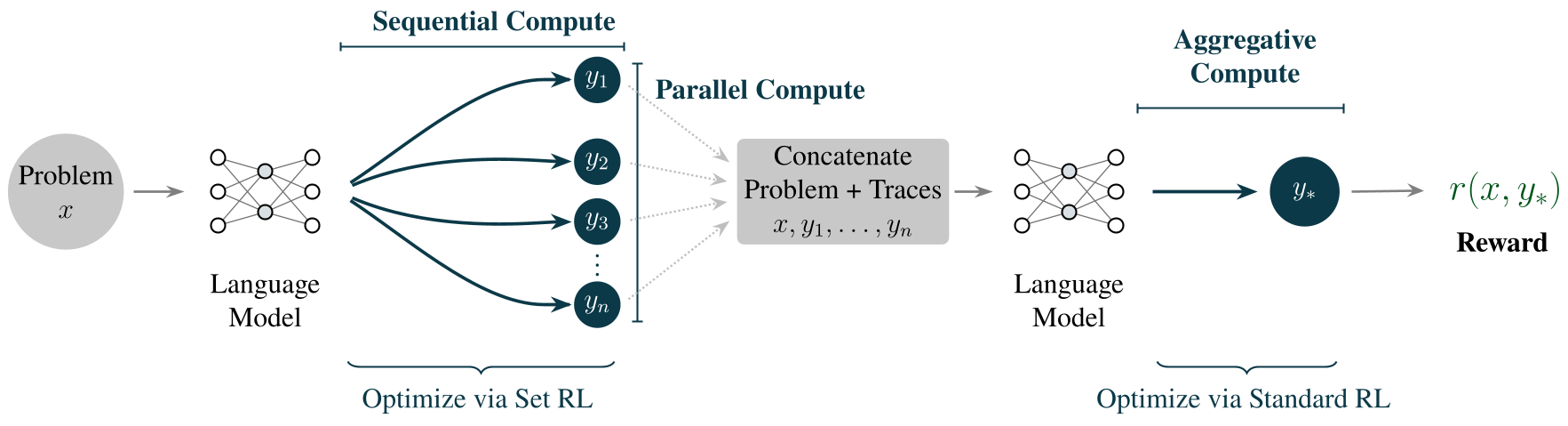 Figure 1: The SPIRAL pipeline vs standard RL. SPIRAL optimizes the search traces (parallel) and the aggregation (synthesis) through a unified reward signal.
Experimental Breakthroughs
The researchers fine-tuned a Qwen3-4b model and compared it against GRPO. The results were clear: as you scale the number of parallel traces (the x-axis in the charts below), SPIRAL's performance grows significantly faster.
Key Metrics:
- Scaling Efficiency: SPIRAL is 11x more efficient than GRPO at scaling parallel attempts.
- Recursive Self-Aggregation (RSA): When the model is allowed to repeatedly aggregate its thoughts, SPIRAL gains a 13.5% lead over GRPO.
- Entropy Preservation: Unlike GRPO, which quickly "collapses" (loses its ability to think outside the box), SPIRAL maintains high token-level entropy throughout training.
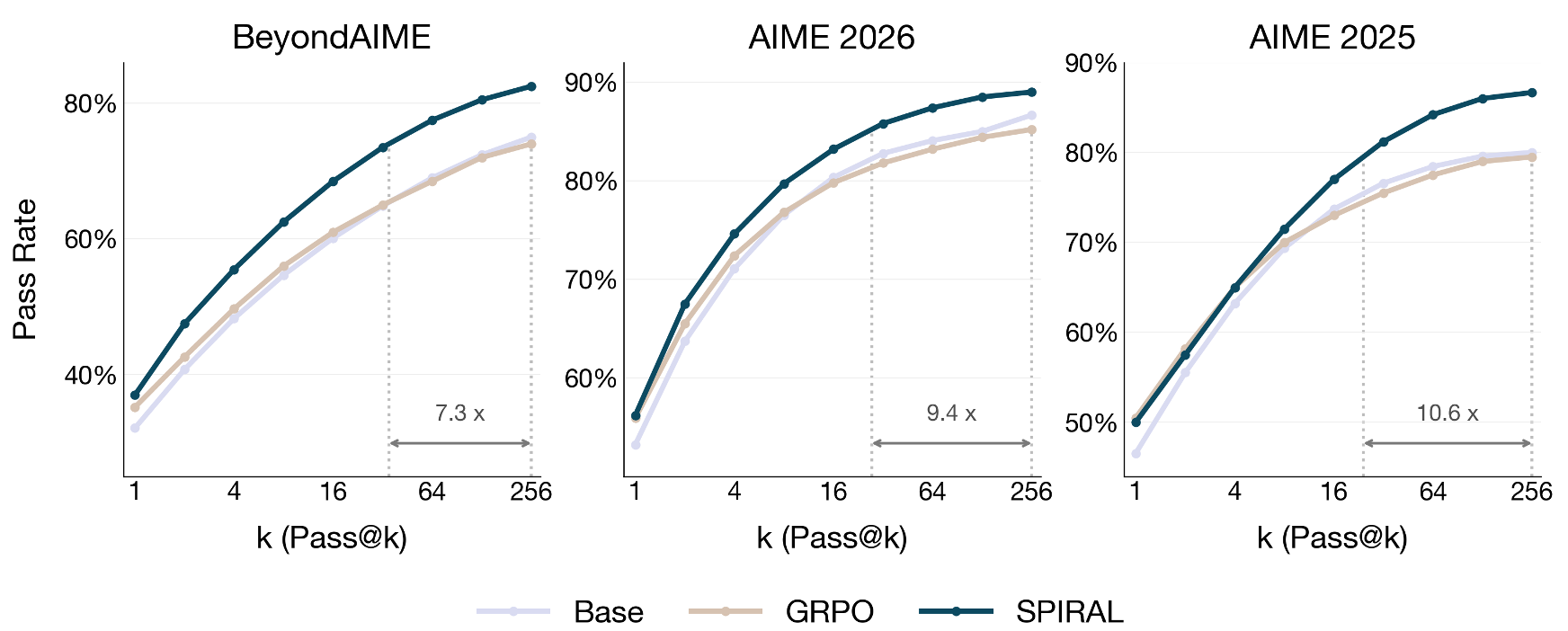 Figure 2: SPIRAL significantly outperforms GRPO as the number of independent attempts (k) increases.
Why It Matters: Scaling for the Real World
Most current LLM "reasoning" is a brute-force sequential process. SPIRAL suggests that the future of AI involves intelligent search. By training models to be aware of their own parallel processing, we move away from "hand-designed scaffolds" (where humans write the logic for how the AI should verify its work) toward learned search procedures.
Limitations & Future Work
While SPIRAL is powerful, the compute cost of training on "sets" is higher than single-trace RL. The researchers also note that while SPIRAL excels at parallel scaling, it performs similarly to GRPO when limited to purely sequential tokens. The next step is scaling this to 8B+ models and testing it in open-ended discovery tasks like coding.
Conclusion
SPIRAL proves that if we want models to use more compute at test time, we have to teach them how to handle that compute during training. By bridging the gap between training and deployment, SPIRAL offers a roadmap for the next generation of self-improving, deeply thinking AI.