
The Digital Spiral: Quantifying Silence in Social Media Ecosystems
Spiral of silence in social networks: A data-driven approach
2016-08-01
Summary
Problem
Method
Results
Takeaways
Abstract
This paper presents a data-driven verification of the "Spiral of Silence" theory within social networks using a large-scale dataset from Sina Weibo. The authors analyze information propagation through four dimensions—width, depth, sentiment, and modularity—to prove that the theory remains valid in digital environments.
## TL;DR
Does the fear of social isolation still silence minority voices in the age of anonymous social media? This study leverages real-world data from **Sina Weibo** to prove that the **Spiral of Silence** theory is alive and well. By analyzing nearly 5 million retweets, the authors demonstrate that the gap between majority and minority opinions widens over time, particularly in subjective categories like Entertainment and Lifestyle.
## The Core Intuition: Why Silence Scales
The **Spiral of Silence**, proposed by Noelle-Neumann in 1973, suggests that individuals scan their environment to gauge the "opinion climate." If they feel their view is the minority, the fear of isolation makes them keep quiet. In the social network era, many believed the "democratization of speech" would break this spiral. However, this paper argues the opposite: the visible "likes" and "retweets" act as real-time barometers, making the majority feel more empowered and the minority more isolated.
## Methodology: Mapping the Silence
The authors modeled information flow as an **Information Propagation Tree**, where the root is the original tweet. They focused on four quantitative "battlegrounds":
1. **Width**: The maximum number of nodes in any single layer.
2. **Depth**: The average "distance" of nodes from the source.
3. **Sentiment**: The emotional intensity/energy of the messages.
4. **Modularity**: The density of internal community connections.
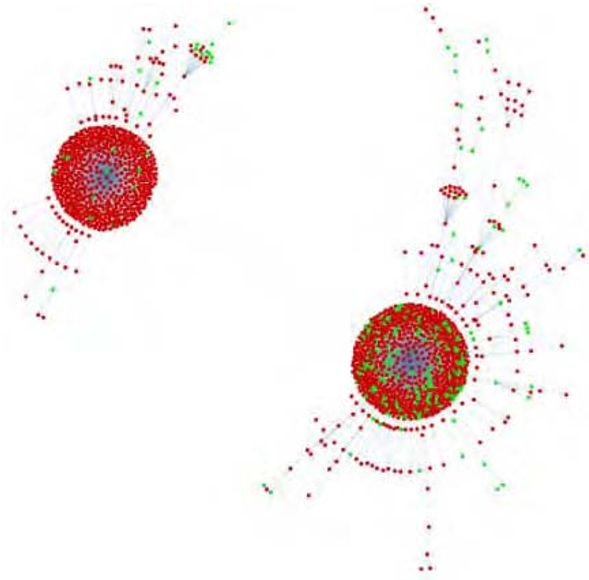
*Figure: A visual representation of majority (red) vs. minority (green) opinion propagation.*
As shown in the visualization above, majority opinions (in red) tend to form much denser, more robust clusters compared to the fragmented, isolated nodes of minority opinions.
## Key Findings: The Widening Gap
The experimental results across 402 hot topics show a clear trend: as time elapses, the disparity in **Width** and **Depth** grows. People are far more likely to "energy transfer" (repost) content that aligns with the perceived majority to avoid social friction.
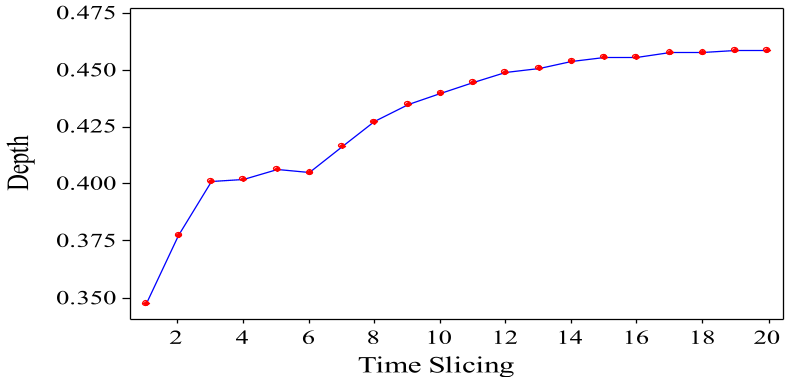
*Figure: Depth disparity evolution, showing how majority opinions penetrate deeper into social strata.*
### Not All Topics Are Equal
Perhaps the most significant insight is that the "Spiral" is context-specific:
* **High Shielding (Strong Spiral)**: Entertainment, Quotations, and Food. In these areas, the majority opinion dominates the public sphere almost entirely.
* **Resilient Minorities (Weak Spiral)**: Science, Technology, and International News. In these technical or ideological fields, minority groups often form their own "tight-knit" communities (high modularity), making them less susceptible to the silencing effect.
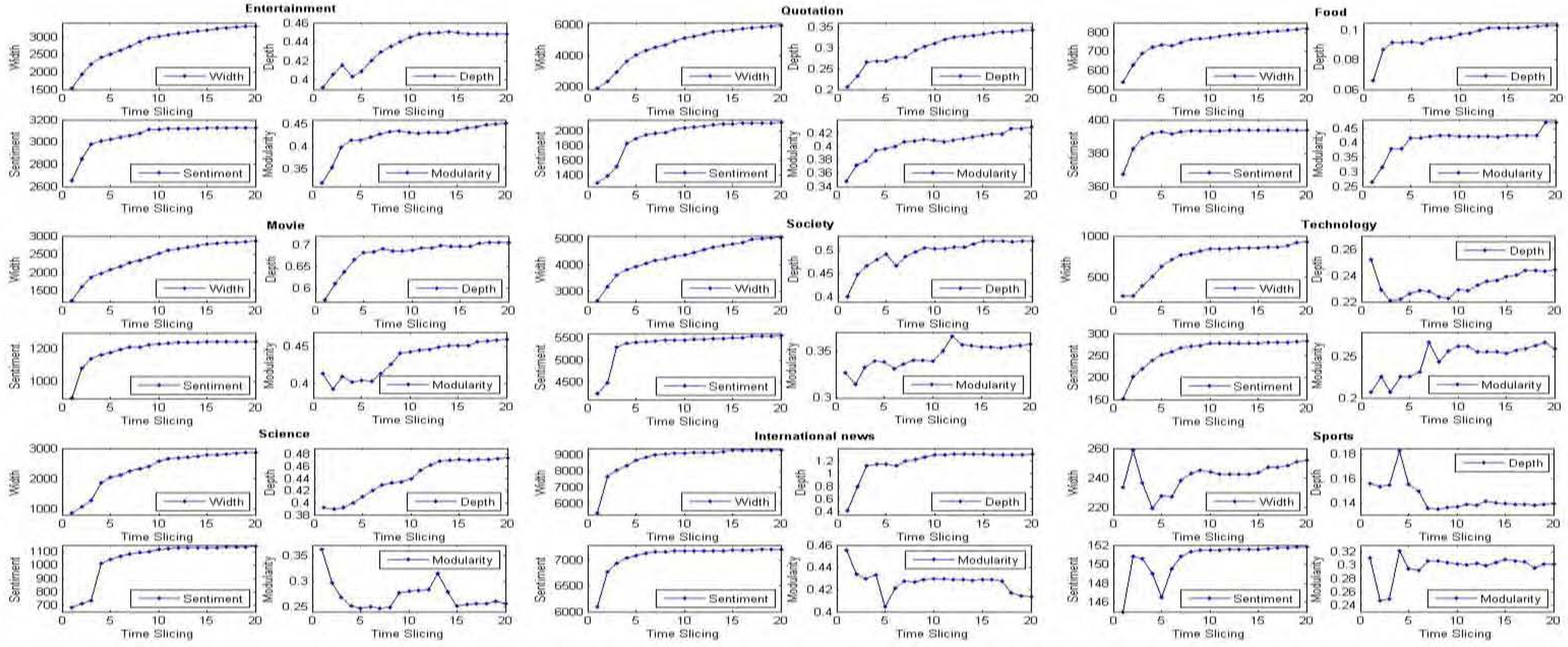
*Figure: Comparative analysis showing how different tweet categories adhere to the theorized spiral.*
## Critical Analysis & Conclusion
This research moves the Spiral of Silence from a psychological theory to a quantifiable data science problem. It proves that social networks, despite providing a platform for all, can ironically accelerate the marginalization of minority views through algorithmic and social feedback loops.
**Limitations**: The study primarily focuses on Sina Weibo, a platform with specific cultural and moderation dynamics. Furthermore, the 95.5% sentiment accuracy, while high, may struggle with sarcasm or complex cultural nuances inherent in social media discourse.
**Future Perspective**: As we move toward more decentralized or AI-curated feeds, understanding these "spirals" will be vital for building platforms that encourage healthy debate rather than monolithic echo chambers.