
Beyond the Dialogue Tree: How Emotional AI is Revolutionizing NPC Conversations
Spoken Conversational AI in Video Games: Emotional Dialogue Management Increases User Engagement
The paper introduces a spoken conversational AI interface for video games using a modified version of the "Alana" system (Amazon Alexa Challenge SOTA). It features an emotional dialogue management system that utilizes sentiment analysis to drive NPC interactions, significantly increasing user engagement in Role-Playing Games (RPGs).
TL;DR
Researchers from Heriot-Watt University have bridged the gap between social AI and gaming. By repurposing a state-of-the-art Alexa Challenge chatbot ("Alana"), they created NPCs that don't just follow scripts—they feel your tone. The result? Players stayed engaged twice as long and felt more immersed in the game world.
Background: The "Death" of Immersion in Menus
For 25 years, RPG veterans have been trapped in a loop: click a text box, watch a canned animation, repeat. This "situated immersion" is often broken because the player isn't acting in the game world; they are navigating a UI. Even modern masterpieces like Fallout 4 or Mass Effect rely on labels like "Persuade" or "Intimidate," making the outcome of a conversation a foregone conclusion.
The Insight: Emotional Gating
The core innovation of this paper is not just adding speech recognition, but adding emotional consequences. The authors argue that if you want a barkeeper to reveal a secret, you shouldn't just click a "Bribe" button. You should have to actually be nice or be scary.
The Architecture
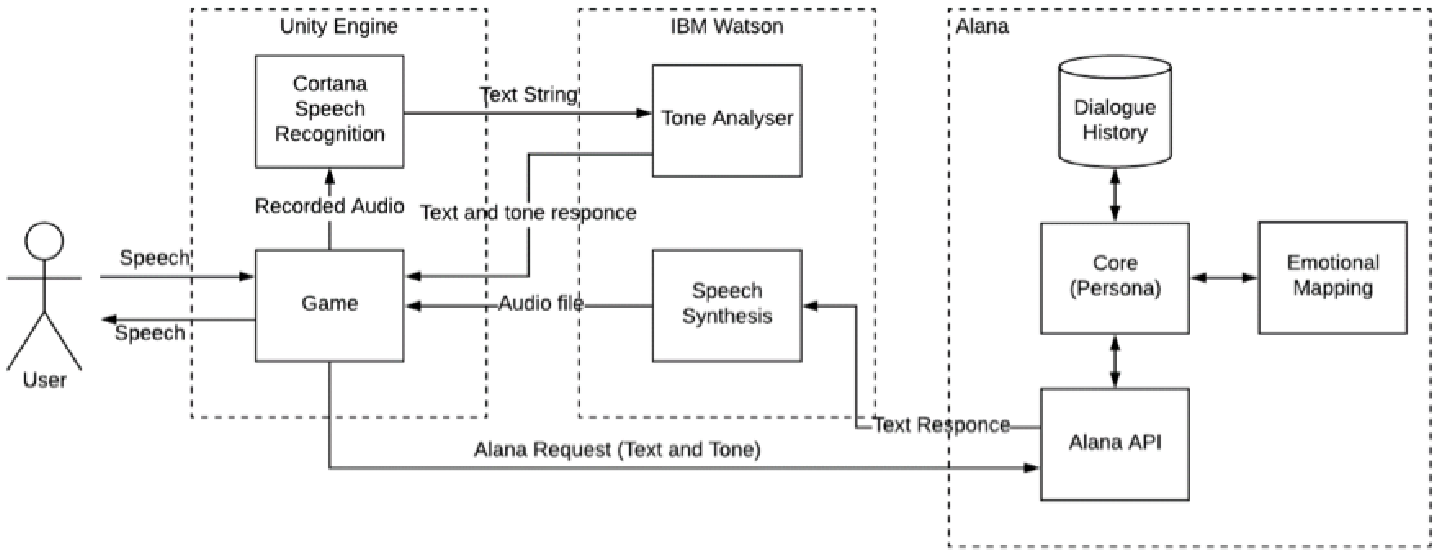
The system is a sophisticated pipeline involving:
- Unity Engine: Handles the 3D environment and ASR (Automated Speech Recognition).
- IBM Watson: Analyzes the "Tone" of the player's voice (Joy, Anger, Sadness).
- Alana AI: A hierarchical ensemble model that generates contextually relevant responses.
Methodology: The Emotional Model
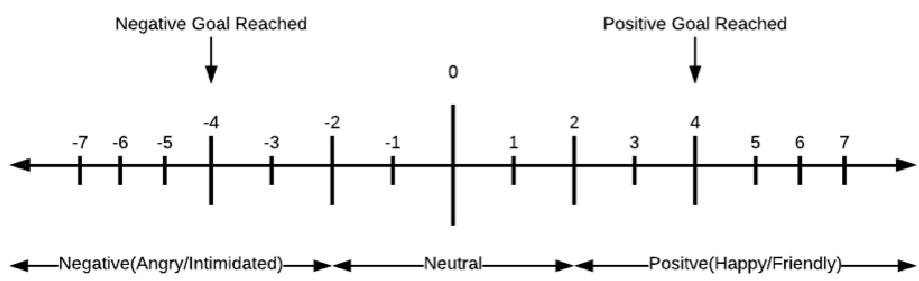
The NPC (based on Hulda from Skyrim) maintains a hidden emotional score between -1.0 (fear/anger) and 1.0 (joy).
- The Multiplier Effect: To simulate human psychology, the system uses "contrast multipliers." If an NPC is already angry and you apologize, the emotional shift is doubled.
- The Dialogue Lock: Information about the quest (the "Dragonbane" sword) is locked. Only by pushing the NPC's score past +0.4 (friendship) or below -0.4 (intimidation) will the secret be revealed.
Experimental Results: Engagement Through Effort
The results were striking. One might think that forcing a player to "work" for information would be frustrating. On the contrary:
- Engagement: Players in the "Emotions Enabled" group spoke with the NPC for 9 minutes and 43 seconds on average—nearly double the control group (5:05).
- Enjoyment: 100% of the emotional-group participants "Agreed" or "Strongly Agreed" that they enjoyed the game.
Why It Works
The "Emotional Version" creates a feedback loop where the player's social choices actually matter. In the non-emotional version, the NPC delivers info like a vending machine; in the emotional version, the NPC feels like a person with a "pride and joy" (her tavern) that can be complimented or threatened.
Deep Insight & Conclusion
This work represents a pivotal shift from reactive NPC design (if A then B) to affective NPC design (if sentiment is S, then state is E).
Takeaways for the Industry:
- Difficulty is Engagement: Players actually want conversations to be challenging. They want to "think about what they are going to say."
- Voice is the Future: While ASR error remains a hurdle, the fluidity of spoken dialogue significantly boosts the sense of "diegetic immersion."
Limitations: The 2018-era ASR and rule-based persona systems (AIML) are dated compared to today's LLMs. However, the framework of using an emotional scale as a gate for game logic remains a gold standard for modern narrative design. The future likely involves combining this emotional state-tracking with the infinite generative capacity of models like GPT-4 or Claude.