
Beyond ASR Scores: Improving Dialogue Understanding via Linguistic Reranking
Spoken Language Understanding via Supervised Learning and Linguistically Motivated Features
The paper investigates the task of Spoken Language Understanding (SLU) by reformulating the N-best hypothesis rescoring problem as a supervised binary classification task. Using linguistically motivated features and semantic error rate (SemER) as the target, the authors compare four machine learning methods—SVM, Weighted KNN, Naïve Bayes, and Conditional Inference Trees—to identify and rank semantically correct dialogue hypotheses.
TL;DR
This research tackles the persistent problem of speech recognition errors in dialogue systems. Instead of just accepting what the speech recognizer thinks is the most likely sentence, the authors use a suite of "intellectual" features—grammar, logic, and context—to re-evaluate the top 6 options. By treating this as a classification problem, they successfully reduced the Semantic Error Rate (SemER) to 11.97%, proving that a system can "re-think" its understanding based on linguistic plausibility.
Background: The "1-Best" Trap
In Spoken Language Understanding (SLU), we typically rely on the Automatic Speech Recognition (ASR) engine's first choice. However, the correct answer is often hidden further down the "N-best" list. The challenge is: how do we pick the right one if the acoustic score failed us? The authors argue that while a sentence might "sound" right (low acoustic error), it might be "grammatically or logically nonsense" (high semantic error).
The Core Insight: Linguistically Motivated Features
The authors move beyond simple word patterns and introduce four tiers of features used to train their classifiers:
- Acoustic/Rank Features: Baseline confidence from the recognizer.
- Syntactic Features: Identifying the "shape" of the sentence (e.g., is it a WH-question or an elliptical fragment?).
- Deep Semantic Features: Checking for logical consistency. For example, "What meetings were there next week?" is linguistically valid but logically impossible (wrong tense for "next week").
- Dialogue-Level Features: This is the most innovative tier. It asks: "If I assume this hypothesis is correct, does the system's resulting response make sense?" A "negative" or "nothing found" response is statistically less likely to be what the user intended than a successful data retrieval.
Methodology: Classification as Ranking
The study transforms the ranking task into a binary classification.
- The Target: Semantic Error Rate (SemER). If a hypothesis yields the same semantic representation as the human transcription, it's labeled
0(Correct); otherwise,1. - The Algorithms: The team compared Support Vector Machines (SVM), Weighted K-Nearest Neighbors (WKNN), Naïve Bayes, and Conditional Inference Trees (CIT).
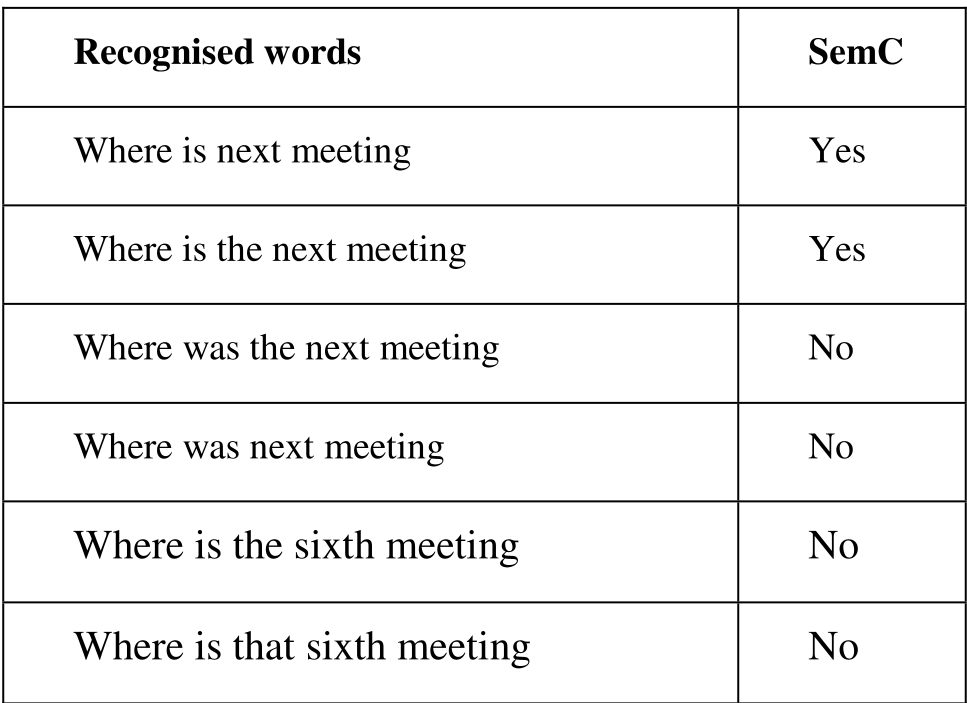 Table 1 illustrates that multiple variations of a sentence can be "correct" if they map to the same underlying meaning.
Experiments and Results
The researchers used a specialized meeting database corpus. They employed ROC analysis to visualize the trade-off between True Positives and False Positives for each classifier.
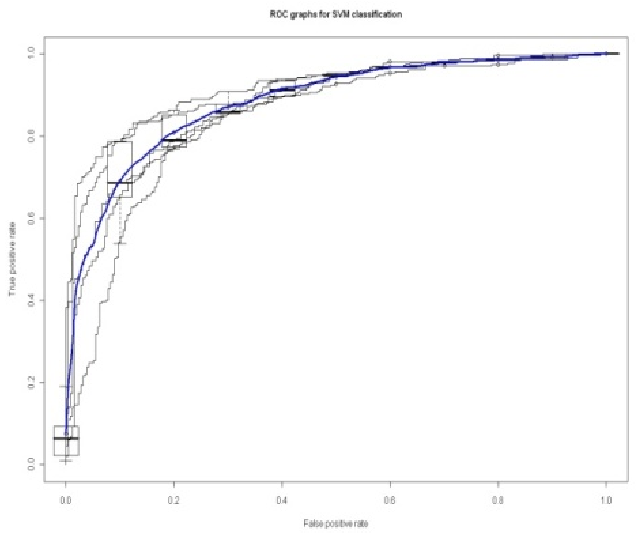 The ROC graphs show that SVM (SVC) and WKNN maintain consistent performance across different decision thresholds, staying close to the y-axis.
Key Findings:
- SVM Dominance: SVM achieved the lowest error rate. By using Platt’s algorithm to extract probabilities, they could rerank the list based on the probability of being "correct."
- The Failure of Naïve Bayes: Interestingly, Naïve Bayes performed worse than the baseline, likely due to its oversimplified assumption of feature independence—a poor fit for highly correlated linguistic data.
- Feature Importance: Dialogue-level features (how the system responds) were among the most informative, confirming that context is king in understanding.
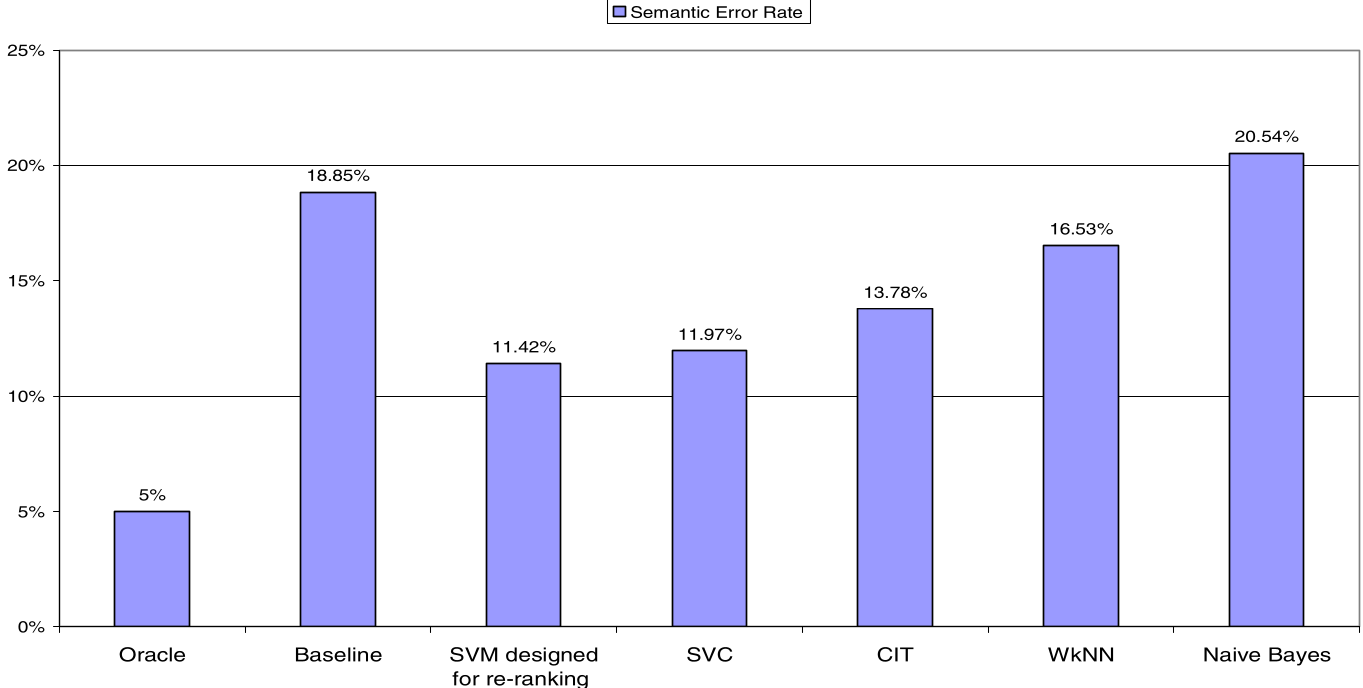 The final summary shows a clear gap between the ASR baseline and the reranked output, with SVM and CIT providing significant boosts toward the "Oracle" (perfect) performance.
Critical Analysis & Conclusion
This work demonstrates that linguistic sophistication matters. While modern SLU has shifted toward end-to-end Neural Networks, the fundamental principle presented here remains relevant: ASR is just a "hearing" stage; the "understanding" stage must account for the rules of language and the state of the conversation.
Takeaway: Treating N-best reranking as a classification problem is not just a mathematical convenience; it's a powerful way to inject external knowledge (syntax, logic, context) into a system that otherwise only understands acoustic probabilities.
Limitations: The corpus used is relatively small (specialized meeting domain). In a broad-domain assistant (like Alexa or Siri), the feature engineering required for "Deep Semantics" would be significantly more complex. However, the success of the classification approach suggests it could scale with more generalized neural embeddings.