
SPORANGIUM: Bridging the Gap Between Virtual Socializing and Real-World Proximity
SPORANGIUM - validating the concept of sporadic social networks in pervasive applications
This paper introduces SPORANGIUM, a multi-layer software platform designed to establish Sporadic Social Networks (SSNs) via ad-hoc mobile connections. It integrates Mobile Cloud Computing (MCC), Semantic Web, and advanced routing protocols to enable resource sharing and personalized content delivery among strangers in proximity.
TL;DR
SPORANGIUM is an innovative platform that creates Sporadic Social Networks (SSNs)—temporary, location-based social hubs formed instantly between mobile devices. By combining ad-hoc networking, mobile cloud resource sharing, and semantic intelligence, it enables strangers at events or on tours to share data, battery power, and storage while receiving personalized content recommendations, all without relying on a central internet infrastructure.
The Motivation: Fighting the Virtual Bubble
In the era of the "Fear Of Missing Out" (FOMO), we are often more connected to our digital followers than the people standing next to us. The authors identify a "de-socialization" effect where technology isolates rather than integrates.
Current mobile solutions for group interactions fail because:
- Infrastructure Reliance: They depend on stable 4G/5G or public Wi-Fi, which is often congested or unavailable.
- Resource Constraints: High-quality media sharing drains battery and exhausts local storage.
- Generic Content: Existing local networks provide "one-size-fits-all" info rather than catering to specific shared interests.
Methodology: The Four-Layer Architecture
The SPORANGIUM platform is built on a robust multi-layer stack designed to abstract the complexity of ad-hoc networking from the end-user experience.
1. Ad-Hoc Communications Layer (Connectivity)
Instead of standard peer-to-peer links, the system uses a Virtual Node Layer (VNLayer+). This creates a persistent infrastructure of "virtual nodes" over the physical mobile devices, which helps maintain routing state despite users moving in and out of range.
2. Mobile Cloud Computing (MCC) Layer (Resource Pooling)
This is the "engine room" where devices cooperate. The authors define four service models:
- NaaS (Network as a Service): Merging multiple 3G/4G links into a single high-bandwidth pipe for the group.
- STaaS (Storage as a Service): Offloading large video files to a peer's device with more free space.
- CaaS (Computing as a Service): Using powerful tablets to render 3D content for low-end smartphones.
- SEaaS (Sensing as a Service): Fusing GPS and sensor data from multiple devices for precise indoor positioning.
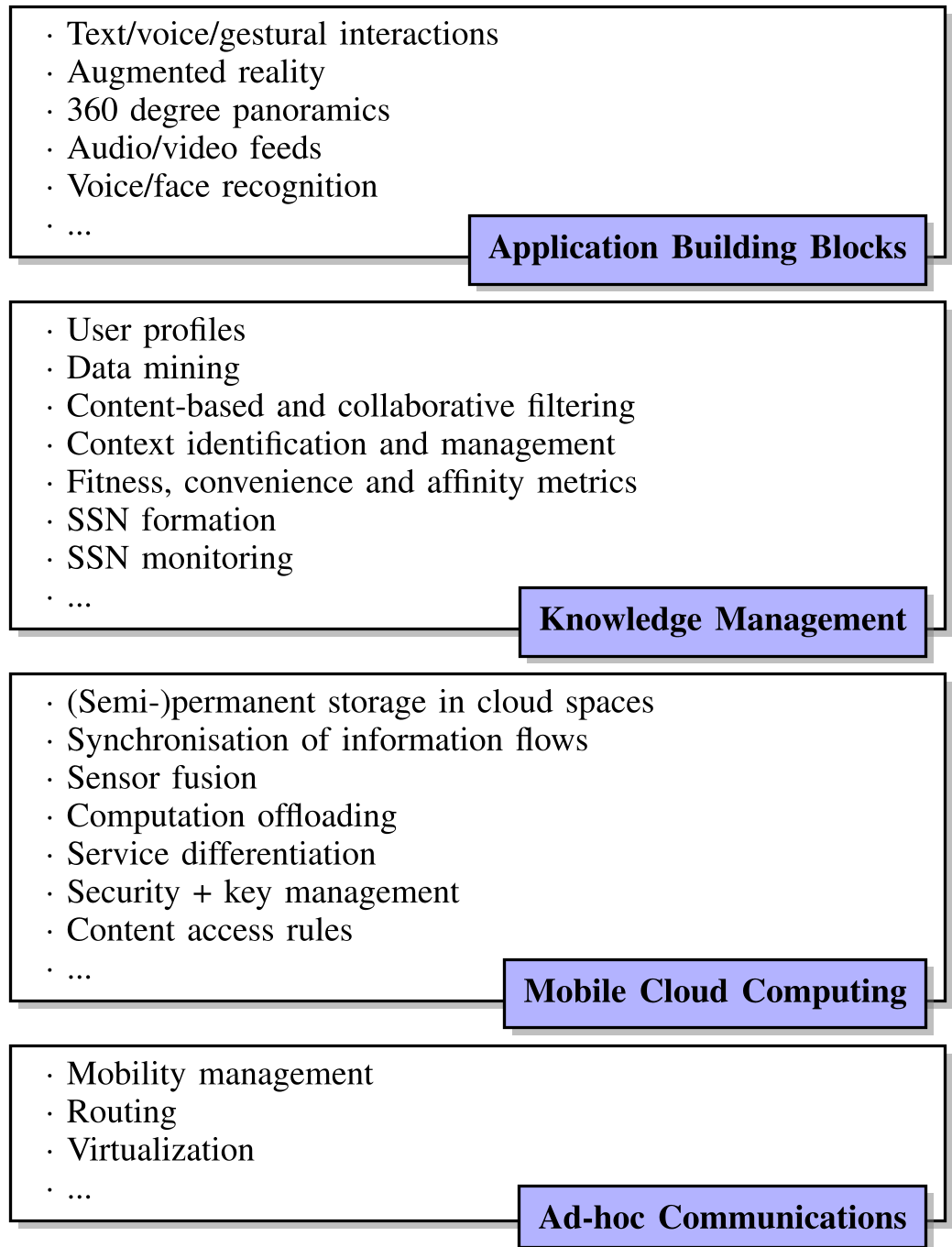
3. Knowledge Management Layer (Intelligence)
This layer acts as a "Social Matchmaker." It uses Semantic Web technologies to analyze user profiles and interests, performing group-based recommendations. It ensures that the nature-lovers on a tour bus get botanic info, while art enthusiasts get history updates.
Validating the Concept: The Bus Tour Scenario
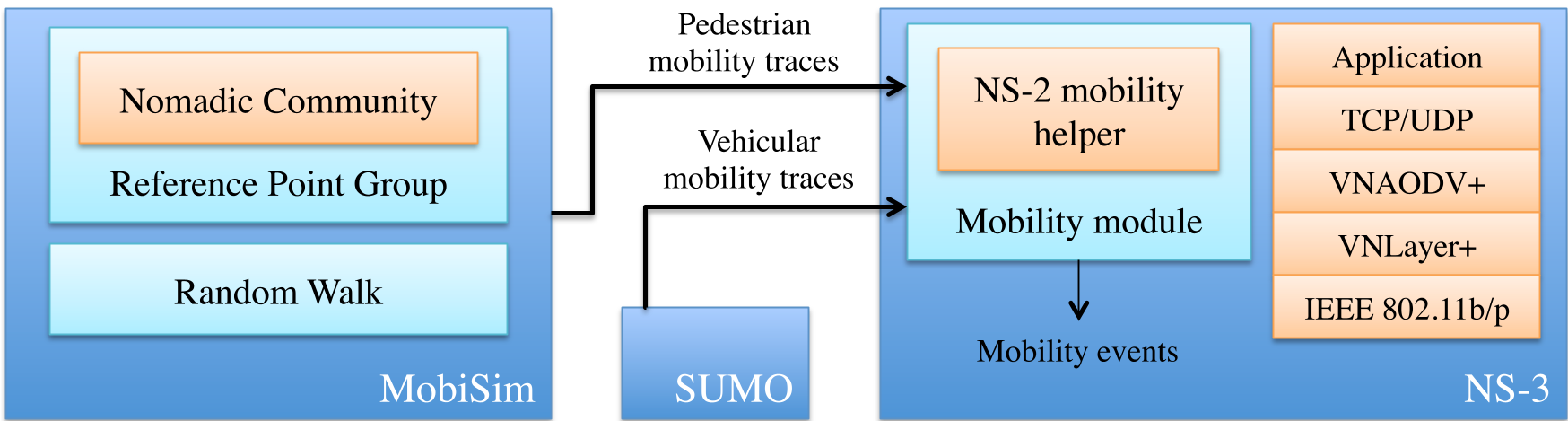
The authors validated SPORANGIUM using a complex simulation of a bus tour in Iceland. This scenario is particularly challenging because it mixes Pedestrian Mobility (tourists walking around waterfalls) with Vehicular Mobility (buses moving between sites).
To test this, they developed a sophisticated simulator that integrates three major tools:
- MobiSim: For modeling individual and group pedestrian movements (Random Walk, Nomadic Community).
- SUMO: For realistic vehicular traffic flow.
- NS-3: For low-level network performance analysis (802.11b/p protocols).
Experimental Results
The simulation results confirm that the VNLayer+ approach significantly improves the robustness of the network.
| Location | Mobility Model Used | Key Requirement |
|---|---|---|
| Meeting Point | Random Walk | Individual discovery |
| Waterfalls | Nomadic Community | Group wandering around a point |
| Art Museum | Reference Point Group | Following a guide |
The trials showed that packet delivery ratios and route stability were higher than standard AODV protocols, even in the high-speed transit sections of the bus tour. By using NaaS, the platform successfully reduced the individual cost of cellular data by aggregating connections across the SSN.
Critical Analysis & Future Outlook
SPORANGIUM successfully demonstrates that "social networking" doesn't have to be a global, permanent concept. Sporadic networks are a powerful alternative for pervasive computing.
Key Strengths:
- Autonomy: Operates effectively in "dead zones" through peer-to-peer resource sharing.
- Privacy-Friendly: Information is shared within a localized, temporary context rather than being permanently stored on a corporate server.
Limitations & Future Work:
- Battery Drain: While the authors mention extended battery life via offloading, the energy cost of maintaining an active ad-hoc mesh network remains a high-overhead task for small devices.
- Security: Trust between "strangers" in an SSN is assumed; future work needs to address malicious actors within these ad-hoc communities.
In conclusion, SPORANGIUM paves the way for a more interactive and resource-efficient "Internet of People," where the device in your pocket works for the benefit of the community around you.