
Social PaL: Reclaiming Privacy in Proximity-Based Networking
SpotShare and nearbyPeople: applications of the Social PaL framework
This paper demonstrates "SpotShare" and "nearbyPeople," two Android applications built on the "Social PaL" framework. The framework enables privacy-preserving discovery of social path lengths (e.g., determining if two people are friends or friends-of-friends) between nearby mobile devices without relying on a centralized server.
TL;DR
Researchers from Aalto University have demonstrated a way to find "friends of friends" nearby without ever telling a central server who you are or where you are. By leveraging the Social PaL framework, they introduced two apps—SpotShare for social WiFi sharing and nearbyPeople for privacy-safe social discovery—moving social networking from the cloud to the device edge.
Context & Motivation: The Privacy Cost of Connection
In the modern digital landscape, finding someone with common interests or mutual friends usually requires a mediator like Facebook or LinkedIn. These platforms act as "trusted" third parties that know your location, your friends, and your intent.
The authors identify a critical flaw: why should a central server in Silicon Valley need to know that two people standing 10 meters apart in Helsinki are trying to share a WiFi hotspot? Existing mechanisms suffer from Interaction Leakage and Location Exposure. The Social PaL framework was designed to break this dependency.
Methodology: How Social PaL Works
The core of the demonstration is the Social PaL framework. Instead of uploading your contact list to a server to find a match, Social PaL uses privacy-preserving protocols to calculate the Social Path Length (the degrees of separation between two users).
Key Pillars:
- Identity Anonymization: Users interact without broadcasting their global social identities.
- Edge Discovery: Using Bluetooth and the SCAMPI opportunistic router, devices talk directly to each other to establish communication.
- Encrypted Distance Estimation: The framework determines if the users are "close enough" (e.g., within 2 degrees of separation) based on local policy, without revealing the names of the mutual friends.
 (Note: This conceptual image represents the framework's branding and conference context.)
Application 1: SpotShare (Social WiFi)
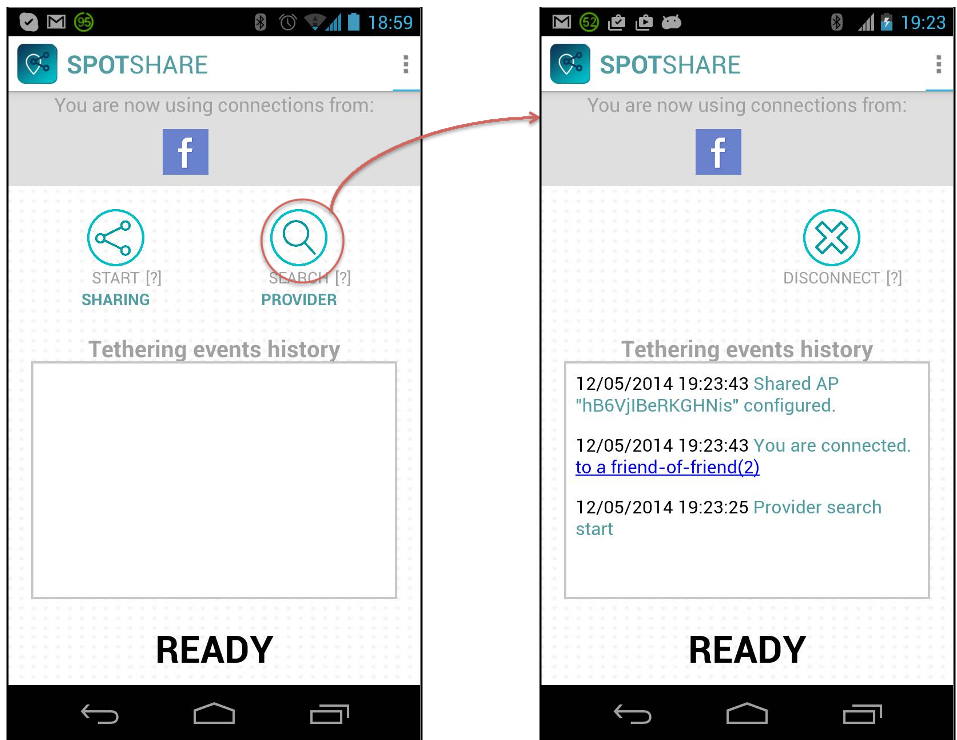
SpotShare addresses the "Roaming Problem" for travelers. It allows a user to turn their smartphone into a WiFi hotspot that is restricted only to people they trust—specifically, friends or friends-of-friends.
- Automation: No manual password typing. The "handshake" happens via Social PaL over Bluetooth.
- Access Control: If the requester is socially verified, the password is sent securely.
Application 2: nearbyPeople (Privacy Radar)
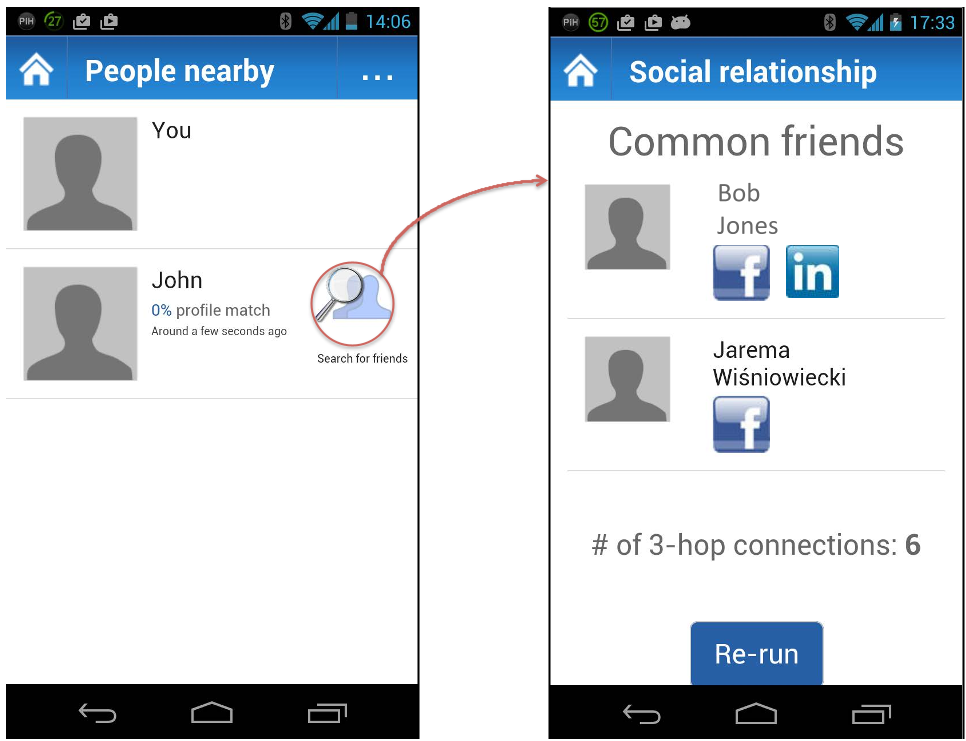
This is a "People Radar" implemented with high privacy guarantees. It allows users to see if anyone socially relevant is nearby without either party having to "Check-in" to a public server. It effectively provides the benefits of social serendipity without the metadata trail.
Critical Insight & Future Outlook
The brilliance of this work lies in its scalability. While many privacy protocols are theoretically sound but computationally heavy, Social PaL was demonstrated running in real-time on 2015-era Android devices.
Takeaways:
- Infrastructure-less Sociality: We don't need 5G or cloud servers to build a social network; physical proximity and device-to-device (D2D) communication can handle the heavy lifting.
- Policy-Driven Privacy: Users can set their own "trust threshold" (1st degree vs 2nd degree).
Limitations: The system still relies on importing graph data from centralized providers (Facebook/LinkedIn). A truly sovereign system would require decentralized social graphs (like Mastodon or Farcaster) to be fully independent.
Conclusion
Social PaL proves that "Social" and "Private" are not mutually exclusive. As we move toward more autonomous edge computing, frameworks like this will be essential for secure, human-centric networking.