
Beyond the Follower Count: A Multi-Platform, Weighted Approach to Social Influence
Spreading influence values over weighted relationships among users of several social networks
The paper introduces a multi-platform social influence metric that aggregates user activity from Facebook and Twitter. By weighting relationships based on interaction intensity and iteratively spreading influence values, it achieves a more accurate representation of social power than single-platform or unweighted benchmarks.
TL;DR
Quantifying social influence is often reduced to a simple numbers game—how many followers do you have? This paper challenges that status quo by arguing that influence is not a static property, but a product of relationship strength across multiple platforms. By weighting interactions like retweets, tags, and "likes" across Facebook and Twitter simultaneously, the authors developed a metric that outperforms industry standards like Klout in real-world recommendation tasks by over 2x.
The Problem: The "Follower Fallacy"
The academic and commercial world has long sought a way to identify "influencers." However, existing tools (like Klout or Facebook Grader) suffer from two fundamental flaws:
- Platform Silos: They treat a user’s Twitter persona and Facebook persona as two separate entities, ignoring the synergy of a holistic digital presence.
- Lack of Interaction Quality: They often assume that if you follow a celebrity, you "inherit" some of their influence. In reality, unless you are actively engaging with that contact, that link is dead weight.
Methodology: Dynamic Weighting & Influence Spreading
The authors propose a three-step framework to bridge this gap.
1. Modeling the Multi-Network Graph
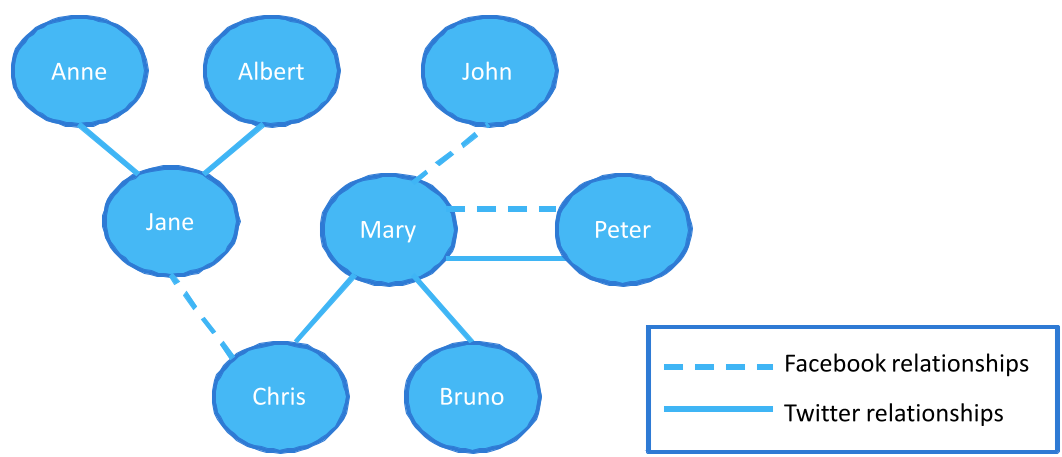
Instead of a simple list, the model creates a complex graph where nodes (users) are connected by specific types of links (Twitter follows vs. Facebook friendships). If two users are connected on both platforms, the potential for influence transfer is doubled—but only if the relationship is active.
2. The Weighting Equations
The core innovation lies in Eqs (1) and (2), which calculate the strength of a relationship () based on 30-day rolling averages of specific actions:
- Facebook Weights: Focused on photo tags (), wall posts (), and group collaborations ().
- Twitter Weights: Focused on Retweets (), Replies (), and the prestigious "Follow Friday" mentions ().
3. Iterative Spreading
Using an iterative process, influence flows through these weighted links. If a user is "narrowly related" (high weight link) to a highly influential contact, their own score rises significantly. If the link is weak, the influence transfer is inhibited.
Experimental Results: Proving Interest Through Influence
The researchers tested their metric in a "Tourist Attraction Recommender" system. They compared their Weighted-Rel method against FBGrader, twInfluence, and Klout.
The results were striking. In an ANOVA test involving 123 users over a 4-month period:
- Weighted-Rel achieved an acceptance rate of 51.1%.
- Klout (Twitter) trailed significantly at 29.5%.
- FBGrader performed the worst at 17.7%.

The high F-statistic (73.573) and the p-value () confirm that these results aren't just a fluke. The metric successfully identified users whose recommendations were actually trusted by their peers.
Critical Insight: Why Does This Work?
The success of this approach stems from the concept of Reliability. When a recommendation comes from a contact with whom you have a high "interaction weight," you are far more likely to perceive that recommendation as high-quality. By quantifying this "reliability" through cross-platform data, the authors have moved social influence from a vanity metric to a functional tool for information diffusion.
Conclusion & Future Horizon
This study serves as a roadmap for the future of social analytics. As social media becomes more fragmented (with the rise of platforms like Google+, which the authors plan to add next—note: the paper reflects the tech landscape of its time), the need for cross-platform integration only grows.
Takeaway: If you want to spread an idea, don't look for the person with the most followers; look for the person with the most active and cross-platform bonds.