
SQL vs. NoSQL: Navigating the Spatio-Temporal Complexity of Social Media Big Data
SQL or NoSQL? Contrasting Approaches to the Storage, Manipulation and Analysis of Spatio-temporal Online Social Network Data
The paper presents a comparative analysis of SQL (Microsoft SQL Server) vs. NoSQL (MarkLogic) for handling spatio-temporal Online Social Network (OSN) data. It specifically evaluates Extract/Transform/Load (ETL) workflows for ~4 million Twitter and Facebook interactions related to the 2012 US Election and 2014 Scottish Referendum.
Executive Summary
TL;DR: This research investigates the friction between traditional relational databases (SQL) and emerging document-oriented stores (NoSQL) when handling millions of geo-tagged social media records. By comparing Microsoft SQL Server with MarkLogic, the study demonstrates that while SQL is familiar, its rigid schema requirements pose a significant risk of data loss and engineering fatigue in the face of unpredictable JSON data structures common in Online Social Networks (OSNs).
Background: Positioned at the intersection of GIS (Geographic Information Systems) and Data Engineering, this work serves as an "exploratory analysis" of storage methodologies during a pivotal era where social media became a primary tool for political mobilization (e.g., the 2012 US Presidential Election).
The Pain Points: Why Your Schema is Brittle
Modern spatio-temporal data from APIs like Twitter or Facebook arrives in JSON (JavaScript Object Notation). Unlike the rows and columns of the 1970s, JSON is hierarchical, nested, and—most importantly—unpredictable.
The author identifies three core limitations of the traditional RDBMS approach:
- The Schema Rigidity Trap: If a new field (e.g., a new geo-tagging format) is added by the API provider, an existing SQL import script will likely fail or truncate the data.
- ETL Complexity: Converting nested arrays into normalized tables requires extensive manual scripting (57 scripts in this study!), increasing the risk of "introduced error."
- Encoding Hazards: Handling UTF-8 strings and emoticons often leads to data corruption in standard SQL import wizards.
Methodology: Tabular vs. Document Models
The author executed two parallel workflows to manage ~4m OSN interactions (roughly 6GB of raw data).
The SQL Workflow (Traditional)
This involved converting JSON to CSV and then attempting to force it into a common table.
- The Problem: DataSift (the data provider) output different numbers of fields for different streams. Stream A had 67 fields, while Stream B had 146. A fixed model designed for A would be incapable of storing B.

The NoSQL Workflow (MarkLogic)
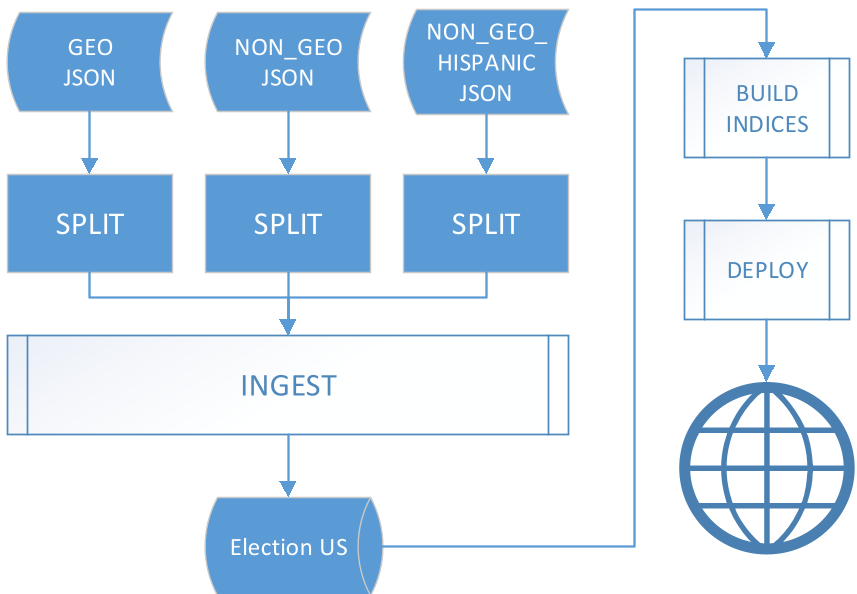
Using a schema-agnostic approach, the author ingested raw JSON directly.
- The Insight: By treating each interaction as a "document" rather than a row, the system accommodates variations in metadata levels without requiring a schema redesign.
- Technical Advantage: Built-in "GeoSpatial Element Pair" indices allow for immediate mapping of longitude/latitude pairs directly from the document.
Experiments & Results: The Pragmatic Truth
The study highlights that while the datasets were "small" by modern standards (~4 million records), the technical overhead of SQL was disproportionately high.
- Operational Efficiency: The NoSQL approach allowed for "Alerting" and "Semantic Enrichment." For example, the system could find all mentions of "Chicago" and automatically tag them with
<placename lat=41.88 lon=-87.62>for future spatial queries. - Scaling Potential: The author notes that if the dataset were 1,000x larger, the "fail-fast" nature of SQL parsing would be catastrophic, whereas NoSQL's "ingest first, structure later" philosophy ensures data preservation.
Deep Insights & Critical Analysis
Key Takeaway
The choice of technology sets the bounds of what is possible. While SQL provides robust GROUP BY and ORDER BY capabilities familiar to all analysts, it was never designed for "free-form text" or "rapidly evolving schemas."
Limitations & Future Work
One notable limitation is the Total Cost of Ownership (TCO). NoSQL systems like MarkLogic often require specialized knowledge (XQuery, SPARQL) and can be expensive to license or host in clustered cloud environments compared to ubiquitous SQL solutions.
The future of the field lies in "Knitting together a patchwork": integrating NoSQL for ingestion and text mining with traditional GIS (like MapInfo) or specialized statistical tools (like R or MatLab) for the final analysis.
Conclusion
For researchers in the spatial analysis community, the era of the "one-size-fits-all" database is over. The "plumbing" of Big Data requires a shift toward flexible, document-based architectures to truly capture the velocity of human behavior on the Geoweb.