
Elevating Tangible Therapy: The Gestalt of Squeeze Interaction
Squeeze Interaction in Physical & Occupational Therapy
This research presents a PhD-level exploration of "squeeze interaction" for healthcare, specifically physical and occupational therapy. By moving from complex SVM-based machine learning to simple mathematical feature extraction (magnitude, speed, location), the author developed the Skweezee toolkit—an accessible, tangible interface for special education and residential care.
TL;DR
This research redefines how we design interactive tools for physical and occupational therapy. By moving away from complex screen-based "black boxes" and embracing the inherent "feel" of soft materials, the author developed Skweezee: a toolkit that allows patients to interact with technology through the natural, expressive act of squeezing. The shift from discrete machine learning classifications to continuous mathematical feature extraction has enabled a new class of standalone, light-emitting therapeutic objects.
Problem & Motivation: The "Black Box" Barrier
In the realm of Human-Computer Interaction (HCI), combining soft materials with healthcare is not new. However, a recurring issue is adoption. Why do therapists ignore technically "functional" DIY kits?
The author identifies two core failures in previous iterations:
- Loss of Interaction Gestalt: Early systems used Support Vector Machines (SVM) to map a squeeze to a single keypress. This reduced a rich, analog physical movement into a dull, digital "on/off" switch.
- Infrastructure Dependency: Most systems required a PC to run the recognition software, making them impractical for the messy, mobile environment of a classroom or a therapy ward.
Methodology: From ML to Material Elegance
The breakthrough in this PhD research lies in the simplification of the signal processing. Instead of asking a computer to "guess" what a squeeze means using complex algorithms, the author uses vector and time-series analysis to extract immediate features:
- Magnitude: How hard is the squeeze?
- Speed: How fast is the movement?
- Location: Where is the pressure being applied?
By shifting to these simple mathematical operations, the interaction becomes continuous. As you squeeze harder, the light gets brighter—creating a tight, phenomenological loop between the user's body and the object.
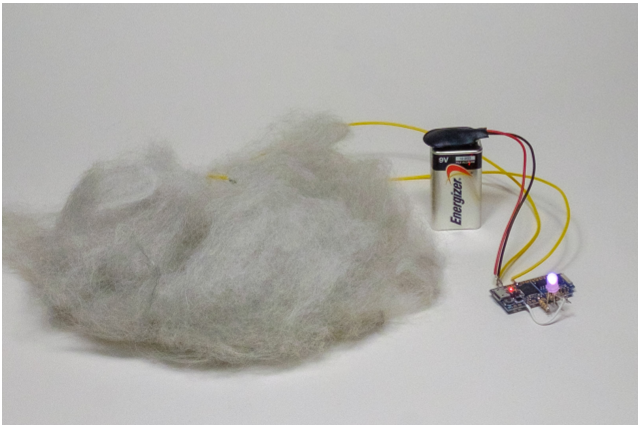 Figure: The Minimal LED prototype demonstrates "material elegance" by aligning raw conductive wool resistance directly with RGB LED output.
Work in Progress: The Three Stages of Evolution
The research evolved through three distinct prototypes that moved the technology from the screen to the hand:
- Ball Drop Game: Taught the researcher that a "continuous mapping" felt better than "discrete states." It respected the "interaction gestalt"—the holistic experience of the movement.
- Minimal LED Prototype: Proved that the system could be "self-contained." Using an Arduino Micro and conductive wool, the interaction moved beyond the screen.
- The Bulbs: A set of soft, interactive objects designed after a year of ethnography in special education. Each bulb has a different "personality"—some react to light touches, others to heavy pressure, allowing therapists to pick the specific tool needed for a child's unique motor goals.
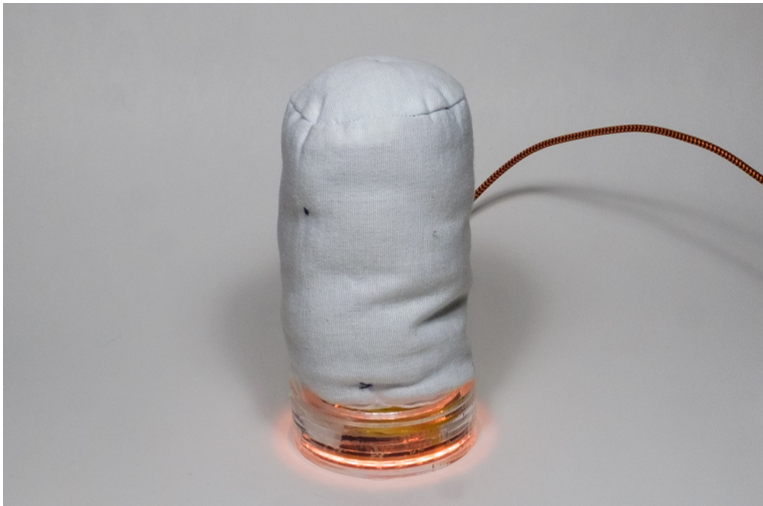 Figure: The specialized bulb prototypes designed for special education, emphasizing different squeeze dynamics.
Critical Analysis & Conclusion
The value of this work is not just in the hardware, but in the philosophy of empowerment. By making the technology "invisible" (no screens, no complex setup), it empowers the therapist to focus on the patient.
Limitations & Future Work
While visual feedback (LEDs) is effective, it may not be suitable for all patients, such as those with visual impairments. The author is currently exploring audio as a primary output modality in a second case study within a residential care facility.
Final Takeaway
This research proves that in healthcare HCI, less is often more. By stripping away the complexity of "AI" and focusing on the "Aesthetic of Friction" and "Tactile Feel," we can create tools that are not just high-tech, but deeply human and truly therapeutic.