
SRaSLR: Bridging the Semantic Gap in Web Services via Social Network Awareness
SRaSLR: A Novel Social Relation Aware Service Label Recommendation Model
The paper introduces SRaSLR, a Social Relation aware Service Label Recommendation model that combines BERT-based text features from service profiles with graph embeddings (Node2Vec) of service social networks. It achieves state-of-the-art performance on the ProgrammableWeb dataset, particularly excelling in scenarios where text descriptions are sparse or vague.
Executive Summary
TL;DR: In the world of service computing, text descriptions are notoriously unreliable. SRaSLR is a new framework that treats web services not just as text snippets, but as nodes in a "social network." By fusing BERT-based semantic features with Node2Vec-based structural features from invocation graphs, the model significantly outperforms traditional text-only classifiers.
Positioning: This work moves beyond traditional NLP-heavy service classification by introducing the Social Relation perspective as a first-class citizen, setting a new SOTA for imbalanced and sparse service datasets like ProgrammableWeb.
Problem & Motivation: The Textual Desert
Why is service labeling hard? Most platforms rely on user-uploaded descriptions. As the authors point out, these descriptions are often:
- Too Vague: A service like Smugmug might have a long description that never mentions the word "Photo."
- Too Brief: Many services have descriptions under 15 words, providing zero semantic signal for BERT to "read."
The insight of this paper is that services do not exist in isolation. They form a Service Social Network through Mashup-API invocations. If a service is frequently used alongside other "Photo" services, it likely belongs to that category—even if its text description is empty.
Methodology: The Best of Both Worlds
The SRaSLR architecture (Social Relation aware Service Label Recommendation) uses a two-pronged approach:
- Text Encoding: It fine-tunes a BERT-base model to extract pooled features from service names and descriptions.
- Social Network Encoding: This is the core innovation. The authors transform the Mashup-API (bipartite graph) into two homogeneous networks: API-API (A-A) and Mashup-Mashup (M-M). They then use Node2Vec to generate embeddings that capture the structural "neighborhood" of each service.
- Feature Fusion: These vectors are concatenated and passed through a decoder (fully connected layers) to map them to the 255-label space.
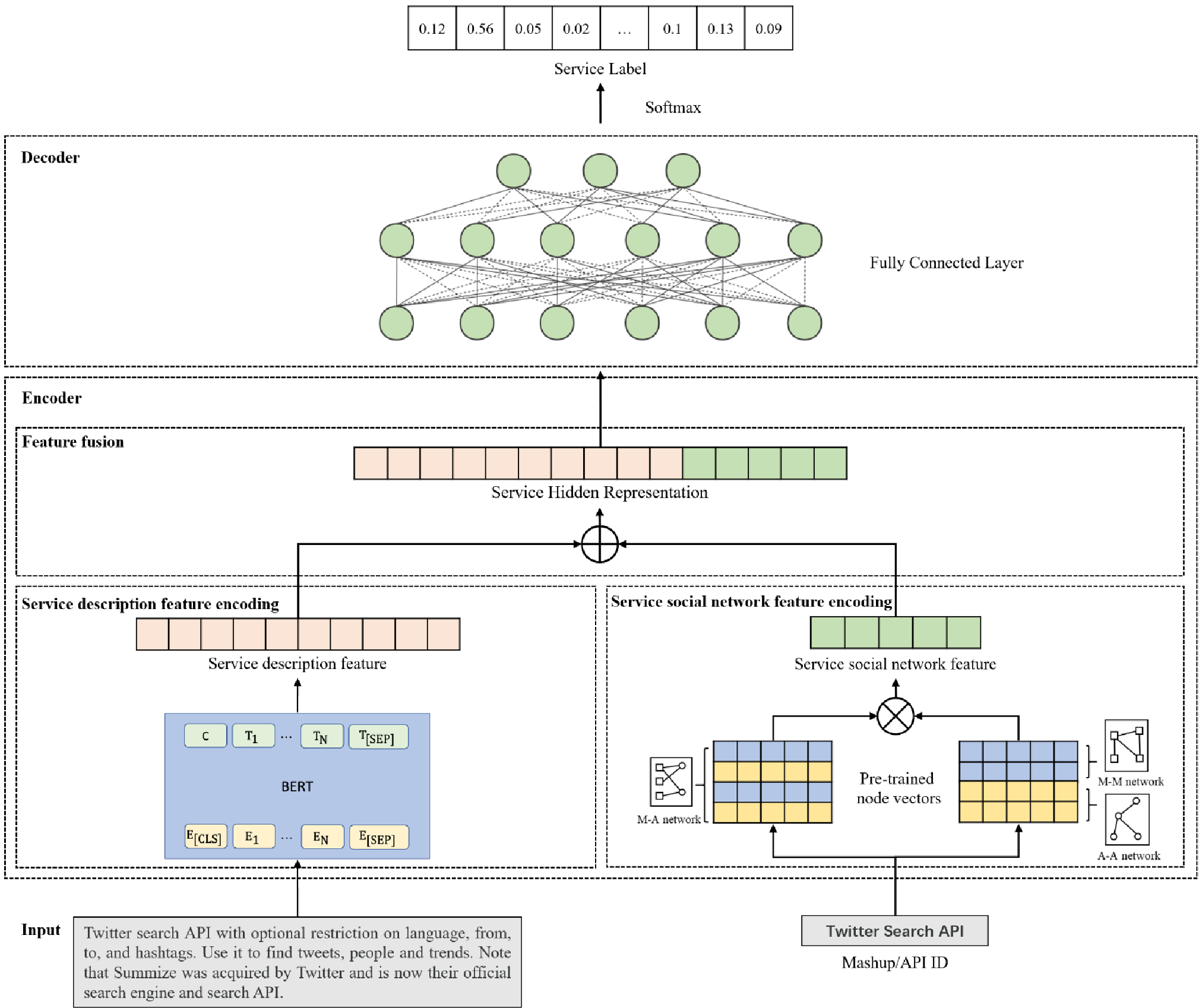
The model effectively uses Hadamard products and Concatenation to ensure that the semantic meaning of the words and the structural role of the service in the ecosystem are considered simultaneously.
Experiments & Results: Robustness Against Brief Text
The experiments on the ProgrammableWeb dataset revealed several key findings:
- SOTA Performance: SRaSLR achieved a Top-5 accuracy of 63.6%, outperforming the advanced ServeNet and BERT-only baselines.
- The "Short Text" Savior: The most striking result (Table III) shows that when service descriptions are short, BERT's Top-5 accuracy drops from 71.3% to 51.8%. However, SRaSLR stays consistent because the social network provides the "missing link."
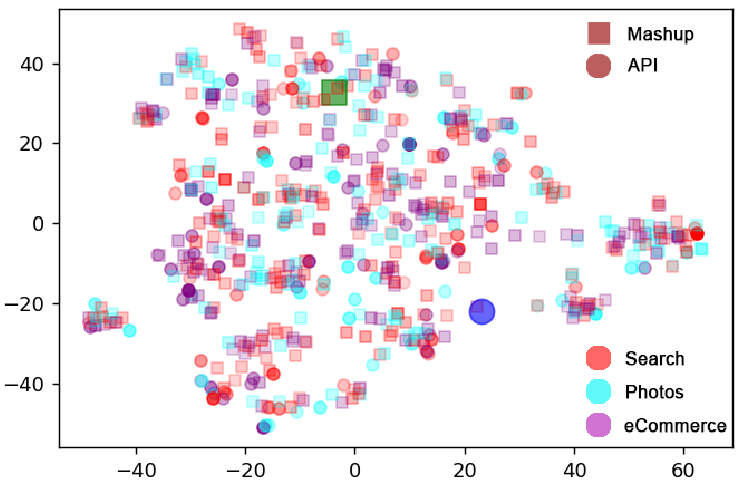 Figure: T-SNE visualization showing that Mashup-API (MA) network features cluster categories much more effectively than isolated mashup/API co-occurrence.
Critical Analysis & Conclusion
Takeaway
The success of SRaSLR proves that structural context is just as important as semantic context. In specialized domains where human-provided metadata is low-quality, the "behavior" of the entity (who it interacts with) is a superior feature.
Limitations & Future Work
While SRaSLR is effective, it uses Node2Vec, which is a "shallow" graph embedding method. It computes embeddings offline, meaning they are not updated end-to-end with the text encoder. The authors suggest that moving toward Graph Neural Networks (GNNs) could capture even deeper relational nuances, potentially handling the "cross-category" nature of services better than simple concatenation.
SRaSLR represents a pivot from "Reading about Services" to "Observing Service Behavior," a transition that will be vital as the API economy continues to explode.