
SSPA-LBS: Redefining Privacy in the Age of Location-Based Social Networks
SSPA-LBS: Scalable and Social-Friendly Privacy-Aware Location-Based Services
The paper introduces SSPA-LBS, the first Location-Based Service (LBS) framework that simultaneously addresses scalability in privacy levels and social-friendliness in user-to-user interactions. It utilizes a novel camouflage algorithm with formal geo-indistinguishability and a Scalable Ciphertext Policy Attribute-Based Encryption (SCP-ABE) mechanism for fine-grained access control.
TL;DR
SSPA-LBS is a breakthrough framework that solves the "Privacy-Utility Paradox" in social location services. It allows users to scale their privacy levels—sharing precise locations with family but "blurred" areas with acquaintances—using a combination of a novel camouflage algorithm and attribute-based encryption (SCP-ABE). It proves that privacy doesn't have to break social features.
Background: The Scalability and Social Barrier
Location-Based Services (LBS) are ubiquitous, yet they present a terrifying privacy risk: precise tracking. Existing solutions like k-anonymity or standard camouflage are often brittle. They either fail in sparse areas or don't allow the user to say, "I want to be private to the server, but somewhat visible to my friends."
The authors identify two fatal flaws in current PA-LBS:
- Rigidity: You can't easily turn the "privacy knob."
- Social Isolation: Most systems assume the server is the only threat, ignoring that we often need to share location with other users whose trust levels vary.
Methodology: The Two-Pronged Solution
1. Multi-Dimensional Camouflage
SSPA-LBS introduces a calibrated version of Geo-indistinguishability. Unlike prior methods that just use a "radius," this system factors in Place Type (e.g., "Starbucks" vs. "Cafe" vs. "Restaurant"). By scaling both the range and the semantic precision of the venue, the user gains a formal privacy guarantee against attackers with prior knowledge of the area.
2. SCP-ABE: Sharing with Nuance
The soul of the "social-friendly" aspect is the Scalable Ciphertext Policy Attribute-Based Encryption (SCP-ABE).
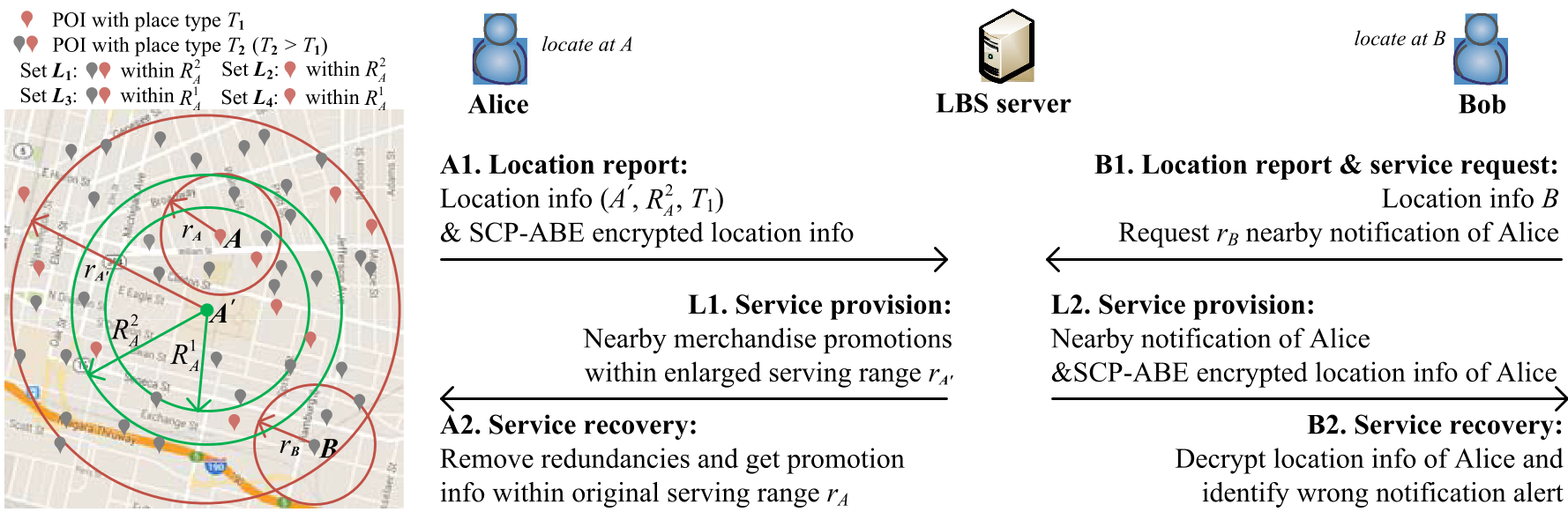
As shown in the architecture, the location data is structured like a layer cake. If Bob is a "Best Friend," his attributes allow him to decrypt a lower layer (more precise). If he is just a "Colleague," he may only see the top layer (a wide radius).
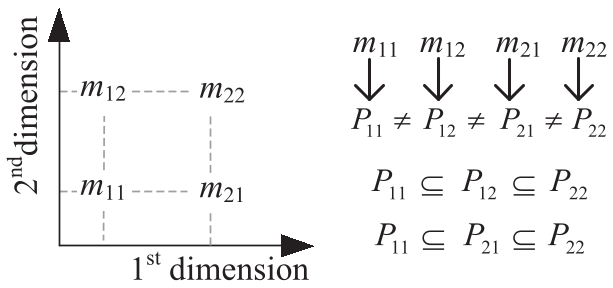 Figure: The SCP-ABE Access Tree allows policies to be defined by dynamic attributes like social relationship and distance.
Experiments: Real-World Performance
The authors didn't just write theory; they tested SSPA-LBS on the Gowalla dataset (6.4 million check-ins) and implemented it on Android (Google Nexus 4).
Key Findings:
- Computation: Total mobile overhead is ~1s. Encryption takes ~60ms per attribute—well within the threshold for a smooth user experience.
- Service Quality: As expected, larger camouflage ranges increase service quality loss (false alerts), but the inclusion of Place Type provides a much more granular control over this trade-off than distance alone.
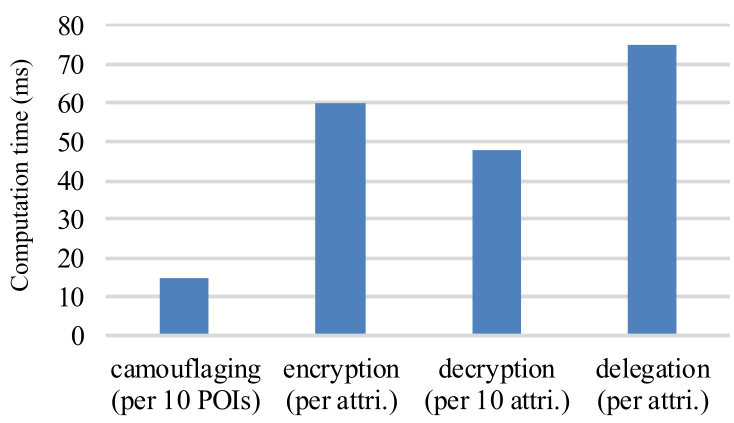 Figure: Average computation time for camouflage, encryption, and decryption across different attribute counts.
Critical Insight: Why This Matters
The most profound contribution here is the recalibration of Geo-indistinguishability. The authors proved that previous "truncated" Laplacian mechanisms actually broke the formal privacy guarantees they claimed. By ensuring the "Observation Set" is determined after the camouflage point is observed, they fixed a significant mathematical vulnerability in the field.
Conclusion & Future Look
SSPA-LBS successfully bridges the gap between high-security encryption and the messy reality of social media. However, challenges remain:
- Battery Life: Frequent re-encryption during high-speed movement is still heavy for power-constrained devices.
- Key Revocation: In a world where friendships (attributes) change instantly, revoking old keys efficiently is the next frontier.
For LBS developers, the takeaway is clear: Context is king. Privacy isn't just a circle on a map; it's the relationship between the person looking and the place being visited.