
HWR Rule: Engineering Stability in the Evolving Chaos of Dynamic Social Networks
9851_Stability analysis in dynamic social networks.
This paper introduces the Highest Weighted Reward (HWR) rule, a decentralized mechanism for social norm emergence in dynamic networks where agents autonomously adjust connections based on utility. The method generalizes prior work by incorporating a time-discount factor, achieving guaranteed convergence to a stable clustering state with optimal payoffs in 2-action pure coordination games.
TL;DR
Social norms often emerge from the bottom up, yet most models assume static relationships. This paper introduces the Highest Weighted Reward (HWR) rule, allowing rational agents to prune unrewarding connections dynamically. By prioritizing recent interactions via a time-discount factor, the authors prove that even selfish agents will eventually cluster into a stable, Pareto-optimal social convention.
The Decay of Relevance: Why Static History Fails
In classical social simulation, authors often use static topologies (like Small-World or Scale-Free networks). However, real human behavior—from high school friendships to scientific citations—is fluid. Previous attempts to model this (like the HRN rule) suffered from "historical inertia": if an agent had 1,000 good interactions with a neighbor, they would ignore 10 recent bad ones.
The authors argue that for a social norm to be robust, agents must be agile. The core problem is balancing the stability of long-term relationships with the necessity of responding to "defectors" or strategy shifts in real-time.
Methodology: The Highest Weighted Reward (HWR)
The HWR rule introduces a temporal discount factor . The math behind the decision-making process is elegant in its simplicity:
- Weighted Total Reward (): . This ensures that past rewards lose influence exponentially.
- Average Reward (AR): When , .
- The Decision Rule: An agent keeps a neighbor only if:
By setting , the agent maintains a "memory window" where recent behavior dominates the utility calculation. This prevents the system from becoming "stuck" in suboptimal connections simply because they were beneficial in the distant past.

The Proof of Stability
The paper provides a rigorous theoretical contribution by proving that in 2-action Pure Coordination Games, the system is guaranteed to reach a Stable Clustering State.
The authors use a "Monkey and Shakespeare" logic: given infinite time and a non-zero probability of agents breaking bad links and forming good ones through a process called "whipping" (systematically isolating uncooperative agents), the system must converge. In this state:
- Every agent is a "Majority Coordinating Neighbor."
- All relationships yield the optimal payoff.
- The "Total Neighbor Lost" metric drops to zero.
Experimental Validation
The authors simulated 300 agents in a random network. The results were striking in their speed of convergence.
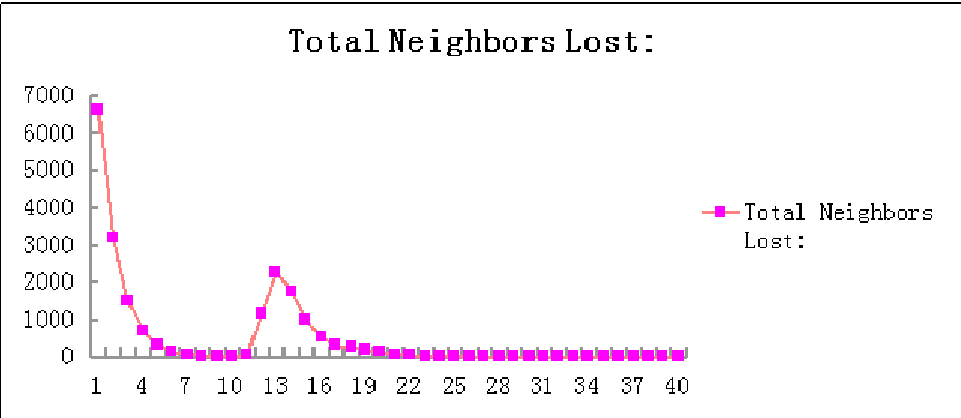 Figure 1: The "Total Neighbor Lost" (connection volatility) collapses within 20 iterations, signaling rapid stabilization.
As shown in the data, the "Number of Perfect Agents" (those whose neighbors all coordinate with them) starts at zero and climbs to the maximum population size as the network settles into distinct, harmonious clusters.
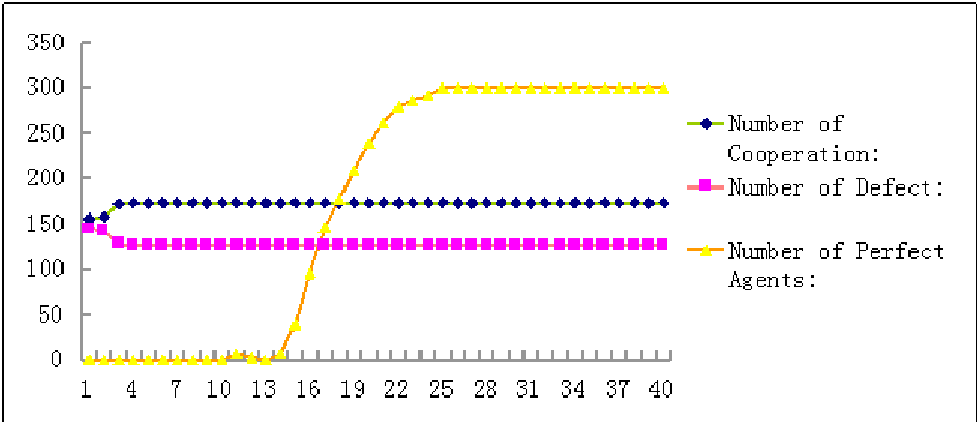 Figure 2: The rise of "Perfect Agents" mirrors the emergence of a global social norm.
Critical Analysis & Conclusion
The HWR rule provides a much-needed "temporal awareness" to multi-agent simulations. By allowing agents to focus on the now, the system actually achieves a more stable tomorrow.
Limitations: The current proof is limited to 2-action coordination games. In the real world, "social norms" are rarely binary. Furthermore, the model assumes a constant number of connections, whereas real social networks often expand or contract.
Future Outlook: This framework paves the way for simulating more complex environments where agents enter and leave the system (open systems). It suggests that for any decentralized system—be it a blockchain protocol or a social media platform—stability isn't just about the rules of engagement, but the speed at which agents are allowed to forget the past.