
Deciphering Social Echoes: Why Fractional Math Predicts Instagram’s Growth Better Than Statistics
Stability analysis of a fractional online social network model
The paper proposes a fractional-order SIR (Susceptible-Infected-Removed) model based on the Caputo fractional derivative to analyze user adoption and abandonment in Online Social Networks (OSNs). By introducing a threshold quantity , the authors establish conditions for user-free and user-prevailing equilibria, achieving state-of-the-art predictive accuracy on historical Instagram data.
TL;DR
Researchers have developed a new mathematical framework using fractional-order calculus to model how people join and quit social networks. Unlike traditional models that only look at the "now," this approach incorporates system memory, proving that the history of user interactions is vital for predicting the future. By testing against actual Instagram data, the model demonstrates remarkable accuracy in predicting user-prevailing stability.
Background: The Memory Problem in Social Dynamics
Most social network models treat users like gas particles—colliding and changing state (joining or leaving) without any regard for the past. In mathematical terms, these are Markovian (memoryless) processes.
However, humans have memory. Your decision to leave Instagram today isn't just based on your current friends; it's a culmination of years of interaction, "infectious" fatigue from others leaving, and personal "noninfectious" burnout. Traditional integer-order differential equations () fail to capture this "weight of the past."
The Methodology: Fractional-Order SIR
The authors bridge this gap by transitioning from standard calculus to fractional calculus.
1. Conceptual Framework
They treat OSN participation like a disease (SIR Model):
- Susceptible (S): Potential new users.
- Infected (I): Active OSN users.
- Removed (R): People who abandoned the platform.
2. The Power of "Non-Local" Derivatives
Instead of a simple derivative, they use the Caputo fractional derivative of order . The physical intuition is that the state of the system at time depends on a weighted integral of all previous states, with the "memory" fading according to a power-law kernel.
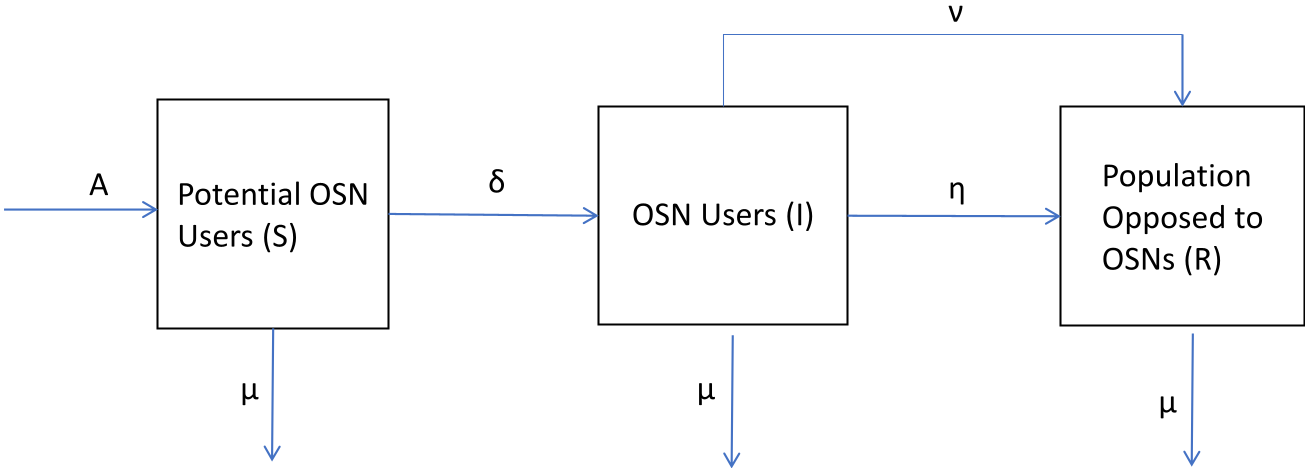 Fig 1: The flow between potential users (S), current users (I), and abandoned users (R), incorporating both infectious and natural abandonment.
3. Dimensional Consistency
A common pitfall in fractional modeling is "dimension mismatch" (where time units don't align). The authors solve this by scaling the rates () to the power of , ensuring the math remains physically meaningful.
The "Golden Ratio" of OSNs:
The most critical contribution is the derivation of the threshold quantity :
u^\alpha)}$$ * **If $R_0^\alpha < 1$**: The platform is heading for a "User-free Equilibrium." Everyone eventually loses interest. * **If $R_0^\alpha > 1$**: The platform reaches a "User-prevailing Equilibrium." It becomes a permanent fixture of the social landscape. ## Experimental Evidence: Fitting Instagram The authors didn't just stay in the realm of theory. They fitted their model to historical **Instagram monthly active user data** from 2013 to 2018. 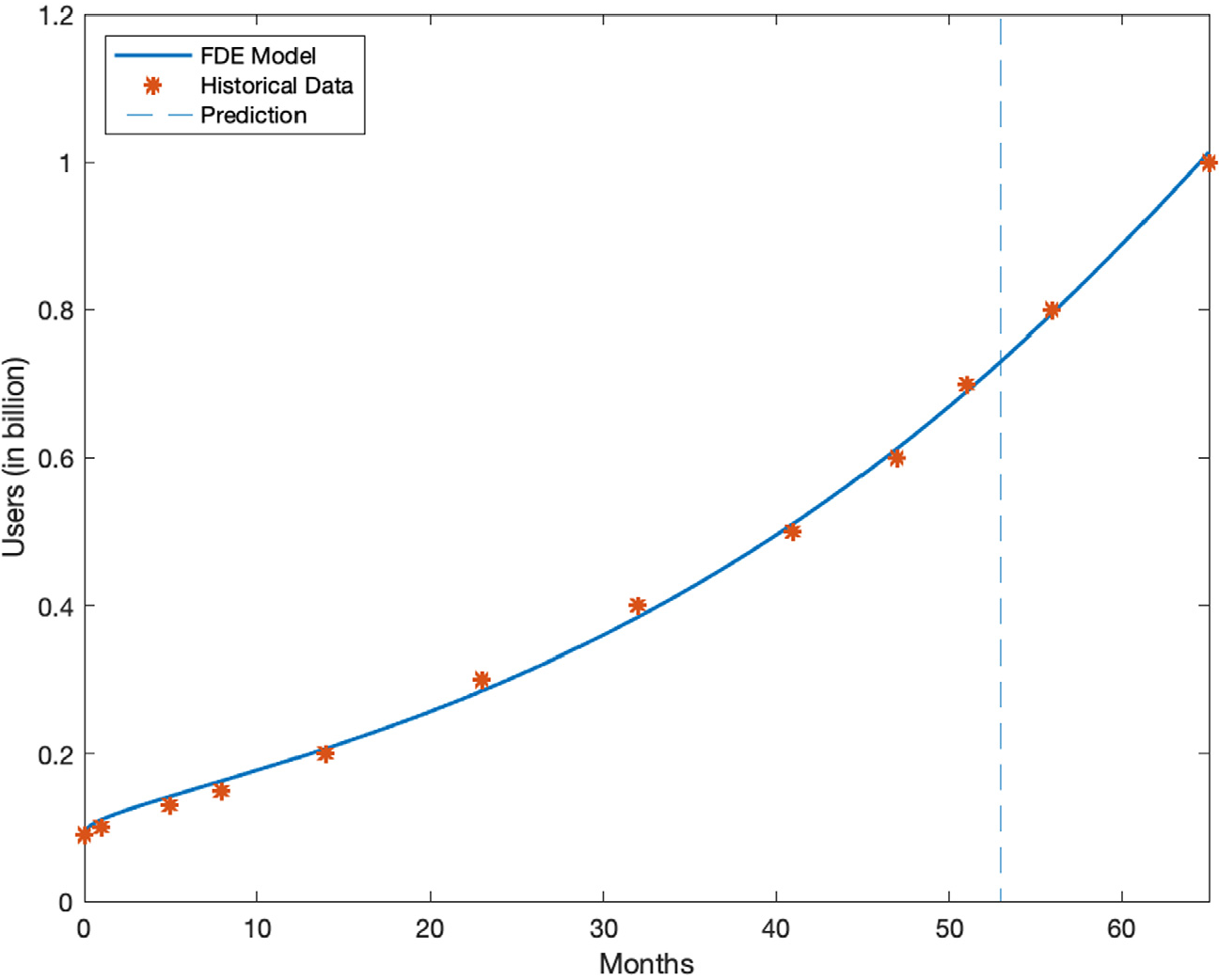 *Fig 2: Model prediction vs. actual historical data. The fractional model (solid line) tracks the exponential-to-logistic transition of Instagram’s growth with high precision.* ### Key Insights from Simulations: * **Stability**: The Lyapunov function analysis proves that once a network crosses the $R_0^\alpha > 1$ threshold, its survival is mathematically guaranteed (it is "globally asymptotically stable"). * **Role of $\alpha$**: Changing the fractional order $\alpha$ acts as a "memory dial." Adjusting this parameter allows the model to fit different platforms (e.g., a "fast-burn" viral app vs. a "slow-build" professional network). ## Deep Insights & Conclusion This paper shifts the paradigm of social network analysis from statistical data mining to **structural dynamical modeling**. **Why it matters for the industry:** 1. **Marketing Strategy**: By calculating $R_0^\alpha$, companies can determine exactly how much they need to increase the transmission rate ($\beta$) via ads to prevent platform collapse. 2. **Churn Prediction**: It distinguishes between infectious abandonment (users leaving because their friends left) and noninfectious abandonment (natural loss of interest), allowing for targeted retention campaigns. **Limitations**: The model assumes a "unit of population" and doesn't account for network topology (who is connected to whom). Future work merging fractional calculus with **Graph Neural Networks (GNNs)** could represent the ultimate frontier in social prediction.