
Stability Analysis of p-Persistent CSMA: Beyond the Independence Assumption
17579_Stability Analysis of $p$-Persistent Slotted CSMA Systems With Finite Population.
This paper provides a rigorous mathematical characterization of the stability region for p-persistent Slotted CSMA systems with finite populations and infinite buffer sizes. Utilizing the "stochastic dominant system" approach, the authors derive exact stability boundaries for asymmetric two-user systems and extend these findings to symmetric N-user configurations, accounting for radio channel errors and IEEE 802.11 MAC parameters.
TL;DR
This research provides a rigorous analytical framework to determine the Stability Region of p-persistent Slotted CSMA systems. Unlike prior works that assume unit-sized buffers or independent user processes, this paper uses Stochastic Dominant Systems to map the exact arrival rate combinations that keep queues from growing infinitely. It proves that CSMA stability can approach TDMA efficiency as sensing delays decrease.
Context: Why the Stability Region Matters
In wireless networking, "stability" isn't just a buzzword; it's a critical boundary. A system is stable if the number of packets waiting in a queue doesn't blow up to infinity. For years, the industry relied on the "Bianchi Model" or the "Independence Assumption," assuming that one user's backoff process doesn't care about another's queue state. While useful, this is physically inaccurate.
The authors tackle the "asymmetric user" problem: What happens when User A has a high arrival rate and User B has a low one? How do their retransmission probabilities () interact with channel sensing to determine if the whole network crashes?
Methodology: The Logic of Dominant Systems
The core challenge in CSMA is coupling. If User A’s queue is empty, they don't transmit, which changes the success probability for User B. This interdependency makes the Markov chain extremely complex.
To solve this, the authors introduce Stochastic Dominant Systems ():
- Hypothetical Setup: A system where users transmit "dummy packets" even if their queues are empty.
- Decoupling: Because a user is always transmitting (either real or dummy packets), the interference seen by other users becomes a constant, not a variable dependent on queue states.
- Boundary Mapping: If the dominant system (which is "harder" to stay stable in) is stable, then the original system is guaranteed to be stable.
 Equation 1: The evolution of the queue length process .
Visualizing Stability: CSMA vs. ALOHA vs. TDMA
One of the paper's most profound insights is the visualization of the stability envelope.
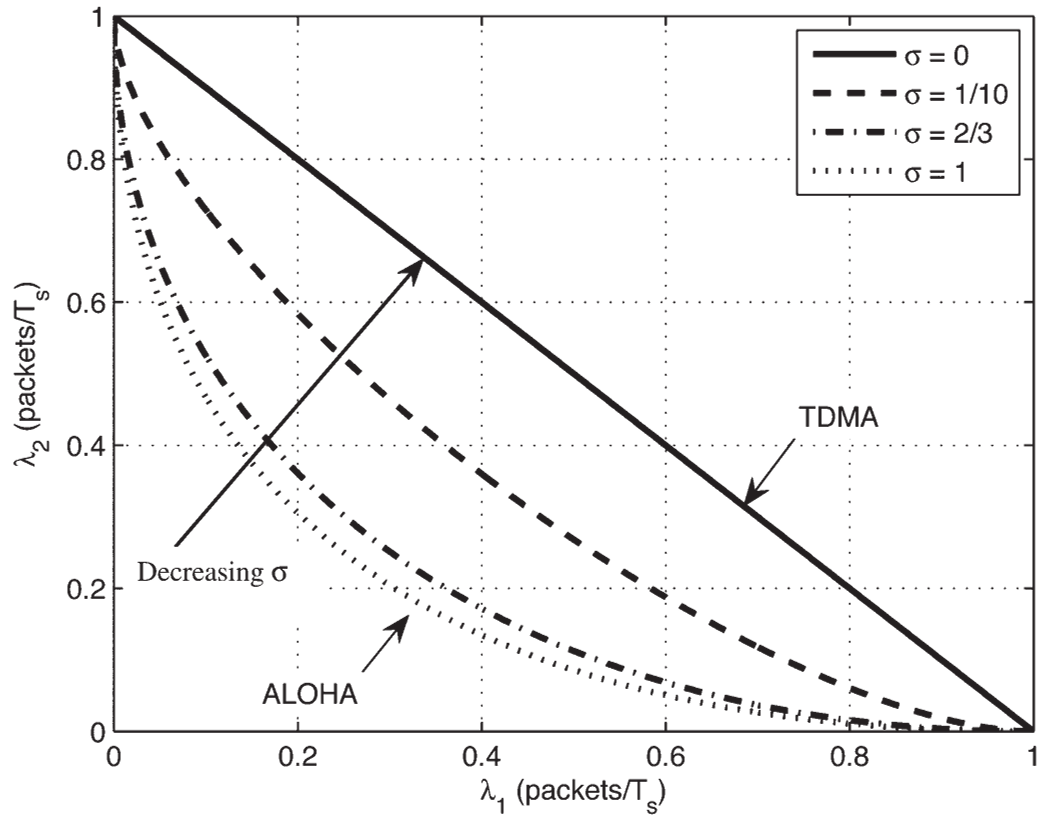
- Non-Convexity: The authors show that for certain sensing slot sizes (), the stability region can be non-convex, meaning the total throughput is maximized when one user is idle.
- The TDMA Limit: As the sensing slot () and collision time () shrink, the CSMA stability region expands from a "shrunken square" (like Slotted ALOHA) to a diagonal line (like TDMA/Time-Sharing).
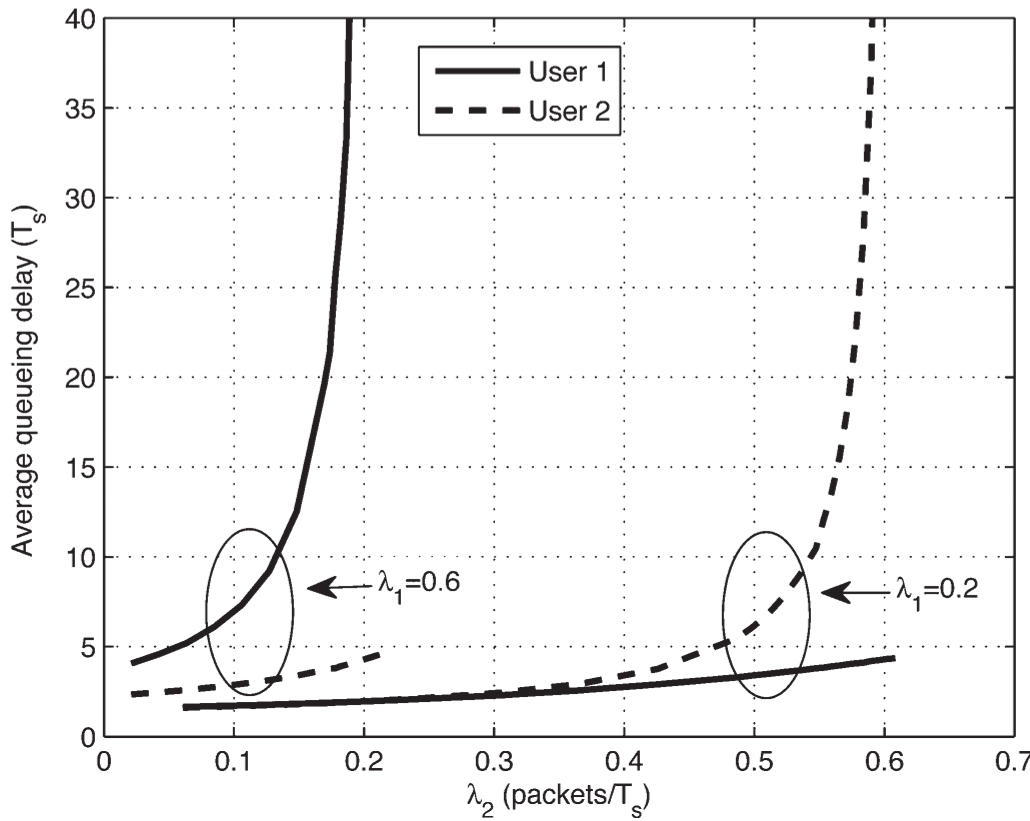 Figure: The impact of arrival rates on queueing delay. As arrival rates approach the calculated boundary, delay spikes to infinity, validating the theoretical stability limit.
Real-World Mapping: IEEE 802.11 (Wi-Fi)
The paper isn't just theoretical; it maps these parameters specifically to IEEE 802.11a/g (24 Mbps).
- Basic vs. RTS/CTS: They show that RTS/CTS provides a significantly "sturdier" stability region because it minimizes the time wasted on collisions ().
- Channel Errors: Radio channel errors () don't just shift the region; they shrink it proportionally. A user with a "noisier" channel effectively reduces the stability window for everyone else.
 Results: Comparative stability regions for Basic Access (collisions are expensive) vs. RTS/CTS (collisions are short).
Critical Insight & Conclusion
The "Industry Takeaway" here is that p-persistent protocols can effectively emulate the Binary Exponential Backoff (BEB) algorithm used in Wi-Fi. By setting the retransmission probability (where is the window size), network designers can use these formulas to predict saturated throughput and prevent network collapse.
Limitations: The model assumes a finite population. In massive IoT scenarios with thousands of nodes, the "average retransmission interval" might become more volatile, requiring further extensions to the case studied in Section III-E.
Ultimately, this work provides the mathematical rigorousness needed to move beyond "best-effort" wireless and toward guaranteed "stable-queue" performance.