
SAIR Model: Controlling the Digital Fire of Online Rumors through Forced Silence
Stability analysis of a SAIR rumor spreading model with control strategies in online social networks
This paper introduces a novel SAIR (Susceptible-Indifferent-Propagating-Recovery) rumor spreading model designed for online social networks. By integrating a silence-forcing function and considering time delays, the authors establish conditions for stability and Hopf bifurcation, identifying strategies to effectively suppress rumor propagation through optimal control.
TL;DR
In the era of virtual identities, rumors spread with unprecedented speed. This paper proposes the SAIR model, which introduces a "forced silence" strategy to mathematically model how platform interventions can suppress gossip. By analyzing stability, bifurcation, and time delays, the authors prove that rumors can be contained if policies are aggressive and timely enough to hit specific mathematical thresholds.
Background: The Social Network as a Biological System
Rumor spreading has long been modeled similarly to infectious diseases. From the classic Daley-Kendall (DK) model to modern epidemiological adaptations, the goal is to predict how a piece of information "infects" a population. However, online social networks introduce a unique variable: the Platform Moderator. Unlike a virus, a rumor can be actively suppressed by "silencing" the spreaders (blocking accounts, reducing visibility, or forcing silence).
The Problem: Why Simple Suppression Fails
Conventional models often fail because they assume:
- Infinite Resources: That administrators can silence every spreader instantly.
- No Lag: That the response to a rumor is immediate.
The authors argue that in reality, there is a saturation recovery rate—platforms have a maximum capacity to monitor and silence users—and a time delay between the rumor's start and the intervention's effect.
Methodology: The SAIR Model & Forced Silence
The paper categorizes the network population into four states:
- S (Susceptible): Unaware of the rumor.
- A (Indifferent): Aware but chooses not to spread it.
- I (Propagating): Actively spreading the rumor.
- R (Recovery): No longer believing or spreading.
The Secret Sauce: The Silence-Function
The core innovation is the function : Where is the maximum silencing capacity and represents efficiency. This "saturated" approach acknowledges that once the number of spreaders becomes too large, the platform's ability to silence them reaches a ceiling.
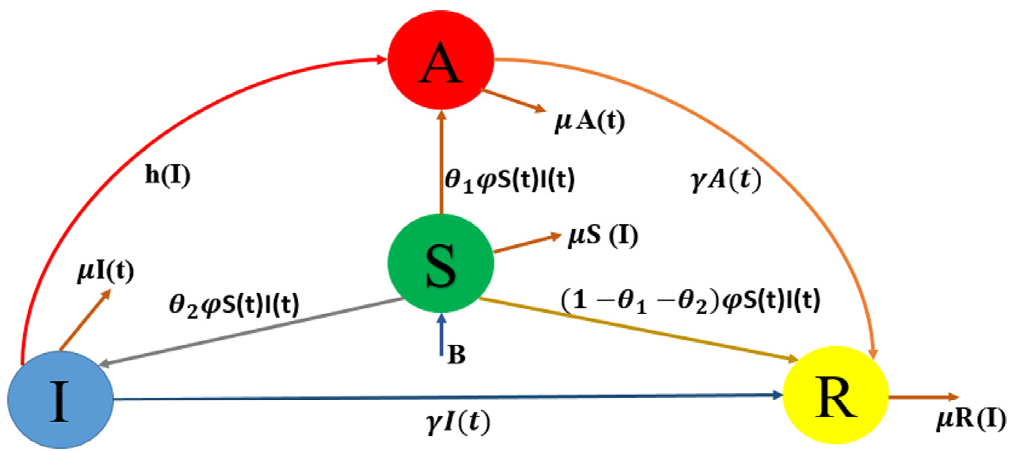 Fig 1: The dynamic transitions between the Susceptible, Indifferent, Propagating, and Recovery groups.
Critical Insight: Stability and Bifurcation
The paper delves deep into the Basic Reproduction Number ().
- If , the rumor should die out.
- However, the authors identify backward bifurcation. In certain conditions (especially with high ), a rumor can persist even if is pushed slightly below 1. This means simply reducing the spread rate isn't enough; you must push the system past a "turning point" to ensure complete eradication.
The Impact of Time Delay
In the real world, platforms don't react instantly. The authors introduce a delay .
- Hopf Bifurcation: As the delay increases beyond a critical value (), the steady state of the system breaks down. Instead of the rumor level stabilizing, it begins to oscillate wildly. This suggests that "slow" administrative response leads to unpredictable waves of rumor recurrence.
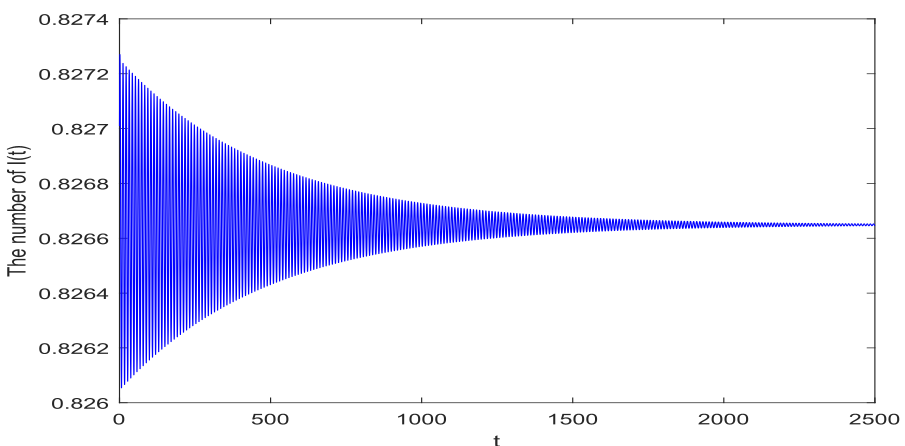 Fig 2: Comparison of Propagating individuals () with different time delays. Notice how stability is lost as the delay increases.
Experiments & Comparison
The authors compared their SAIR model with previous work (like Hu et al., 2018). By introducing the forced silence strategy, the SAIR model achieves a significantly lower stable level of rumor spreaders. While the rumor still exists, the "peak" and the "steady state" of infection are successfully suppressed into a manageable range.
Deep Insights & Takeaways
- Aggression Matters: The parameter (silencing capacity) must be high. If is too low, the system enters a "rumor-prevailing" equilibrium that is hard to break.
- Speed is Vital: Time delay is the enemy of stability. A delayed response causes the system to fluctuate, making it harder for platforms to predict the rumor's impact.
- Optimal Control: The paper provides a mathematical framework for administrators to minimize the "cost" of intervention while maximizing the suppression of the rumor.
Limitations & Future Work
The current model assumes a homogeneous network (everyone is equally connected). Future research needs to apply these silence-forcing functions to heterogeneous/scale-free networks (like Twitter or Weibo), where "super-spreaders" or influencers exist, potentially requiring different values for different nodes.
Conclusion
This paper elevates rumor modeling from simple observation to active control. By treating social network management as a mathematical stabilization problem, it provides a blueprint for how digital platforms can use forced silence to maintain social stability in the face of viral misinformation.