
Geometric Emotions: Applying Field Theory to Cross-Cultural Social Media Mining
Stability of a Type of Cross-Cultural Emotion Modeling in Social Media
The paper introduces a novel field-theoretic approach to model the "emotional context" of social media discourse, drawing an analogy to physical field equations like electromagnetism. By applying unsupervised learning to extract an 8-dimensional Hilbert space from raw forum data, the authors aim to quantify and visualize cross-cultural emotional stability.
TL;DR
Researchers have developed a mathematical "field-theoretic" model to map the emotional context of social media discussions. By treating online posts like physical particles that generate a force field, the study maps subjective "moods" into a measurable 8-dimensional space. While different cultures (English vs. Cantonese) perceive emotional intensity differently on average, the model identified specific "clique structures" where emotional agreement transcends language barriers.
Background: The Physics of Feel
In the physical world, we understand gravity and electromagnetism through Field Theory—the idea that objects influence each other through a medium even without direct contact. The authors of this paper argue that social media operates similarly. Every post is a "source" that contributes to an "emotional context," which then influences subsequent participants.
The primary challenge they address is the lack of "geometry" in text. Unlike height or weight, "anger" or "joy" doesn't come with a built-in ruler. By applying field equations, the researchers sought to "geometrize" this abstract space.
Methodology: From Text to Hilbert Space
The core innovation lies in the Field Equations used to transform raw, coordinate-free text into a structured N-dimensional Euclidean space (specifically, an 8-dimensional Hilbert space).
The Process:
- Feature Extraction: Using standard methods like Tf-idf to process thousands of threads and posts.
- Field Equation Solving: Solving for the "potential" of the emotional field, where the posts themselves provide the boundary conditions.
- Spectral Decomposition: This creates a natural coordinate system without requiring pre-defined labels or manual coding.
 Equation showing the minimization of distance between derived vectors and original metrics to find a stable coordinate system.
The Cross-Cultural Experiment
To test the "stability" of this model, the researchers compared how two different groups—native English speakers and Cantonese speakers (with English as a second language)—rated the emotional intensity of the same sports blog posts.
The Conflict in Perception
Statistically, the two groups were worlds apart. ANOVA tests confirmed that their raw scores (0–10) could not be considered part of the same population. This highlights a classic problem in sentiment analysis: a "7" in one culture might be a "4" in another.
The Structural Agreement
However, when the data was projected into the 8D model, a surprising "artifact" appeared. The two groups generally only agreed that a post was "highly emotional" when those posts clustered within specific cliques in the mathematical space.
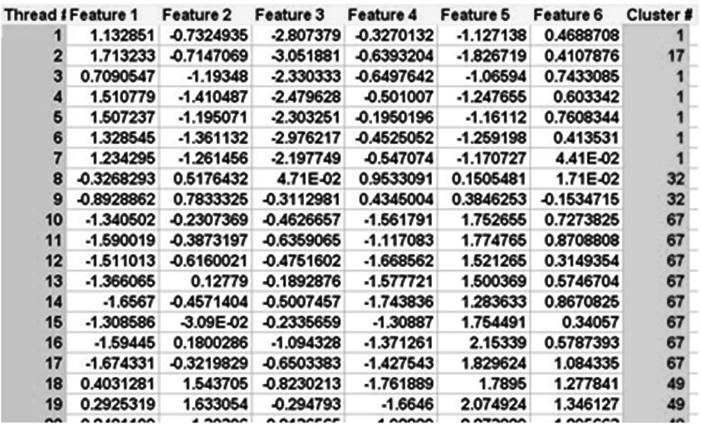 Representation of feature vectors across different threads, used to identify these emotional cliques.
Critical Insights & Future Outlook
The value of this work isn't just in identifying "angry" posts, but in quantifying the distance between emotions. By measuring the "emotional separation" between individuals or groups, we can predict which users are likely to escalate a conversation or where "semantic tagging" might fail.
Limitations
- Sample Size: With only 12 raters total, the statistical power was low.
- Deterministic Modeling: The model treats human behavior as somewhat consistent stimulus-response, which may overlook the nuance of individual psychology.
Conclusion
This research paves the way for "Emotion Terrain-Forming"—the ability to map and potentially influence the emotional landscape of online communities. By moving away from subjective labels and toward rigorous field-theoretic models, we might finally find a universal language for human emotion in the digital age.
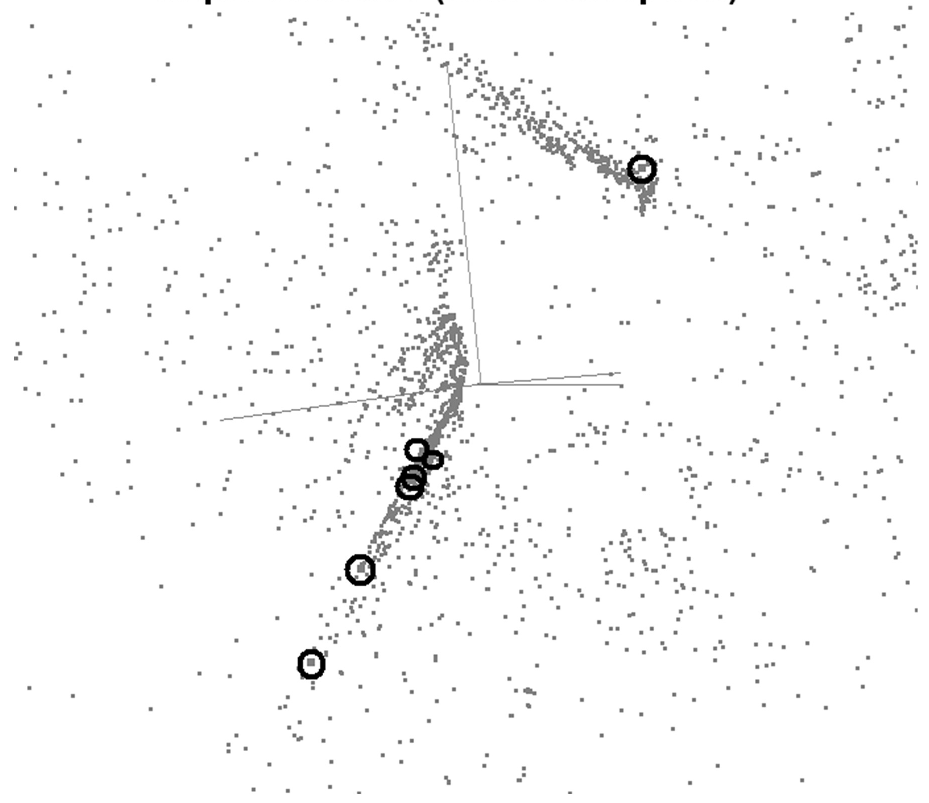 Visualization of the emotional 'terrain' where cross-cultural agreement occurs.