
Stability, Efficiency, and Contentedness: The Game Theory of Social Storage
Stability, efficiency, and contentedness of social storage networks
The paper introduces a game-theoretic model for endogenous Social Storage Networks (SSNs), where agents autonomously form data backup partnerships. It proposes the concept of Bilateral Stability and identifies a unique Stability Point that determines the ideal neighborhood size for efficient and contented networks.
Executive Summary
Social Storage, or Friend-to-Friend (F2F) backup, offers a compelling alternative to centralized cloud providers by leveraging personal social ties for data redundancy. However, most existing models treat these networks as "given" (exogenous). This paper shifts the paradigm by treating social storage as an endogenous network formation game. By introducing Bilateral Stability, the authors provide a mathematical framework to ensure that self-interested agents form stable, efficient, and "contented" networks where data isn't just stored, but stays stored.
Problem & Motivation: The Risk of Unilateral Action
The central tension in P2P backup is reliability versus cost. While more neighbors increase the probability of data recovery (), they also increase maintenance costs ().
Previous literature relied on Pairwise Stability, which dictates that link addition requires mutual consent, but link deletion can be unilateral. In a storage context, this is a fatal flaw: if your backup partner unilaterally deletes your data to save costs, you lose your "insurance" without warning. This paper argues that backup partnerships must be viewed as Bilateral Contracts—agreements that require both parties to agree before a relationship is severed.
Methodology: The Core Mechanics
The authors define agent utility through two primary lenses:
- Multi-Objective (MO) Framework: A weighted balance between the expected value of backup data and the linear cost of link maintenance.
- Single-Objective (SO) Framework: A risk-averse model where agents maximize data reliability strictly within fixed storage and budget constraints.
The Stability Point ()
A brilliant contribution of this work is the derivation of the Stability Point. This is the specific neighborhood size where no agent has an incentive to deviate.
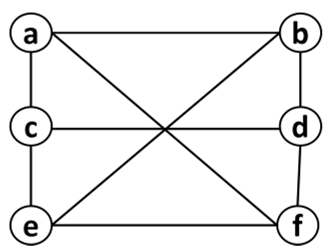 Fig 1: Examples of stable networks under MO-Framework where .
The stability point is unique and, crucially, independent of the number of agents (N) in most non-trivial cases. This means the local behavior of agents scales predictably regardless of the network's global size.
Experiments & Results: Stability vs. Contentment
The authors distinguish between three states of a network:
- Stable: No pair wants to change their links (Endogenous equilibrium).
- Efficient: The sum of all agent utilities is maximized (Social Welfare).
- Contented: Every single agent has reached their maximum possible utility.
Key Findings:
- Symmetry Matters: In symmetric networks (where agents have similar data values and costs), a regular network where everyone has neighbors is both efficient and contented.
- The Odd-Number Paradox: If (total agents) and are both odd, a perfectly contented network is mathematically impossible without external intervention, as the total number of links must be an integer.
- The Administrator's Role: The paper suggests that an independent regulator can bridge the gap between stability and efficiency by introducing "dummy agents" or small perturbations.
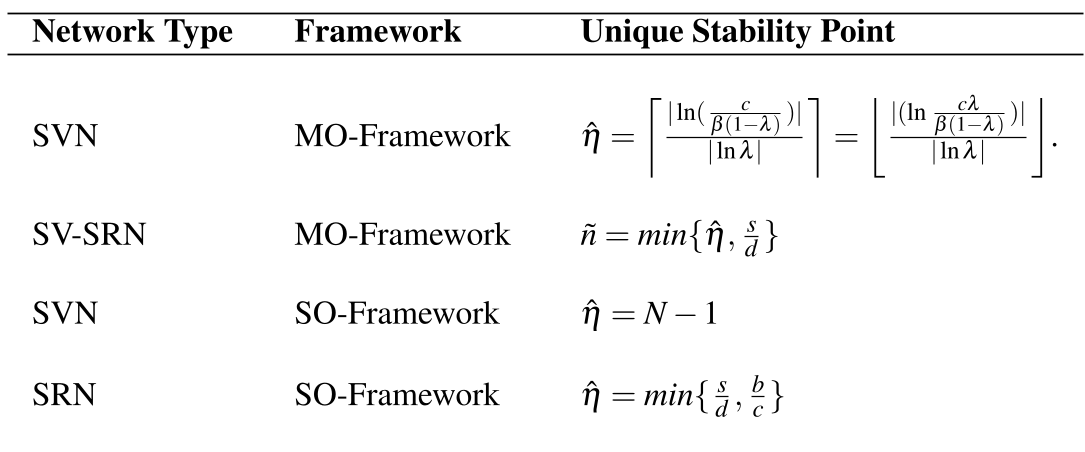 Table: Summary of unique stability points () across different frameworks.
Critical Analysis & Conclusion
This work provides a rigorous foundation for building decentralized systems that are "stable by design." By moving from exogenous graphs to strategic games, the authors align the "Social" in Social Storage with "Rational" self-interest.
Limitations: The current model assumes a degree of symmetry and trust that may not exist in highly heterogeneous or malicious environments. The authors acknowledge this, suggesting Social Range Matrices (incorporating friends, enemies, and neutrals) as a vital future extension.
Future Outlook: As privacy concerns drive users away from centralized "Big Tech" storage, the principles of Bilateral Stability will be essential for the next generation of DSNs (Decentralized Storage Networks) and Edge Computing SLAs.