
Hybrid Intelligence in Healthcare: Enhancing Stability Selection with Genetic Algorithms
Stability selection using a genetic algorithm and logistic linear regression on healthcare records
The paper introduces GASS, a novel Stability Selection (SS) framework that integrates a Genetic Algorithm (GA) for feature importance measurement in large-scale healthcare databases. By using GA-based feature selection paired with unregularized logistic linear regression, the method achieves superior diagnostic prediction performance compared to traditional top-k stability selection methods.
TL;DR
Predicting patient outcomes accurately requires filtering through the noise of massive healthcare databases. This paper presents GASS, a framework that marries the global search capabilities of Genetic Algorithms (GA) with the robustness of Stability Selection (SS). By using GAs to evolve optimal feature subsets for unregularized logistic regression, the researchers achieved significant gains in predictive AUC on massive inpatient datasets.
The Overfitting Trap in Medical Data
In medical informatics, we often face a "p-greater-than-n" problem or simply a "noise problem." Unregularized models like standard Logistic Regression are notorious for overfitting—memorizing noise in the training data rather than learning clinical signals.
While modern techniques like Lasso or Random Forests have built-in feature selection, many legacy or specific statistical models do not. Traditional Stability Selection (SS) helps by running a selection algorithm many times on different data slices, but it is only as good as its "internal" selector. The authors argue that a Genetic Algorithm acts as a more powerful internal engine for searching the massive combinatorial space of feature subsets.
Methodology: The GASS Framework
The core innovation lies in the GASS algorithm, which treats feature selection as an evolutionary survival-of-the-fittest.
The Evolutionary Loop
- Subsampling: The data is partitioned into multiple subsamples of records and features.
- GA Initialization: A population of binary strings (where 1 means "feature selected") is created.
- Fitness Evaluation: For each individual, an unregularized logistic regression model is trained. The AUC (Area Under the Curve) obtained via cross-validation serves as the fitness score.
- Evolution: Through binary crossover and mutation, the GA explores new feature combinations.
- Selection Stability: Instead of taking just one "best" result, the GASS scores are averaged across multiple subsampled runs to ensure only the most stable features survive.
 Figure 1: Conceptual overview of GASS and its integration into the stability selection pipeline.
Experimental Results
The authors tested GASS on the Nationwide Inpatient Sample (NIS) from the Healthcare Cost and Utilization Project (HCUP).
AUC Performance
The hybrid approach (GASS + top-4 SS) emerged as the clear winner. By combining the evolutionary search of GASS with the ranking logic of top-k SS, the model achieved a stable and high AUC.
| Method | Average AUC | Std. Dev. |
|---|---|---|
| GASS + top-4 SS | 0.8929 | 0.0026 |
| GASS (Standalone) | 0.8920 | 0.0027 |
| All Features (Baseline) | 0.8685 | 0.0036 |
| top-1 SS | 0.8317 | 0.0045 |
Clinical Feature Ranking
Beyond pure performance, the GASS + top-4 SS method identified highly relevant clinical markers. Features like Age, Hyperlipidemia, and Diabetes received perfect stability scores (1.00), while it was more selective/sensitive regarding specific stages of Chronic Kidney Disease compared to standard methods.
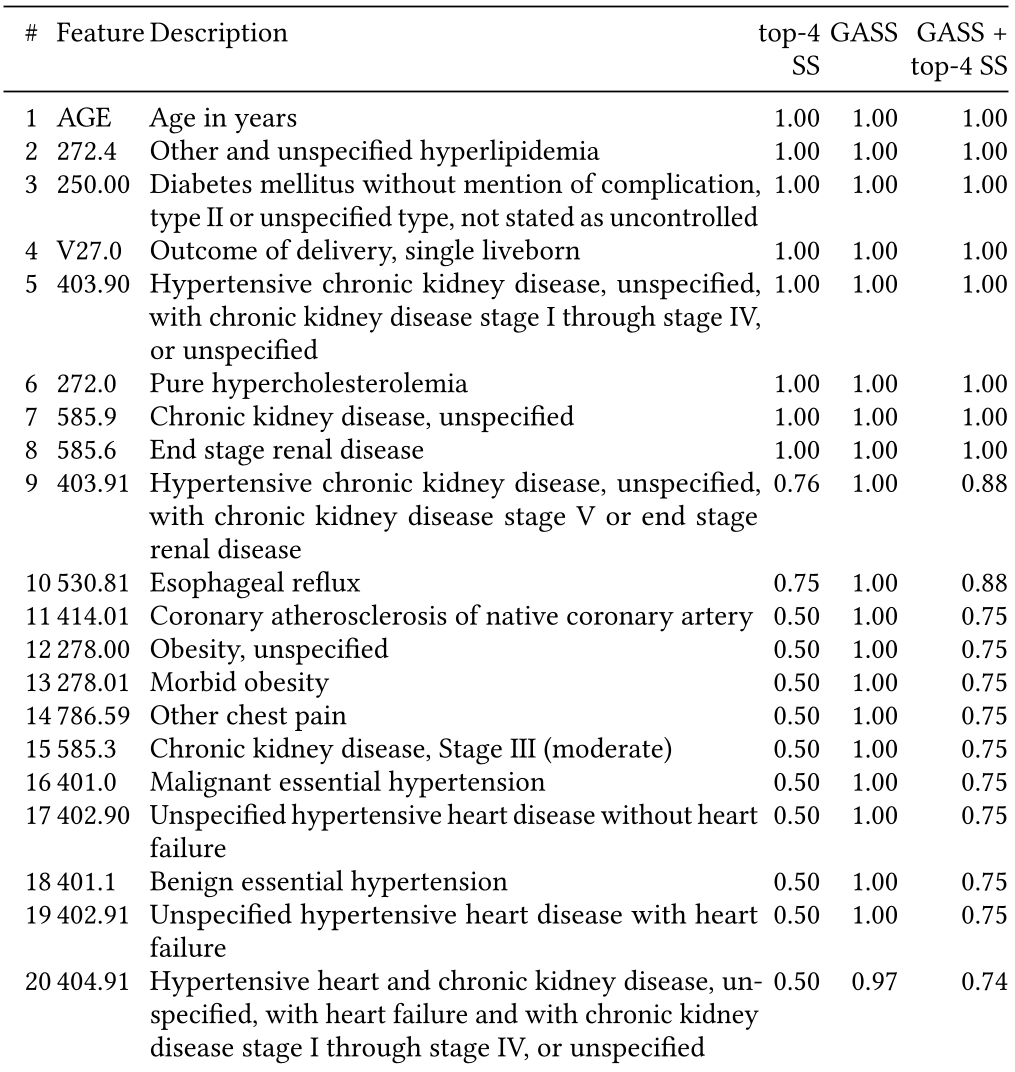 Figure 2: Comparative ranking of top features across different selection methods.
Critical Insight & Conclusion
The true value of this work is proving that evolutionary computation isn't just a niche optimization tool—it can be the "engine" that makes statistical frameworks like Stability Selection more robust.
Takeaway: If you are dealing with high-dimensional data where interpretability is key (like medical diagnostics), don't just rely on a single selection pass. Using a GA to find the most "stable" features across different data views can prevent overfitting and identify the true biological or clinical drivers of your outcome.
Limitations: The primary drawback remains computational cost; running a GA within an iterative SS loop is significantly more resource-intensive than a simple Lasso path. However, in the context of healthcare research where model accuracy can impact lives, the trade-off for higher AUC is often justified.