
Stabilized Sparse Ordinal Regression: Outperforming Clinicians in Suicide Risk Stratification
Stabilized sparse ordinal regression for medical risk stratification
The paper introduces a stabilized sparse ordinal regression framework for medical risk stratification using Electronic Medical Records (EMR). By treating EMR data as a "temporal image" and employing relational regularization via feature networks (Laplacian and Random Walk priors), the authors improve model stability and predictive accuracy. The method achieves a 200% improvement in high-risk suicide detection compared to clinical assessments.
TL;DR
Researchers from Deakin University have developed an automated framework that transforms messy EMR data into "temporal images" to predict medical risk. By using a novel stabilization technique that links related medical codes (like different types of depression), the model remains consistent even when data varies. It successfully identified twice as many suicide-related cases as human clinicians, offering a transparent and reproducible tool for mental health screening.
The Stability Dilemma in Medical AI
In clinical settings, "why" a model makes a decision is just as important as "what" it predicts. Sparse models (like Lasso) are favored because they highlight a few key risk factors. However, they suffer from a "winner-takes-all" instability: if two risk factors are highly correlated, Lasso might pick one today and another tomorrow based on tiny shifts in the data. For a doctor, this inconsistency—termed model instability—is a dealbreaker for clinical adoption.
Methodology: EMR as a Temporal Image
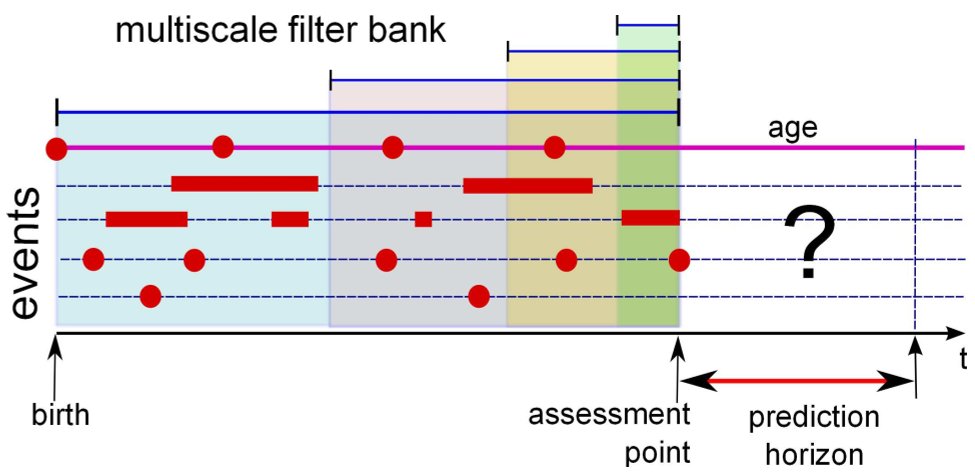
The framework approaches EMR data not as a simple table, but as a sparse 2D temporal image.
- One Dimension: Time (historical medical events).
- Second Dimension: Event Type (ICD-10 diagnosis codes, medications, etc.).
Multi-scale Feature Extraction
The authors use a one-sided filter bank to process these images. By applying kernels with different "widths" (time windows), the model can distinguish between acute conditions (e.g., a recent suicidal ideation) and chronic conditions (e.g., long-term type I diabetes).
Stabilization via Feature Networks
To solve the instability problem, the team introduced Relational Regularization. They built a network where nodes are medical features and edges represent relationships (e.g., "Sibling" codes in the ICD-10 tree).
- Laplacian Smoothing: Encourages related features to have similar weights.
- Random Walk: Distributes smoothness equally across the network.
This ensures that if "Severe Depression" is a predictor, its closely related codes are treated consistently, preventing the model from jumping erratically between similar features during training.
Experiments: Machine vs. Human
The model was tested on a massive dataset of mental health patients. The goal was to stratify risk into three ordinal levels: Low (C1), Moderate (C2), and High (C3).
Performance Breakthrough
The machine learning models decimated the clinical baseline. For the highest-risk category (C3), the machine identified 30 suicide cases, whereas clinicians only flagged 14.

Stability Verification
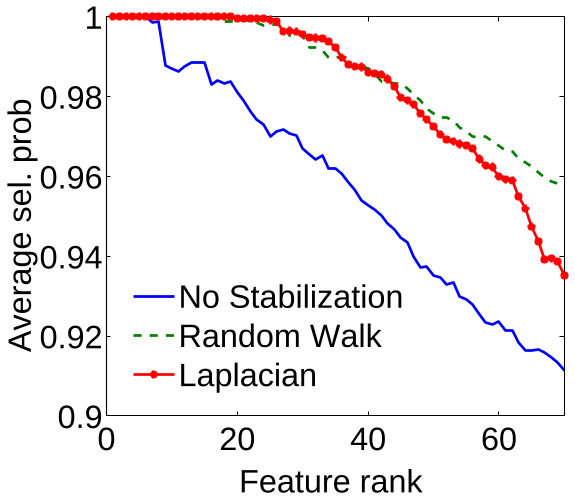
Using two new metrics—Averaged Selection Probability (ASP) and Signal-to-Noise Ratio (SNR)—the authors proved that their network-stabilized models were significantly more robust than standard Lasso.
Critical Insight: Why Does This Work?
The genius of this work lies in the Inductive Bias. By forcing the math to respect medical hierarchies (ICD-10), the researchers injected domain knowledge directly into the regularization process.
The paper also introduces the Stagewise Classifier, which models risk not as a single number, but as a progression. This mirrors the clinical reality where a patient "progresses" through stages of severity, rather than jumping instantly to high risk.
Conclusion & Future Outlook
This work demonstrates that for AI to be useful in medicine, it must be more than accurate—it must be stable and grounded in existing medical knowledge. The discovered risk factors (e.g., frequent home moving as a socio-economic stressor, combined with history of drug abuse) align with decades of psychiatric research but were identified automatically from "noisy" hospital data.
Limitations: The study was conducted at a single hospital. Testing on multi-institutional data is the next frontier to ensure these "stable" features hold across different demographics.