
Stability Matters: Enhancing EEG Emotion Recognition via ICC-based Feature Selection
513_Stable Feature Selection for EEG-based Emotion Rec
The paper introduces a novel framework for EEG-based emotion recognition that prioritizes feature stability using the Intra-class Correlation Coefficient (ICC). By extracting a diverse set of features (Fractal Dimension, Statistics, HOC, etc.) and selecting those with high cross-session consistency, the authors aim to improve the robustness of BCI systems in real-world scenarios.
TL;DR
Long-term EEG-based emotion recognition is notoriously difficult because brain waves change over time. This paper argues that we should stop chasing just "accuracy" and start looking for stability. By using the Intra-class Correlation Coefficient (ICC), the authors identify EEG features that remain consistent across sessions, leading to significantly better performance in scenarios where the model isn't re-calibrated daily.
The Problem: The "Session Effect" in BCI
Most Brain-Computer Interface (BCI) studies report high accuracy by training and testing on data collected in a single sitting. However, when you try to use that same model the next day, performance usually collapses. This is due to the non-stationarity of EEG—physiological changes, electrode impedance shifts, and mental state fluctuations make yesterday's "optimal" features today's noise.
The authors identify a critical gap: existing feature selection methods like PCA or mRMR focus on discriminative power but ignore reproducibility.
Methodology: Quantifying Reliability
The core innovation is the application of Intra-class Correlation Coefficient (ICC) to EEG features. ICC is a statistical measure used to determine how much of the variance in a dataset is "real" (between different emotional states) versus "error" (within the same state across different trials).
1. Feature Extraction Toolbox
The study extracts a wide range of features to find the most stable ones:
- Fractal Dimension (FD): Captures signal complexity.
- Higher Order Crossings (HOC): Analyzes the oscillatory pattern of the signal after various filtering passes.
- Hjorth Parameters: Measures Activity, Mobility, and Complexity.
- Spectral Band Power (POW): Traditional band energies.
- Statistics (STAT): Mean, standard deviation, and first/second differences.
2. Measuring Stability via ICC
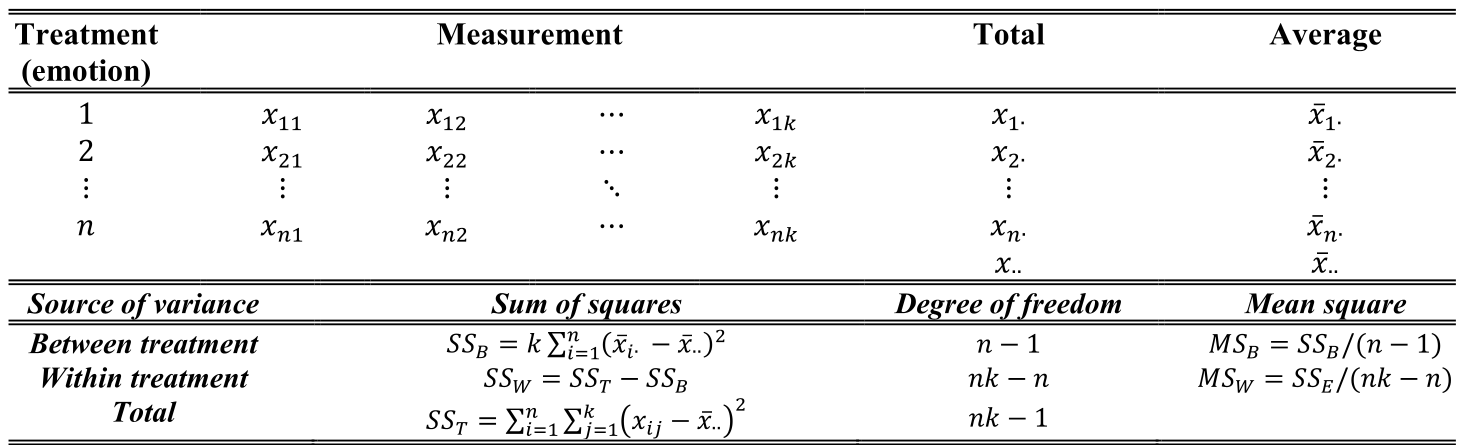
The stability is calculated using a variance analysis (ANOVA) approach: Where represents Mean Square Between treatments (emotions) and represents Mean Square Within treatments (sessions). A high ICC indicates a feature that is consistent for a specific emotion across different times.
Experiments and Results
The authors tested their approach in three simulation scenarios:
- With Re-calibration: Training and testing on the same day.
- Without Re-calibration: Training on Day 1, testing on subsequent days (The "Hard" but realistic task).
- Stable Feature Selection: Using ICC to pick the best features for the "Without Re-calibration" task.
Performance Breakthrough
The results showed that while high-dimensional features like HOC (Higher Order Crossings) perform well with re-calibration, they are extremely unstable. In contrast, the "Ours" method (Stable Feature Selection) consistently provided the best results in cross-session testing.

In the "Ours" row, we see that for Subject 4, the accuracy reached 43.66%, whereas almost all other standard feature sets hovered around or below 30% on the same test data.
Critical Insights: Which Features are Actually Stable?
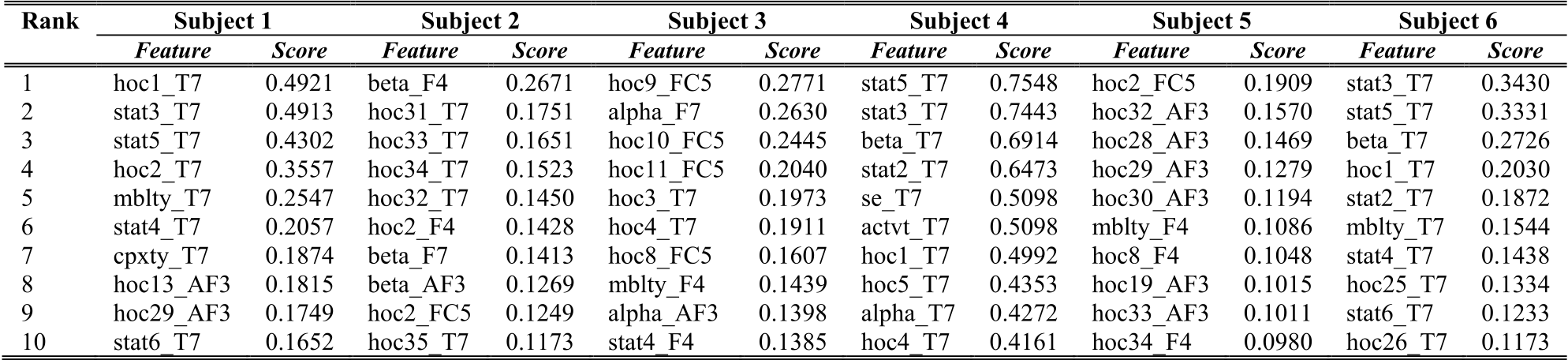
The paper provides a fascinating ranking of features by their ICC scores. Interestingly, Temporal features (from the T7 electrode) and specific HOC indices often ranked highest. For Subject 4, simple statistics (stat5_T7, stat3_T7) were remarkably stable, proving that complex frequency-domain features aren't always the best for long-term use.
Conclusion & Future Work
This research shifts the focus of BCI from "maximum accuracy" to "reliable accuracy." By identifying stable biomarkers through ICC, we can build emotion recognition systems that actually work in everyday life without requiring the user to spend 20 minutes calibrating the device every morning.
Limitations: The study was conducted on a limited number of subjects (6). Future work should validate these stable features across larger, more diverse populations to see if certain "universal" stable EEG features exist for emotion.