
Beyond Accuracy: Why LSTM is the Secret to Stable Environmental Forecasting
Stable Forecasting of Environmental Time Series via Long Short Term Memory Recurrent Neural Network
This paper investigates the application of Long Short Term Memory (LSTM) networks for environmental time-series forecasting, specifically targeting water quality, air pollution, and ozone alerts. By comparing LSTM against standard RNNs and MLPs, the authors demonstrate that LSTM's gated architecture provides superior predictive stability and accuracy in data-limited and noisy environments.
TL;DR
Predicting environmental shifts like Algal blooms or Ozone spikes is notoriously difficult due to "messy" data. This paper demonstrates that LSTM (Long Short Term Memory) networks aren't just more accurate than traditional models; they are significantly more stable. By balancing the "impact" of data across time, LSTMs remain reliable even when sensors fail or data goes missing.
The "Coarse Data" Problem in Environmental Science
In fields like computer vision, data is abundant. In environmental modeling, researchers deal with coarse data: irregular sampling, human error in collection, and sensor noise.
The authors identify a critical flaw in existing tools:
- MLP (Multilayer Perceptron): Ignores the sequential nature of time, treating all time-lagged inputs as independent variables, leading to high sensitivity to specific input errors.
- Vanilla RNN: Suffers from Gradient Vanishing. It "forgets" the past too quickly, effectively ignoring long-term dependencies and placing too much weight on the most recent (and potentially noisy) data.
The Core Insight: Impact Balancing
The mathematical brilliance of the LSTM lies in its Gated Structure. While most papers focus on how gates prevent gradient vanishing, this study highlights a secondary effect: Impact Balancing.
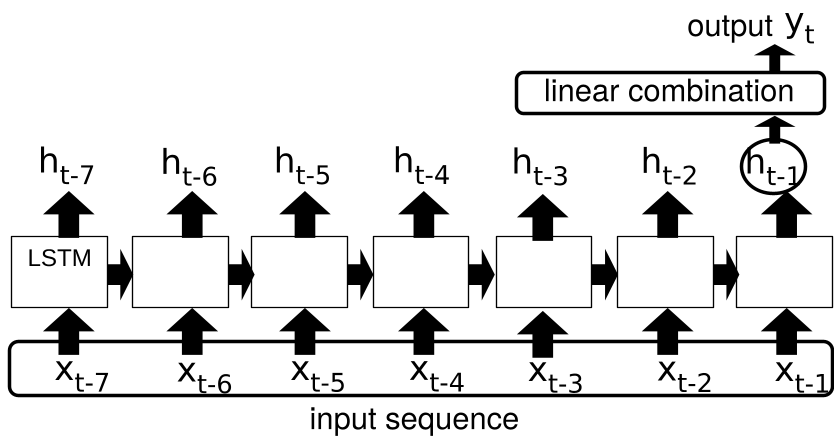
As shown in the architecture above, the cell state () allows information to flow across time steps with minimal modification. This creates a "balanced distribution of impact." If a sensor reports a "noise spike" at time , the LSTM can rely on the "remembered" context from and to smooth out the error. In contrast, an RNN would be forced to over-react to the recent noise.
Experimental Proof: Resilience to Chaos
The researchers tested three models (MLP, RNN, LSTM) across three critical domains: Water Quality (Chlorophyll-a), Air Pollution (CO levels), and Ozone Alarms.
1. Robustness to Noise and Missing Values
When the team intentionally injected Gaussian noise or deleted data points (simulating sensor failure), the results were stark.
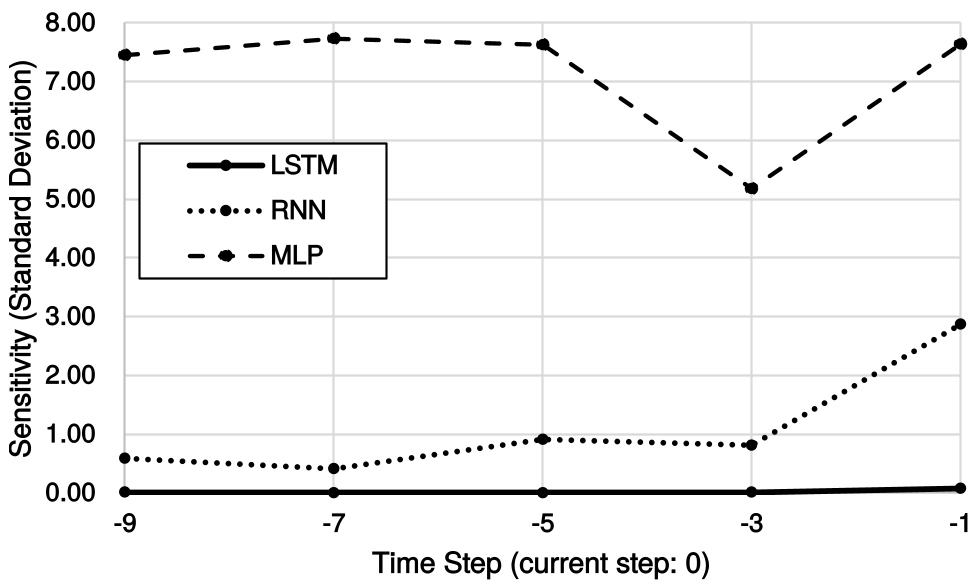
The Standard Deviation (SD) of the output is the key metric here. A high SD means the model's prediction fluctuates wildly when the input changes slightly. As seen in the sensitivity chart, LSTM maintains a near-flat line, indicating that it "filters" the noise, whereas MLP and RNN show massive sensitivity spikes.
2. Long-Term Forecasting
Environmental management often requires predicting weeks in advance. The study found that as the "time lag" (the gap between last observation and prediction) increased, the accuracy of RNNs plummeted due to their inability to leverage older, relevant data. LSTM maintained a stable error rate, proving its "Long-Term" memory is not just a name—it's a functional necessity for ecological survival.
Critical Analysis & Takeaways
The paper argues that in scientific modeling, Stability > Accuracy. A model that is 99% accurate on perfect data but fails during a sensor blackout is useless in the field.
Key Conclusions:
- LSTM as a Filter: The gating mechanism acts as an implicit denoising filter.
- Architectural Superiority: Even simple "Vanilla" LSTMs outperform complex MLPs because they respect the temporal physics of environmental systems.
- Limitations: While LSTM is robust, it still relies on "mean imputation" for missing values in this study. Future work could integrate Gated Recurrent Units (GRU) or Transformers to see if attention mechanisms provide even better selective forgetting.
For practitioners in environmental IoT, this research provides a clear directive: move away from static regression and towards memory-cell-based architectures to build systems that don't just predict the future, but survive the messiness of the present.