
The Power of the Many: Stability and Social Foraging in Chaotic Environments
Stable Social Foraging Swarms in a Noisy Environment
This paper investigates the stability and cohesion of "social foraging swarms"—groups of agents (biological or robotic) searching for resources in noisy environments. The authors propose a Lyapunov-based control framework to maintain swarm aggregation and collective gradient climbing despite significant sensing errors in position, velocity, and nutrient gradients.
In the natural world, biological swarms—from bacterial colonies to avian flocks—demonstrate a remarkable ability to navigate complex environments and locate resources. In the realm of engineering, we strive to replicate this collective intelligence in robot swarms. However, a critical barrier remains: Noise. Whether it is a sensor calibration error in a drone or the erratic chemical diffusion in a bacterial environment, uncertainty is the enemy of coordination.
In the seminal work "Stable Social Foraging Swarms in a Noisy Environment," Yanfei Liu and Kevin M. Passino provide a rigorous mathematical foundation for why swarms don't just survive noise—they leverage their numbers to overcome it.
TL;DR
The paper proves that multi-agent swarms can maintain cohesion and successfully follow resource gradients even when individual agents are blinded by sensing noise. By using Lyapunov stability analysis, the authors demonstrate that social foraging is inherently superior to individual searching, as the group effectively "averages out" the errors of its members.
The Problem: Why Noise Breaks Coordination
Most swarm models assume agents know exactly where their neighbors are and which way the "food" is. In reality:
- Position/Velocity Sensors have tolerances.
- Resource Gradients (like smell or light) are often turbulent and "patchy."
If an individual agent acts solely on its own noisy data, it will likely wander aimlessly. The challenge is designing a control law that forces the group to stick together (cohesion) while ensuring the noise doesn't lead the entire group off a cliff.
Methodology: The Math of Social Potential
The authors employ a point-mass dynamics model for agents. The core of their approach is the Attract-Repel Potential.
1. The Control Law
Each agent is driven by a control input consisting of:
- Attraction: Pulls agents toward the swarm center to ensure they don't drift away.
- Repulsion: An exponential function that prevents collisions (though not guaranteed in all cases, it maintains "comfortable" spacing).
- Velocity Damping: Prevents the system from oscillating wildly.
- Gradient Climbing: A term that pushes the agent toward higher nutrient concentrations.
2. Lyapunov Stability in the Dark
The authors define an error system that tracks an agent's deviation from the swarm's average position and velocity. Crucially, they assume the noise is bounded but potentially growing with distance.
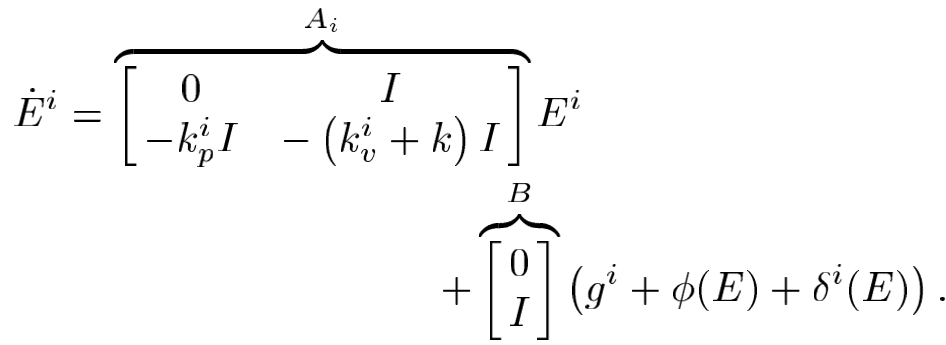
By constructing a composite Lyapunov function , the authors derive the conditions under which the swarm is Uniformly Ultimately Bounded (UUB). This means the swarm might not collapse to a single point, but it will stay within a predictable, tight "ball" of space.
Key Insight: The "Noise-Averaging" Effect
The most profound takeaway is found in the analysis of large swarms. When an individual agent searches for a resource in a noisy environment, its error is its own. However, in a swarm, the collective average velocity depends on the average of all sensing errors.
If the noise is zero-mean or randomly distributed, a swarm of 100 agents will follow the true resource gradient much more accurately than a single agent could. The group acts as a physical low-pass filter for environmental uncertainty.
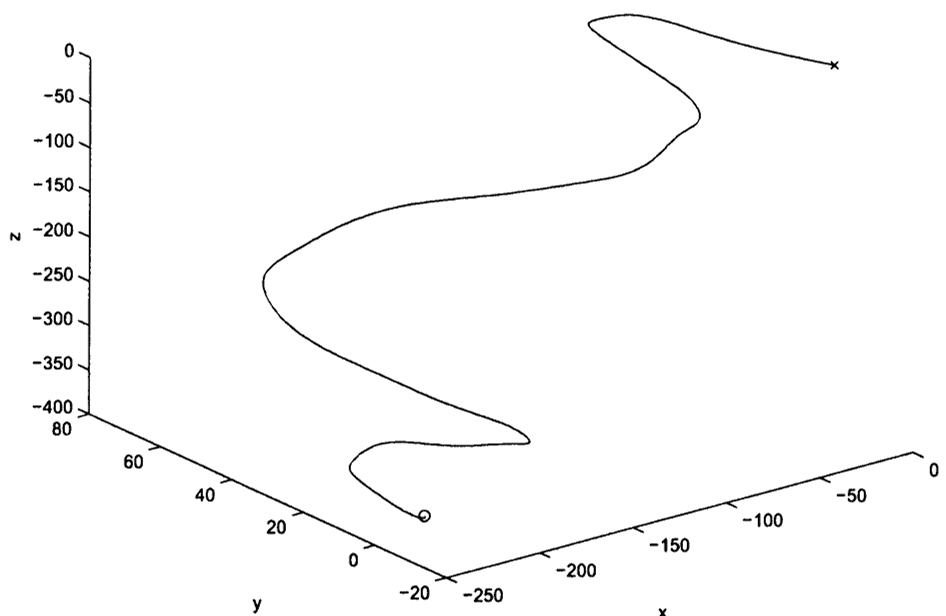 Above: Comparison between a swarm (left) and an individual (right) navigating a noisy gradient. The swarm exhibits far smoother trajectory following.
Results and Simulations
The authors tested their theory using chaotic noise generated by Duffing’s Equation.
- Cohesion Success: Even with chaotic sensing errors, the swarm agents successfully aggregated and moved as a single unit.
- Swarm Size Matters: Increasing the repulsion parameters and predictably increased the swarm radius but decreased collisions.
- Large vs. Small: Simulations showed that as increases, the "oscillations" caused by noise are dampened, confirming the Grunbaum Principle of biological advantage in groups.
Critical Analysis & Conclusion
The Takeaway
This paper is a cornerstone for anyone designing autonomous vehicle networks. It provides the quantifiable bounds needed to guarantee that a robot team won't scatter when its sensors start failing in the field.
Limitations
While the math is robust, the model treats agents as point masses. In real robotics (e.g., quadrotors), non-holonomic constraints and complex aerodynamics would add layers of difficulty. Additionally, the "repulsion" function used here does not strictly guarantee zero collisions—a "hard" barrier function would be needed for safety-critical applications.
Senior Editor's Note: Liu and Passino effectively bridge the gap between biological intuition and control theory. This work proves that in the face of chaos, there is safety—and accuracy—in numbers.