
SAw-SHARC: Solving the "Wandering Community" Problem in Mobile Social Networks
On the generation of stable communities of users for dynamic mobile ad hoc social networks
The paper introduces SAw-SHARC, a distributed community detection algorithm designed for Mobile Ad Hoc Social Networks (MoSoNets). It enhances the SHARC heuristic by incorporating node-centric link stability estimation and a proactive "break mode" to maintain stable, size-bounded communities in highly dynamic environments.
TL;DR
Mobile Ad Hoc Social Networks (MoSoNets) demand stable, localized groups for tasks like interactive gaming and media sharing. However, high mobility often breaks standard community detection algorithms. This paper presents SAw-SHARC, a distributed heuristic that combines neighborhood similarity with link stability estimation. Unlike prior work, it includes a "break mode" that prevents a single community label from dominating the entire network in high-speed scenarios like highways.
Background: Why Static Algorithms Fail in Motion
Community detection is usually an a posteriori analysis of static graphs. In MoSoNets, the graph is a living, breathing entity. Nodes (users) move in and out of range, making links volatile.
- Centralized Failure: Coordination is impossible in decentralized ad hoc environments.
- The "Monster Community" Problem: Simple epidemic label propagation tends to merge small groups into one giant, meaningless cluster.
- The Wandering Community Effect: This paper identifies a specific flaw where a label persists in a group that has moved far away from its origin, eventually "infecting" unrelated nodes and killing label diversity.
Methodology: Stability Meets Similarity
SAw-SHARC evolves the previous SHARC heuristic through two major technical pillars:
1. Node-Centric Relative Link Stability
Instead of treating all links equally, SAw-SHARC uses a T-CDF (Truncated Cumulative Distribution Function) to weight links.
- Physical Intuition: Every node independently assesses its neighbors. If a link's age or quality is in the bottom percentile of its current neighborhood, its influence on community assignment is penalized.
- The Formula: The contribution of a neighbor to node 's community count is filtered by , ensuring only reliable connections drive the grouping.
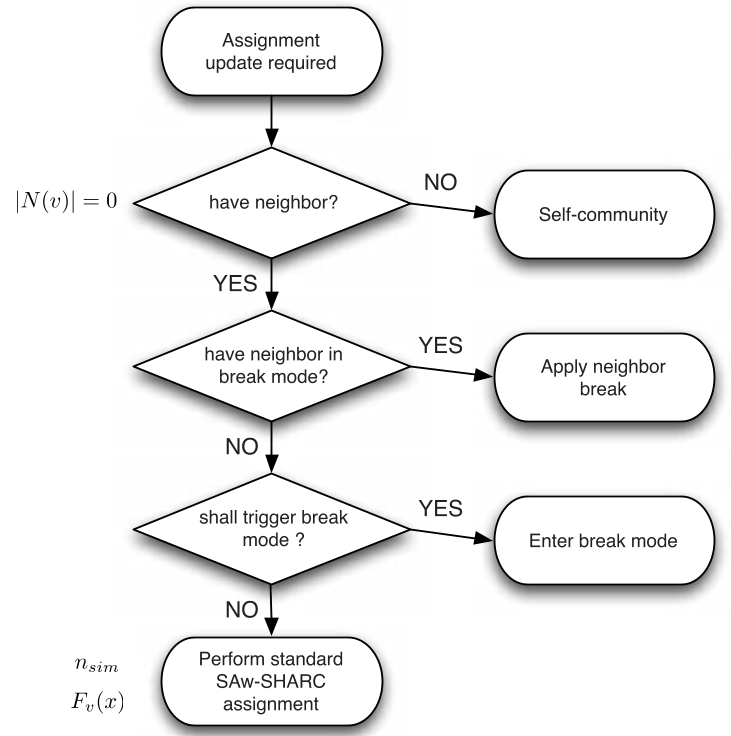
2. The "Break Mode" Mechanism
To fight the Wandering Community Effect (illustrated below), SAw-SHARC assigns an "originator" to every community.
- Nodes track their distance to the originator and a freshness counter.
- If a group of nodes is cut off from the originator, the counter stalls.
- The node closest to the split point enters "break mode," declaring itself the originator of a new community and rapidly resetting local labels.
Evaluation: Highway to Stability
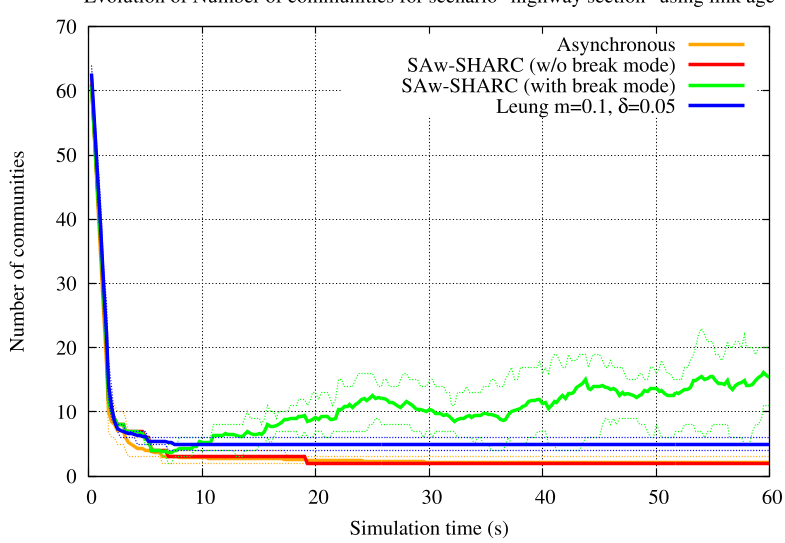
The authors tested the algorithm in two extreme urban scenarios: a "Shopping Mall" (low mobility) and a "Highway Section" (high mobility, 140 km/h).
SOTA Comparison
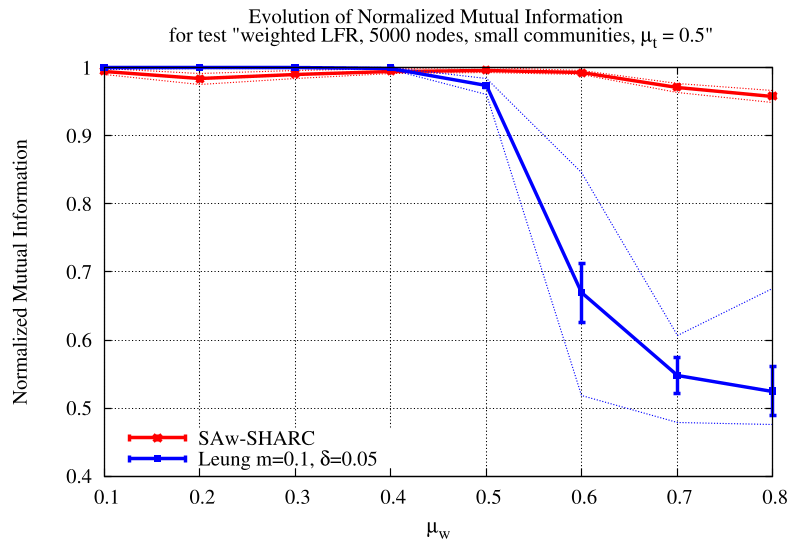
The algorithm was benchmarked against the Raghavan (unweighted) and Leung (weighted) models.
- In Static Benchmarks: SAw-SHARC maintained high Normalized Mutual Information (NMI) even when network noise (mixing parameter ) increased, where others failed by creating a single global community.
- In High Mobility: In the Highway scenario, SAw-SHARC was the only algorithm that didn't experience label collapse. It maintained a steady number of diverse communities reflecting the actual clusters of cars moving together.
Critical Insights & Takeaways
The transition from SHARC to SAw-SHARC represents a shift from "topological-only" to "stability-aware" networking.
- Inductive Bias: By penalizing unstable links via T-CDF, the algorithm inherently favors clusters that are likely to persist, which is the "Gold Standard" for Quality of Service (QoS) in MoSoNets.
- Scalability: The entire process is decentralized and node-centric, requiring only 2-hop neighborhood information.
- Limitations: The "break mode" relies on configurable stalling thresholds. If these thresholds are too aggressive, communities might fragment unnecessarily; if too lax, "wandering" still occurs.
Conclusion: SAw-SHARC provides a robust framework for building interactive social applications in the wild, ensuring that digital "communities" actually mirror the physical reality of human movement.