
Stalking from a Distance: How Simple Automation Unmasks LBSD Privacy
Stalking Beijing from Timbuktu: A Generic Measurement Approach for Exploiting Location-Based Social Discovery
This paper presents a "broad-net" measurement approach to exploit Location-Based Social Discovery (LBSD) services like WeChat. By combining off-the-shelf tools such as Android emulators, GPS spoofers, and OCR, the authors demonstrate how a weak adversary can track the precise locations and mobility patterns of thousands of users simultaneously without API access or reverse engineering.
TL;DR
Researchers from NYU demonstrated that Location-Based Social Discovery (LBSD) apps—popular tools for meeting nearby strangers—can be weaponized for mass surveillance. Using a generic framework of emulators and OCR, they tracked nearly 1,800 users in Manhattan from a remote location. Their "Overlapping Algorithm" bypasses standard distance-banding privacy measures, increasing location accuracy by over 18x.
The "Weak Adversary" Insight
Most privacy researchers assume an attacker needs deep technical skills: reverse engineering encrypted protocols or gaining unauthorized API access. This paper flips the script. It asks: What can a low-skill "weak adversary" do using only free, consumer-grade tools?
The answer is alarming. By simulating an Android environment and automating the "People Nearby" feature, an attacker can turn a social discovery tool into a global stalking grid. Unlike targeted attacks, this "broad-net" approach allows for the mass harvesting of mobility data, potentially exposing the habits of high-profile individuals, corporate employees, or entire city populations.
Methodology: The Honeycomb Grid
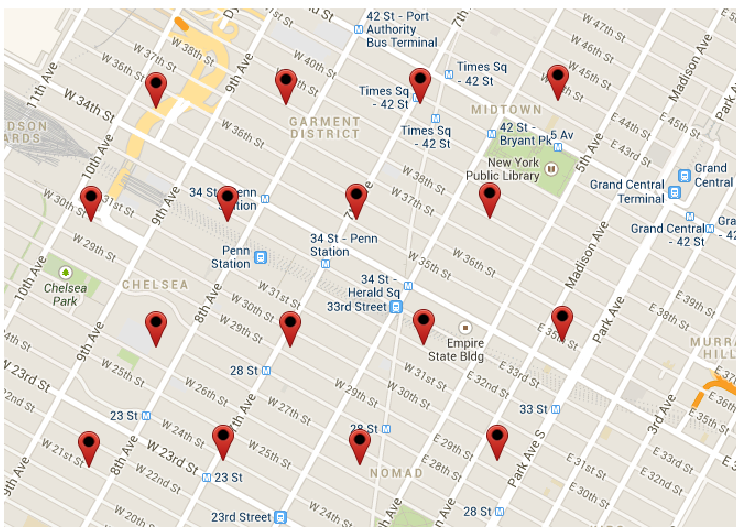
The core of the attack lies in the deployment of Virtual Probes. The researchers used eight machines to manage 16 probes arranged in a honeycomb pattern across Manhattan.
The Overlapping Algorithm
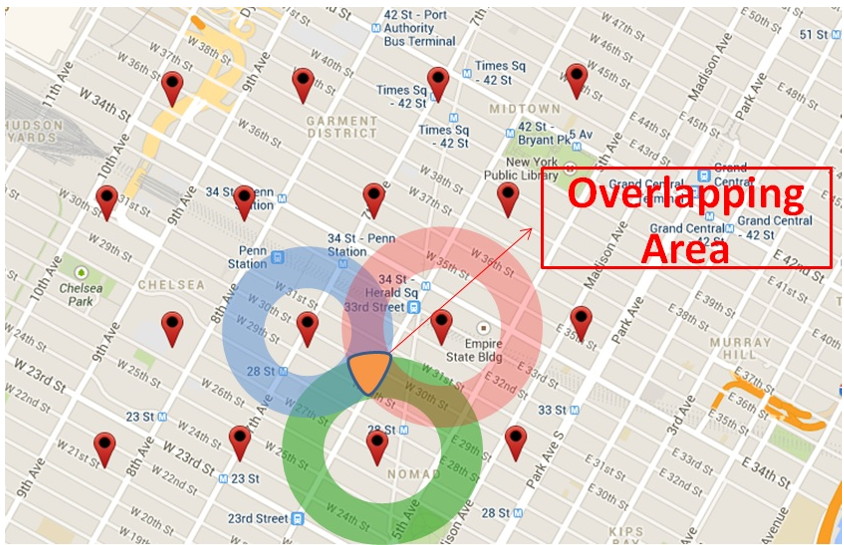
WeChat doesn't give an exact location. It says a user is "within 300 yards." Normally, this puts a user in a massive circular area. However, when three probes all see the same user at different distance bands, the intersection of those rings creates a much smaller, specific region.
To handle the "messiness" of the real world—such as GPS jitter or WeChat's server-side delays—the authors introduced an error margin (ε) of 200 yards. This adjustment ensured that in 94.5% of cases, the user was actually within the calculated overlap, despite intentional noise added by the app.
Results: From Metadata to Mobility
The experiments in Manhattan proved devastatingly effective:
- Precision: The algorithm narrowed the user's location to an area 18.1 times smaller than the app's default reporting.
- Volume: 120,000 location readings were captured over one week.
- Contextual Intelligence: By plotting these locations over time, the researchers could distinguish between where a user lived (nighttime data) and where they worked or socialized (daytime data).
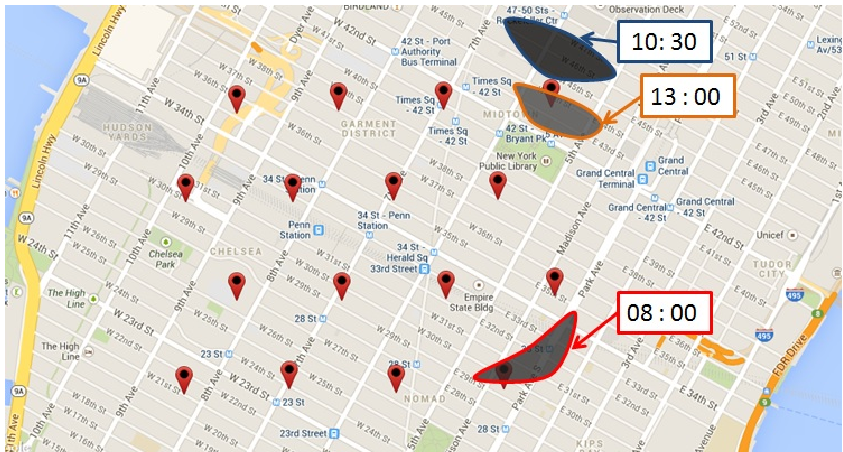 Visualizing a single user's life: (a) Workday routine, (b) Friday social activities, (c) Weekend mobility.
Critical Analysis & Future Outlook
The study exposes the fallacy of "Distance Banding" as a viable privacy defense. While WeChat attempts to protect users by hiding direction and introducing 100-yard bands, the mathematical reality of multi-point intersection renders these hurdles trivial for an automated system.
Limitations:
- Duplicate Names: Without using unique IDs, users with common names (e.g., "John") can create noise in the data.
- OCR Reliance: The accuracy of the attack is currently tied to the quality of image-to-text conversion.
The Path Forward: For LBSD apps to survive the "Stalking from Timbuktu" threat, they must move beyond static distance bands. Implementing Differential Privacy—where the noise added to a user's location is mathematically guaranteed to protect identity—is a necessity. Furthermore, LBSD servers must detect "non-human" behavior patterns, such as an account "teleporting" between 16 different locations in a grid every 30 minutes.
Ultimately, this paper serves as a wake-up call for the LBSD industry: if you provide a "search nearby" feature, you might accidentally be providing a "search everywhere" tool for the wrong people.