
Beyond the Shadow: Restructuring "Stalking" as a Modern Reading Practice
All We Do is "Stalking": Studying New Forms of Reading in Social Networks
This paper defines "stalking" as a new, non-criminal reading practice native to social networks, where users systematically browse hypertextual content to gain insight into a subject. It utilizes the READ-IT project framework to model the interactions between the reader (stalker), the content (the stalked), and the platform (medium).
TL;DR
Forget the criminal connotations for a moment—in the world of social media, we are all "stalkers." This paper reclaims the term to describe a systematic, hypertextual reading practice used to gain insights into people and organizations. Investigated within the READ-IT project, the authors argue that stalking is a native digital literacy where we hunt for content across the "architexts" of platforms like Facebook, LinkedIn, and Twitter.
Context: A New Dimension of Literacy
While "stalking" once strictly implied predatory behavior, the digital age has "territorialized" the word. It now serves as a vernacular metaphor for the deep, often obsessive exploration of a target’s digital footprint. The authors position this work within the Digital Humanities, aiming to understand how the medium (the social network) and the content (the profile) create a brand-new reading experience that is often clandestine, systematic, and serendipitous.
The Problem: Why Old Models of Reading Fail
Traditional reading models assume a linear or focused interaction with a static text. However, social media reading is:
- Hypertextual: Navigating links, names, and faces as "clickable signs."
- Industrialized: Competing with "feeds" and algorithms that hide as much as they reveal.
- Affective: Often accompanied by "guilty" feelings or the fear of accidentally "liking" a post (the "clumsy" stalker).
Current research lacks a framework to categorize these behaviors as "reading," often dismissing them as mere browsing or surveillance.
Methodology: The Anatomy of a Stalk
The authors utilize the READ-IT model to break down the stalking process into three core components:
1. The Stalker (The Reader)
The stalker isn't just a voyeur; they are an agent with a specific Aim (getting insight) and specific Habits. Their state of mind is influenced by their skills in bypassing platform constraints.
2. The Means (The Medium)
Social networks are not neutral. They are Environments that mediate access. The paper introduces the concept of Architext—the functional template of the platform that dictates how we see content.
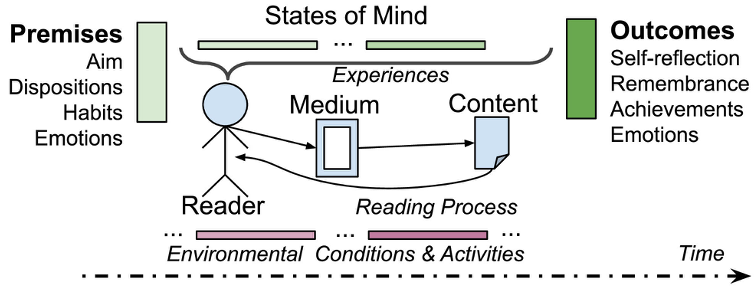 Figure 1: The READ-IT model showing reading as a process triggering changes in the Reader's State of Mind.
3. The Systematic Activity
What distinguishes "stalking" from "reading" is systematicity. It is a methodical "hunt" that involves:
- Analytical Reading: Deciphering what the author intended to post.
- Narrative Reading: Engaging emotionally with the person's life story.
Key Insights: Professional vs. Ludic Stalking
The paper categorizes stalking into two main flavors:
- Ludic (Playful): Driven by curiosity, fan culture, or nostalgia. Outcomes include feeling "relieved," "grateful," or sometimes "puzzled" by old comments.
- Professional: Driven by strategic needs, such as researching a company on Glassdoor or a candidate on LinkedIn. Here, the risk shifts from social embarrassment to unwanted professional engagement (e.g., "harassment" by recruiters).
Critical Analysis: The Risky Environment
The authors highlight a dark side: the uncontrolled space. Because algorithms are opaque, the stalker lacks "agency" and "legibility." You don't always know why a profile appears in your feed, and you can’t always control the "traces" you leave behind (the "unwanted engagement").
Conclusion: Stalking as a Cultural Reflex
"Stalking" is no longer just a crime; it’s a globalized vernacular reading practice. By modeling it, we gain a window into how "surveillance capitalism" has turned our personal lives into public hypertexts. The study challenges the Hypertext research community to stop looking at social media as just a tool for connection and start seeing it as a complex, often clandestine library of human experiences.
Future Outlook
As privacy laws (like GDPR) and platform algorithms evolve, the "tools of the hunt" will change. Future research should look at how AI-driven "suggested content" either facilitates or disrupts the stalker’s systematic intent.