
Scaling the Digital Paper Trail: Moving Toward Decentralized Big Social Provenance
An Approach to Standalone Provenance Systems for Big Social Provenance Data
The paper introduces a comprehensive evaluation of current standalone provenance systems (PReServ, Karma, and Komadu) in the context of "Big Social Provenance Data." It proposes a new decentralized architectural design that leverages W3C PROV-O, big data frameworks like Hadoop, and in-memory caching to address the bottlenecks in existing centralized solutions.
TL;DR
As social media interactions explode into the billions, tracking the "provenance" (origin and life cycle) of data becomes a massive technical hurdle. This paper evaluates the breaking points of current standalone systems like Karma, Komadu, and PReServ, proving they fail beyond a threshold of 4,000 operations. To solve this, the authors propose a new decentralized architecture combining Map/Reduce, in-memory caching, and extended W3C standards to handle the scale and privacy needs of Big Social Data.
Problem & Motivation: The Provenance Bottleneck
In an era of "fake news" and rapid information diffusion, knowing where a tweet or a post originated is vital for assessing data quality and trustworthiness. This metadata is known as Provenance.
However, recording provenance for social networks presents a unique challenge: the metadata can often be larger than the social data itself. Prior standalone systems were designed for scientific workflows with relatively controlled steps. In the chaotic, high-velocity environment of social media, these centralized databases (usually MySQL backends) become a massive bottleneck. The authors identified that existing systems lack:
- Scalability: They cannot handle the thousands of concurrent social interactions (likes, retweets, replies).
- Semantics: Standards like PROV-O don't natively track data ownership or privacy violations.
Methodology: Benchmarking and a New Blueprint
The study first puts three industry-standard systems to the test:
- PReServ: Based on Service-Oriented Architecture (SOA) and XML.
- Karma: A publish-subscribe based system using relational databases.
- Komadu: The successor to Karma, using W3C PROV-O and optimized connection pooling.
The Proposed Decentralized Architecture
To overcome the limits discovered during testing, the authors propose a modular, decentralized system.
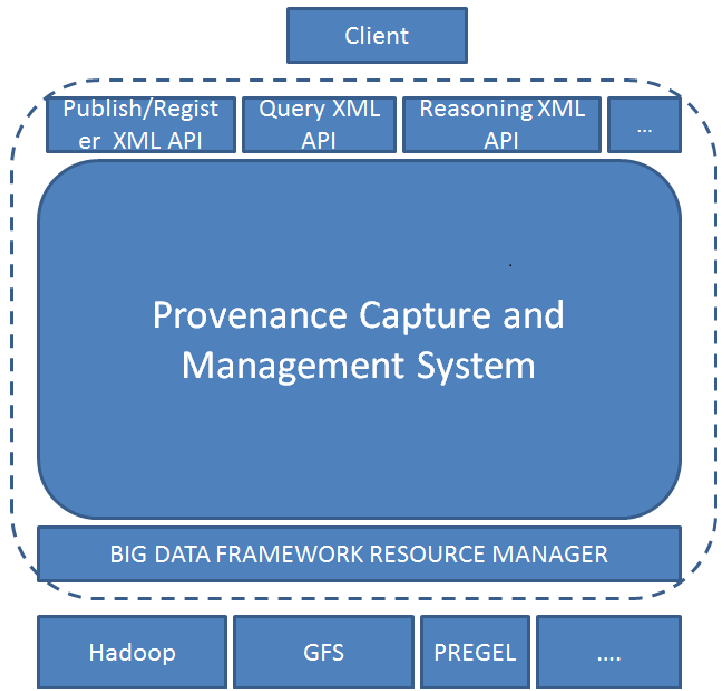
Core Components:
- In-Memory Cache: For ultra-fast retrieval of key-value based provenance queries.
- Map/Reduce Processor: To distribute the ingestion and processing load across a cluster.
- Ontology Extensions: Enriching the standard PROV-O model with specific metrics for Data Quality and Privacy.
- Decentralized Storage: Utilizing Hadoop (HDFS) or GFS to store semi-structured provenance metadata without the limitations of a single relational server.
Experiments: The 4,000 Operation "Wall"
The authors conducted performance and scalability tests on Google Compute Engine nodes. They measured ingestion time and query latency as the number of social operations (tweets, likes, etc.) increased.
Key Findings:
- Ingestion: PReServ showed the lowest ingestion time but failed significantly in complex querying because it relies on non-indexed XQueries.
- The Breaking Point: All systems encountered internal errors, memory leaks, or HTTP timeouts once a single workflow trace exceeded 4,000 social operations.
- Query Performance: Karma and Komadu performed better than PReServ for multi-criteria searches because they utilize SQL indexing, but they still suffered from linear latency increases as concurrent client numbers rose.
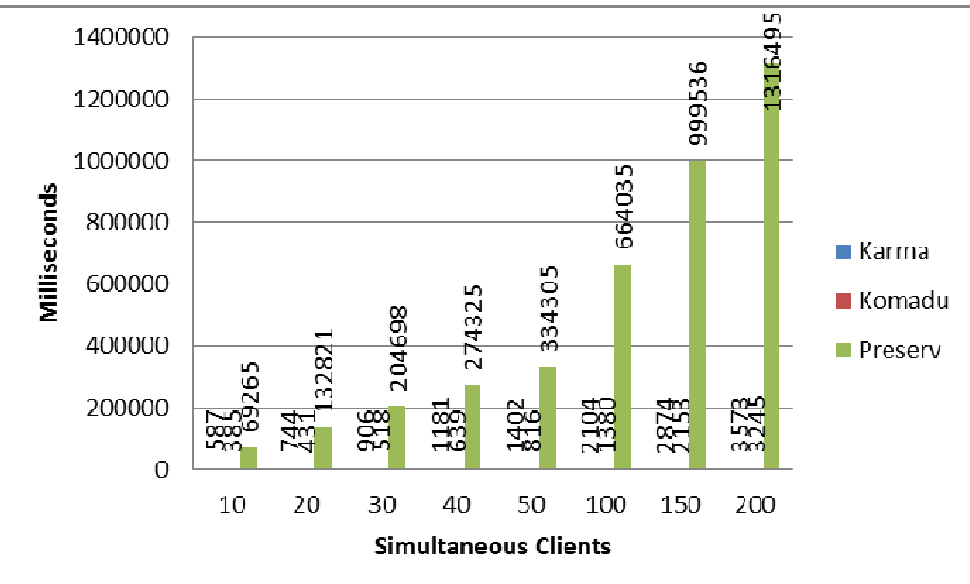 Fig: Latency of concurrent clients on a 4000 social workflow, showing the struggle of centralized systems under load.
Critical Analysis & Conclusion
Takeaway
The paper effectively demonstrates that the "Big Data" problem isn't just about the data itself, but about the metadata required to trust that data. Centralized standalone systems are "legacy" in the face of modern social streams.
Limitations
- Evaluation Depth: While the paper proposes a brilliant decentralized architecture, it focuses heavily on evaluating existing systems rather than providing empirical performance data for the proposed system (reserved for future work).
- Standard Specifics: The extension of PROV-O for privacy is conceptually sound, but the exact mathematical metrics for "Privacy Violation" scores need more definition.
Future Outlook
This work sets the stage for shifting provenance from a "side-car" service to a fundamental, distributed component of social media infrastructure. Integrating this with Differential Privacy or Blockchain could provide the ultimate secure and scalable digital paper trail.