
Beyond the iFrame: Standardizing Remote Labs as Scalable Educational Services
Standardization Layers for Remote Laboratories as Services and Open Educational Resources
This paper proposes a three-layer standardization architecture to transform remote laboratories into "Lab-as-a-Service" (LaaS) and "Open Educational Labs" (OEL), enabling seamless integration into web-based learning platforms like edX and Graasp.
TL;DR
To address the fragmentation of remote engineering labs, this paper introduces a three-layer standardization architecture. By decoupling physical hardware from the user interface and utilizing protocols like LTI and OpenSocial, the authors transform isolated experiments into interoperable Open Educational Labs (OEL). This allows a remote lab to function not just as a tool, but as a fully integrated service within platforms like edX and Graasp.
Problem & Motivation: The "Silo" Trap
In STEM education, "learning by doing" is vital. While Remote Laboratories provide access to physical hardware via the web, they are often implemented as standalone applications. This leads to several critical failures:
- Fragmentation: Students must log in to multiple separate systems.
- Data Loss: Experimental results (sensor readings) and interaction traces (how a student uses the UI) are often lost or trapped within the lab's proprietary database, rather than being linked to the student's progress in a Learning Management System (LMS).
- Rigidity: Lab interfaces cannot be easily adapted for different courses or pedagogical scenarios.
The authors' insight is that a lab should be treated as a Service (LaaS) first, and then wrapped in a standard Educational Layer (OEL) to provide the necessary context.
Methodology: The Three-Layer Architecture
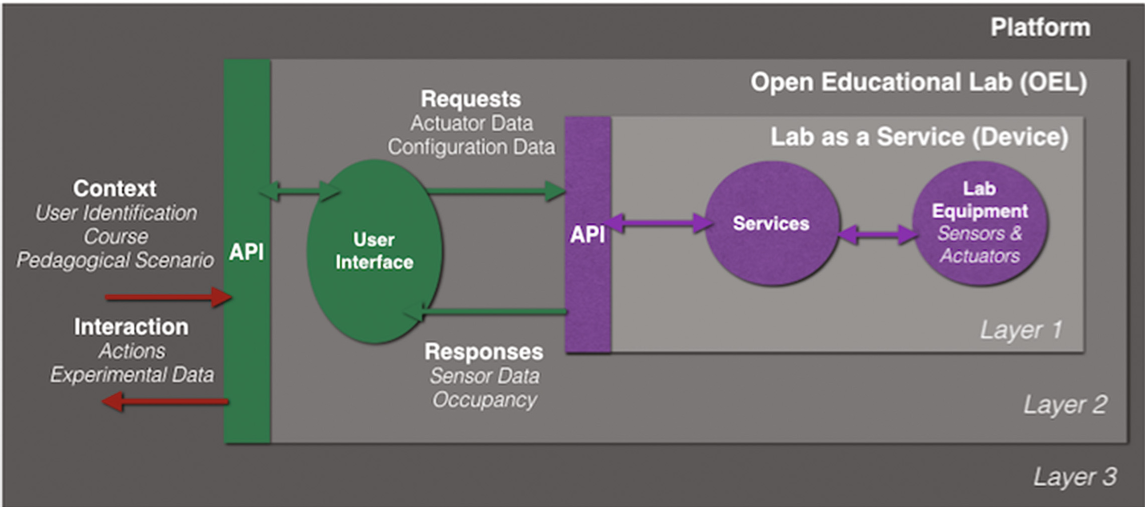
The proposed solution moves away from ad-hoc integration toward a "Separation of Concerns" model.
Layer 1: Lab as a Service (LaaS)
The physical equipment is abstracted using the Smart Device Paradigm. Instead of the UI talking directly to a specific driver, it communicates with a well-defined RESTful API.
- Metadata: Uses human-readable JSON to describe sensors and actuators.
- Decoupling: The lab side manages the hardware, while the client side only cares about the data exchange.
Layer 2: Open Educational Labs (OEL)
This layer adds the "Educational" intelligence. It handles:
- Single-Sign On (SSO): Propagating the user's identity from the school platform down to the lab.
- Activity Tracking: Utilizing Learning Analytics to see how students interact with the UI.
- Data Archiving: Ensuring experimental results are stored in a way that other pedagogical tools (like graphers) can access.
Layer 3: Integration Layer
The final layer utilizes external standards to "plug" the OEL into a host.
- IMS LTI: For traditional LMS platforms like edX or Moodle.
- OpenSocial: For social learning environments like Graasp.
Real-World Use Cases
1. MOOLs for MOOCs (edX Integration)
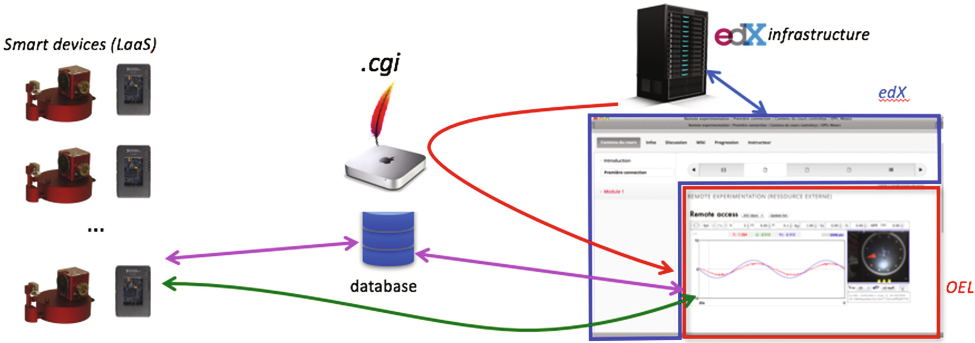
The authors integrated a control systems lab into the edX platform. Since edX is an LTI consumer, they extended the LTI parameters to include:
- Experimental Parameters: Pre-configuring the lab.
- Experiment Duration: Implementing a "turn-taking" system for limited physical resources.
- CGI Interface: Bridging the gap between LTI and the lab's backend to facilitate data saving.
2. Mach-Zehnder Interferometer (Graasp Integration)
For a high school physics lab, the team used Graasp. Unlike edX, Graasp uses an OpenSocial container. This allowed the lab to act as a "Social Gadget" that could seamlessly save data into the platform’s "Documents API," making the data immediately available for a Data Viewer app within the same workspace.
Deep Insight & Conclusion
This work represents a shift from "Remote Labs as Apps" to "Remote Labs as Infrastructure." By standardizing the communication layers, the educational community can treat a physical lab in Switzerland like any other cloud resource—easily embedded, tracked, and graded within a Global MOOC or a local classroom.
Takeaway: The real challenge of remote labs isn't the hardware control anymore; it's the interoperability of data and identity.
Limitations: The paper acknowledges that while APIs can be standardized, the host platform's specific integration requirements (like LTI versions) still require some custom "glue" code.
Future Outlook: We are likely moving toward a world where remote labs are part of a federated network, where a student in one country can use a "Smart Device" in another, with all credits and data flowing back to their home institution's dashboard automatically via these standardized layers.