
Star Search: Why Your Team Needs a Leader, Not Just "Good Vibes"
Star Search: Effective Subgroups in Collaborative Social Networks∗
The paper introduces "Star Search," a novel approach to identifying effective collaborative teams within large social networks (e.g., DBLP). It proposes focusing on a "Star Topology"—centered on a team leader—rather than a "Clique Topology" to measure group cohesiveness and predict task success.
TL;DR
Is a team of five friends better than a star professor and four students? According to "Star Search," the latter is not only easier to find in a crowd but often more effective. This paper argues that team success is driven by "Star Topologies" (leader-centric) rather than "Clique Topologies" (everyone connected to everyone), turning an NP-hard search problem into a computationally efficient task.
Context: This work resides at the intersection of Social Network Analysis (SNA) and combinatorial optimization, challenging the long-standing SOTA assumption that "denser subgraphs" always equal "better teams."
The "Clique" Trap: Why Finding the Perfect Team is Hard
Traditional team formation models often rely on the Clique Topology. The intuition is simple: if everyone is closely connected and collaborates well with every other member, the team should be highly effective.
However, this leads to two massive roadblocks:
- Computational Wall: Finding a maximum-weighted clique is an NP-hard problem. If you have a network of millions of professionals, finding the "perfect" clique is mathematically impossible in a reasonable timeframe.
- Information Noise: Does the relationship between the two junior interns really impact the project's success as much as their relationship with the Project Manager? The clique model assumes "yes," which the authors argue is a fallacy.
Methodology: The Power of the Star
The authors propose the Star Topology. In this model, we identify a leader ()—typically the individual with the highest expertise (e.g., H-index)—and only measure the weights of the edges connecting that leader to the rest of the team.
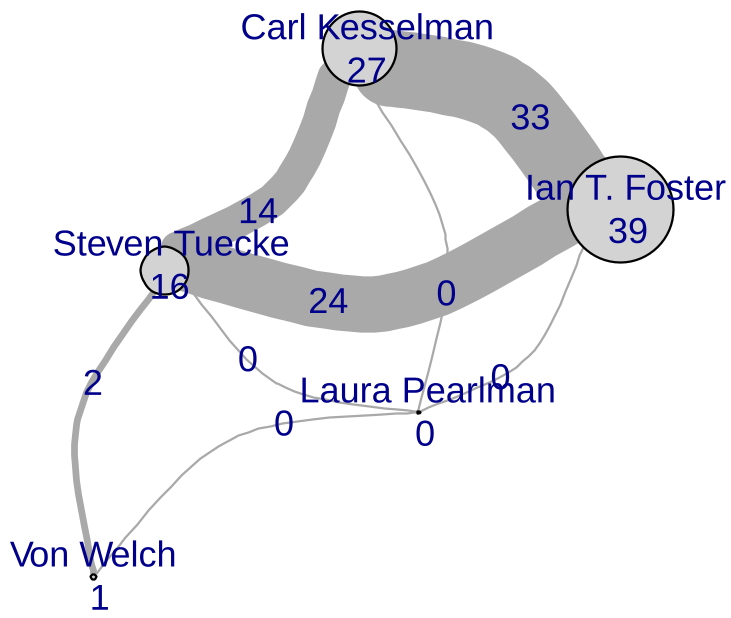 Fig 1: A visualization of a team where high-impact individuals (large circles) drive the group's potential, even if not every member is connected.
This shift has a profound algorithmic impact:
- Complexity: While MAX-CLIQUE is intractable, MAX-STAR can be solved by simply iterating through each vertex , picking the strongest incident edges, and selecting the best "star" found. This is a linear-time operation relative to the number of edges.
Experiments: Validating Intuition with DBLP Data
Using the DBLP dataset (computer science publications), the authors tested whether these "Star" metrics actually predict success (measured by citations).
Key Metrics Compared:
- Binary: Simple yes/no on prior collaboration.
- H-index / Citations: Weighted ties based on previous impact.
- Density: The average of all pairwise ties (Clique).
- TopTwo: A refined model focusing on the two most expert members.
The Verdict:
Surprisingly, the Star topology outperformed the Clique topology across almost every metric. In the "Binary" collaboration test, the Star correlation with success was 0.218, while the Clique was only 0.163.
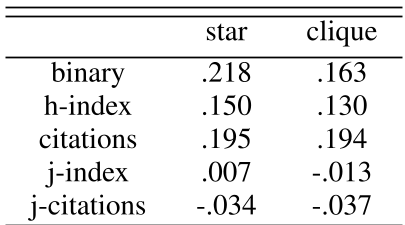 Table 1: Pearson Correlation Coefficients. Note that Star consistently outperforms Clique.
Furthermore, the topTwo model, which looks at the two highest expertise scores and the two strongest ties, provided the best results (RMSE 1.540), suggesting that most "team" success is top-heavy.
Critical Analysis & Conclusion
Takeaway
The core contribution of "Star Search" is the realization that social "noise" (minor pairwise ties) can be ignored. By focusing on the hierarchy, we gain both predictive power and computational speed. This has massive implications for HR tech, academic recruitment, and automated project staffing.
Limitations
- Domain Specificity: The results are specific to academic publishing (DBLP). In creative fields or highly agile software "squads," the lack of a "clique" (flat structure) might be more detrimental than in a research lab.
- Data Skew: As shown in the paper's conclusion, citation data is heavily "zero-inflated" and right-skewed. While logging the data helps, it suggests that "success" is often influenced by factors outside the social graph.
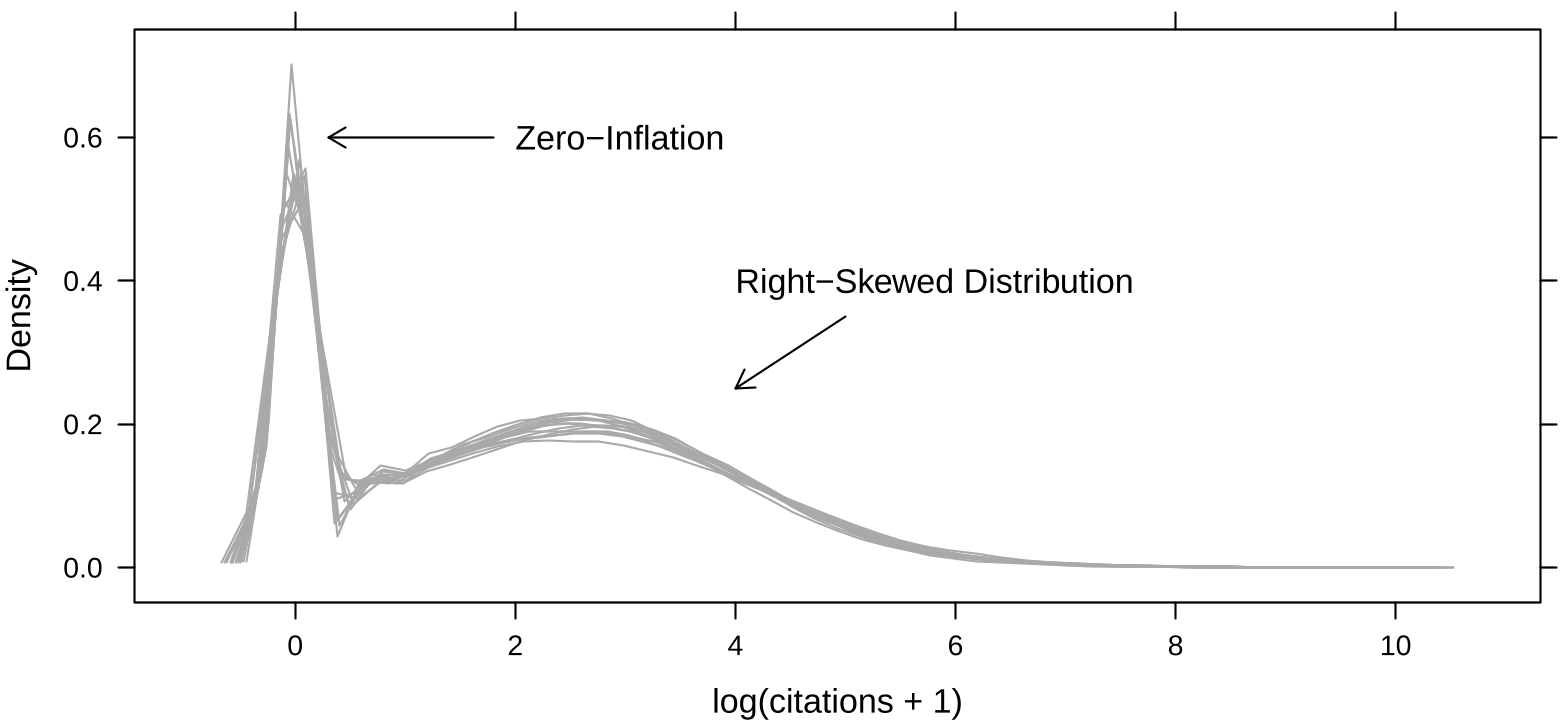 Fig 2: The distribution of citations across years, highlighting the difficulty of predicting outliers in academic success.
Final Thought: If you're building a team, don't worry about whether everyone is "best friends." Find a strong anchor, and build the spokes from there.