
STAR: Bridging Logic and Social Trust via Semiring Inference
STAR: Semiring Trust Inference for Trust-Aware Social Recommenders
The paper introduces STAR (Semiring Trust Inference for Trust-Aware Social Recommenders), a novel trust inference framework based on a 2D semiring algebraic structure. It effectively models both trust and distrust while incorporating certainty information to improve rating prediction in social recommender systems.
Executive Summary
In the landscape of social recommender systems, "Trust" is the gold standard for filtering noise. However, trust networks are notoriously sparse. The paper STAR tackles this by treating trust inference not just as a graph walk, but as a formal algebraic problem. By utilizing Semiring theory, the authors provide a rigorous yet flexible framework to propagate trust and distrust through a network.
STAR achieves a rare "triple threat" in academic research: it is mathematically sound (based on semiring properties), highly accurate (95%+ accuracy), and computationally efficient (graph-traversal based).
The Core Conflict: Linearity vs. Human Intuition
Most classic trust models (like TrustWalker or simple matrix factorization) assume that trust is additive or averageable. But human trust is rarely linear. If User A trusts B, and B distrusts C, what does A think of C? Simple averaging often fails to resolve these conflicts or ignores the "certainty" of the connection.
The authors identify three main pain points:
- Data Sparsity: Most users have very few explicit trust connections.
- Distrust Interaction: Distrust (negative trust) does not follow the same transitivity rules as positive trust.
- Certainty Modeling: Knowing how much someone is trusted is different from knowing how sure we are about that opinion.
Methodology: The 2D Distrust Semiring
The heart of STAR is representing trust as a 2D vector , where is the trust level and is the certainty .
1. The Algebraic Engine
To move through the graph, STAR defines two operations:
- Multiplication () for Propagation: When trust moves along a path (A -> B -> C), the trust values are multiplied while certainty decays. If any link is negative (distrust), the result reflects the complexity of "the friend of my enemy."
- Addition () for Aggregation: When multiple paths lead to the same user, STAR uses an "optimistic" aggregation—selecting the opinion with the highest certainty.
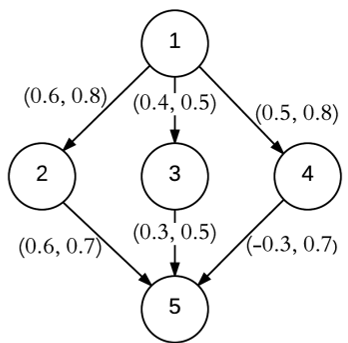 Figure 1: Example of trust paths where vectors are propagated (multiplied) and aggregated (added).
2. Inferring the Unknown: Iteration and Reciprocity
To solve the sparsity problem, the authors introduced:
- Iterative Evaluation: Unlike a one-pass algorithm, STAR can run iteratively, using newly inferred trust values to calculate even deeper relationships.
- Partial Reciprocity: If I trust you, there is a high statistical probability you trust me back (98% sign agreement in Epinions data). Captured as a source of evidence, this significantly boosts coverage.
Experimental Validation
The authors tested STAR on the Epinions dataset (over 840k edges). They analyzed how the maximum path length () affected results.
Key Findings:
- Depth matters: Increasing the hop count to 4 significantly increases coverage without a major hit to accuracy.
- Certainty Models: The authors compared path-based vs. degree-based certainty. They found that an exponential degree-based model (where users with more connections are deemed more reliable) provided the most stable results.
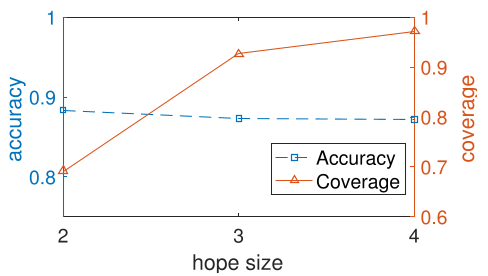 Figure 2: Performance metrics showing the impact of iterative methods and reciprocity on coverage and accuracy.
Critical Insight & Conclusion
The true value of STAR lies in its Distrust handling. While many models struggle with negative links, STAR’s rule that "the enemy of your enemy is unknown" (rather than a friend) aligns perfectly with the empirical data found in large-scale social networks.
Takeaway for Practitioners: If you are building a social recommender, don't just aggregate links. Assign a certainty score based on node degree and path length, and use non-linear aggregation to ensure that highly certain, extreme opinions aren't washed out by neutral noise.