
STAR: Bridging Social Trust and Recommendation via Semiring Algebra
STAR: Semiring Trust Inference for Trust-Aware Social Recommenders
STAR (Semiring Trust Inference for Trust-Aware Social Recommenders) is a graph-driven trust inference framework that utilizes a 2-D algebraic semiring to model trust and certainty. It achieves state-of-the-art accuracy of approximately 95% on the Epinions dataset, significantly outperforming traditional linear models and machine learning approaches in social recommendation tasks.
TL;DR
Trust-aware recommendation systems often fail due to "cold start" and sparse social links. STAR (Semiring Trust Inference) solves this by treating trust not as a single number, but as a 2-D vector of Trust and Certainty. By applying nonlinear semiring algebra, it achieves a staggering 95% accuracy in predicting user relationships, providing a denser and more reliable knowledge base for social recommenders.
The "Certainty" Gap in Social Trust
Most social recommenders answer the question: "How much does User A trust User B?" with a simple scalar. However, this ignores a vital human intuition: Confidence.
The authors identify three fatal flaws in prior SOTA:
- Linearity Bias: Humans don't "average" trust; we prioritize high-certainty or extreme opinions.
- Negativity Blindness: Distrust is not just "low trust"; it has distinct transitivity rules (e.g., "the enemy of my enemy is unknown").
- Connection Sparsity: If there’s no direct link, many models simply give up.
Methodology: The 2-D Semiring Framework
STAR moves beyond simple scalars into the realm of Algebraic Semirings. A semiring allows us to define custom rules for "adding" (aggregating) and "multiplying" (propagating) trust.
1. The Opinion Vector
Every relationship is defined as :
- Trust (): Range (Includes Distrust).
- Certainty (): Range .
2. Nonlinear Operations
- Propagation (): As trust moves along a chain (), certainty decays and trust values multiply. If any link is "distrust," the chain breaks (trust becomes 0).
- Aggregation (): When receiving opinions from multiple neighbors, STAR uses a Non-increasing logic. It prioritizes the opinion with the highest certainty, rather than a weak average.
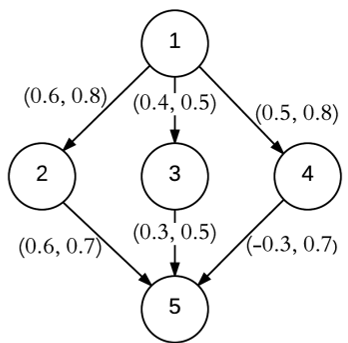 Figure 1: Illustration of a trust network where path-based certainty determines the final inferred trust.
3. Solving the Data Sparsity
The authors introduce Iterative Trust Evaluation. Similar to PageRank, the model suggests that if we infer a new trust link in Step 1, we should use that "inferred" link to calculate deeper links in Step 2.
Experimental Results: SOTA Performance
The STAR framework was tested on the massive Epinions dataset (over 841k edges).
- Accuracy: Hit ~95% accuracy, outperforming both Matrix Factorization and traditional Machine Learning (which hover around 93%).
- Coverage: By utilizing 4-hop propagation and reciprocity, the model could predict nearly 99% of reachable node pairs.
- Robustness: The "Iterative" version of STAR proved incredibly stable, regardless of the order in which links were processed.
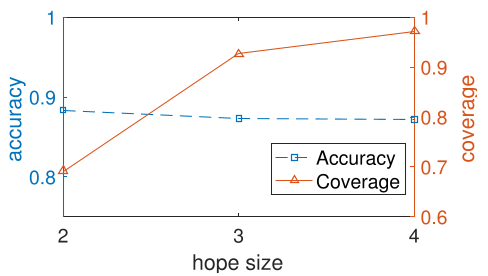 Figure 2: Performance gains across Accuracy and Coverage as hop count () increases.
Critical Analysis & Conclusion
Why it Works
The "magic" of STAR isn't just the math—it's the inductive bias. By explicitly modeling certainty as a function of path length and node degree, the model effectively filters out "noise" that plagues standard graph algorithms.
Limitations
The primary hurdle for implementation is that most commercial datasets don't have explicit "Distrust" labels. While STAR works on binary data (+1/-1), its full 2-D potential for continuous trust values remains largely untested on a global scale due to lack of public "fine-grained" datasets.
The Takeaway
STAR proves that Algebra > Pure Luck. By using semiring properties to enforce the "physical" rules of trust (propagation decreases certainty, aggregation increases it), we can build social recommenders that are not only more accurate but also more explainable.