
E-Participation in Kampala: Digital Reality or Political Deception?
The State of E-local Participation in Kampala Capital City Authority in Uganda: A Reality or Deception?
This study investigates the state of digital civic engagement within the Kampala Capital City Authority (KCCA) in Uganda. Using a "Participatory Rhombus" framework and mixed methods, the authors evaluate how online instruments like Facebook and SMS are being integrated into local governance to move beyond traditional representative models.
TL;DR
This paper examines whether digital tools in Uganda's capital, Kampala, truly empower citizens or merely serve as a top-down information channel. While SMS and social media have significantly increased the quantity of communication, the "deliberative quality"—the power of citizens to influence actual policy—remains limited, resulting in a "blended democracy" that leans heavily on monitoring rather than collaborative planning.
Positioning the Local Governance Crisis
In many developing democracies, established political structures are often viewed as "empty railway stations"—formal institutions devoid of meaningful debate. In Uganda, this disconnection has led to a cycle where government-led "invited spaces" fail to satisfy the public, forcing citizens into "invented spaces" of protest. The authors ask a critical question: Can ICT bridge this gap, or is it just a new layer of the same hierarchical control?
Methodology: The Participatory Rhombus
The authors utilize the Participatory Rhombus, a framework that categorizes engagement into four distinct spheres:
- Representative: Voting and contacting politicians.
- Direct: Referendums and participatory budgeting.
- Deliberative: Deep discussion and town hall meetings.
- Demonstrative: Expressive protests and demonstrations.
By applying this to Kampala, they analyze how tools like Facebook, Twitter, and SMS function within these spheres.

Key Findings: The Dominance of "Top-Down" Tools
The research reveals a clear hierarchy in the digital tools used by the Kampala Capital City Authority (KCCA):
- SMS is King: 84% of representatives use SMS, primarily because it works on low-tech devices and bypasses slow internet speeds.
- The Social Media Surge: 70.1% utilize Facebook and WhatsApp for citizen engagement.
- The Deliberation Gap: In stark contrast, 94.3% of officials have never used electronic town halls, and 91.1% avoid complaint chat rooms.
This suggests that while the quantity of information is increasing (as noted by 72% of respondents), the quality of bilateral communication—where citizens actually help shape the city's future—is still in its infancy.
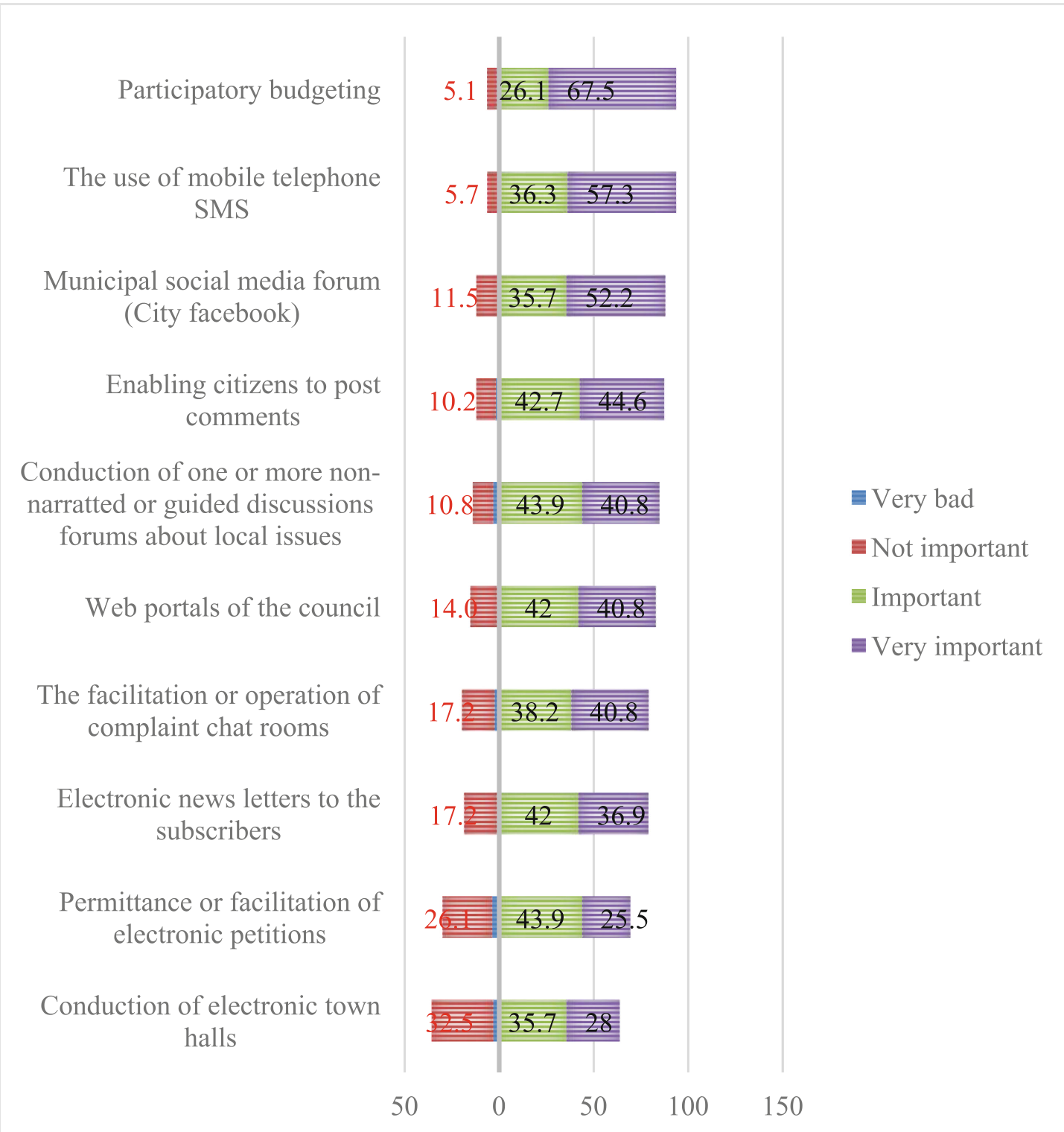
Critical Insight: Monitoring vs. Planning
The study notes a fascinating trend: digital participation in KCCA is currently used for monitoring. Citizens report broken infrastructure via social media, and administrators use these platforms to push out information about service delivery.
However, the "State of E-Participation" is not yet a reality for planning. Decisions are still made within traditional structures, and online interaction remains "demonstrative"—citizens use it to air grievances rather than engage in a reflexive, argument-based deliberative process.
Deep Insight & Conclusion
The authors conclude that we are witnessing the rise of a Blended Democracy. It isn't a purely virtual political life, but an interaction between offline reality and digital convenience.
The Verdict: Is it a reality or a deception? Currently, it is a partial reality. The infrastructure for engagement has been built, but the political will to move from "surveying" the citizens to "co-deciding" with them is not yet fully realized. For Kampala to move forward, the KCCA must transition from using digital tools as a "notice board" to using them as a "round table."
Future Outlook
As digital literacy grows in Uganda, the pressure for "invented spaces" (online protests) will likely force the government to improve its "invited spaces." The next evolutionary step for KCCA will be the integration of Participatory Budgeting and electronic town halls into the formal legislative process.