
Social Influence Analysis: Navigating the Epidemic of Information in Modern Networks
State of Art Techniques for Social Influence Analysis: A Systematic Literature Review
This paper presents a Systematic Literature Review (SLR) on Social Influence Analysis (SIA) techniques published between 2014 and 2018. It categorizes contemporary approaches into topology-based, topic-based, and hybrid models, evaluating state-of-the-art methods like Epidemic Betweenness and Diffusion Centrality for tasks such as influence maximization and spreader identification.
TL;DR
This systematic literature review (SLR) provides a critical evaluation of state-of-the-art techniques for Social Influence Analysis (SIA) from 2014 to 2018. By dissecting 9 seminal works, the authors categorize influence measurement into topology-based, topic-based, and hybrid approaches. The review demonstrates that while topology remains the dominant factor, the integration of semantic data and community-aware algorithms is essential for boosting accuracy in influence maximization and seed-set selection.
Problem & Motivation: Beyond Simple Connectivity
In the era of viral marketing and opinion propagation, identifying a "social influencer" is no longer just about counting followers (Degree Centrality). The problem is inherently complex: information spreads like an epidemic, but its path is dictated by the hidden architecture of the network and the specific relevance of the content.
Prior works often treated networks as homogeneous, ignoring that:
- Complexity matters: Many centrality measures are too computationally heavy for real-world networks with millions of nodes.
- Context is key: A node might be influential in "Technology" but irrelevant in "Politics."
- Network Dynamics: Static models fail to capture the "Susceptible-Infected-Recovered" (SIR) dynamics of how information actually dies out or persists.
Methodology: The Landscape of Influence
The review categorizes SIA into three main pillars based on the "factors considered" during the influence measurement process:
- Topology-Based: Uses the "shape" of the network (k-shell, degree, betweenness) to find spreaders.
- Topic-Based: Uses semantic content (interests, historical posts) to determine if a node will spread a specific piece of information.
- Hybrid (Topology + Topic): The current "Gold Standard," combining structural position with content relevance (e.g., Topic-Sensitive PageRank).
Core Framework Overview
The research process followed a strict SLR protocol to ensure the quality of the included studies:
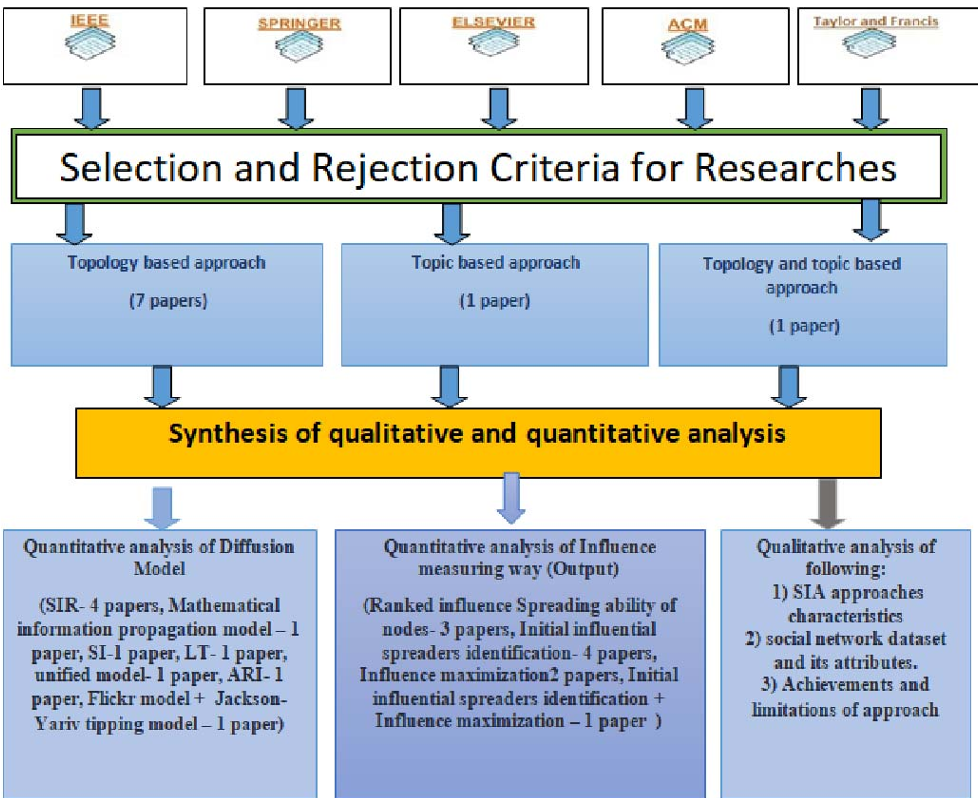
The authors specifically analyzed how different Diffusion Models fit these approaches. For instance, the Linear Threshold (LT) model is often used for topology-based seed identification, while the Author-Reader Influence (ARI) model is tailored for citation and topic-driven social media like Twitter.
Experimental Insights & SOTA Comparison
The paper reveals a clear trend: moving toward "Local" and "Community-based" measures provides the best balance between speed and precision.
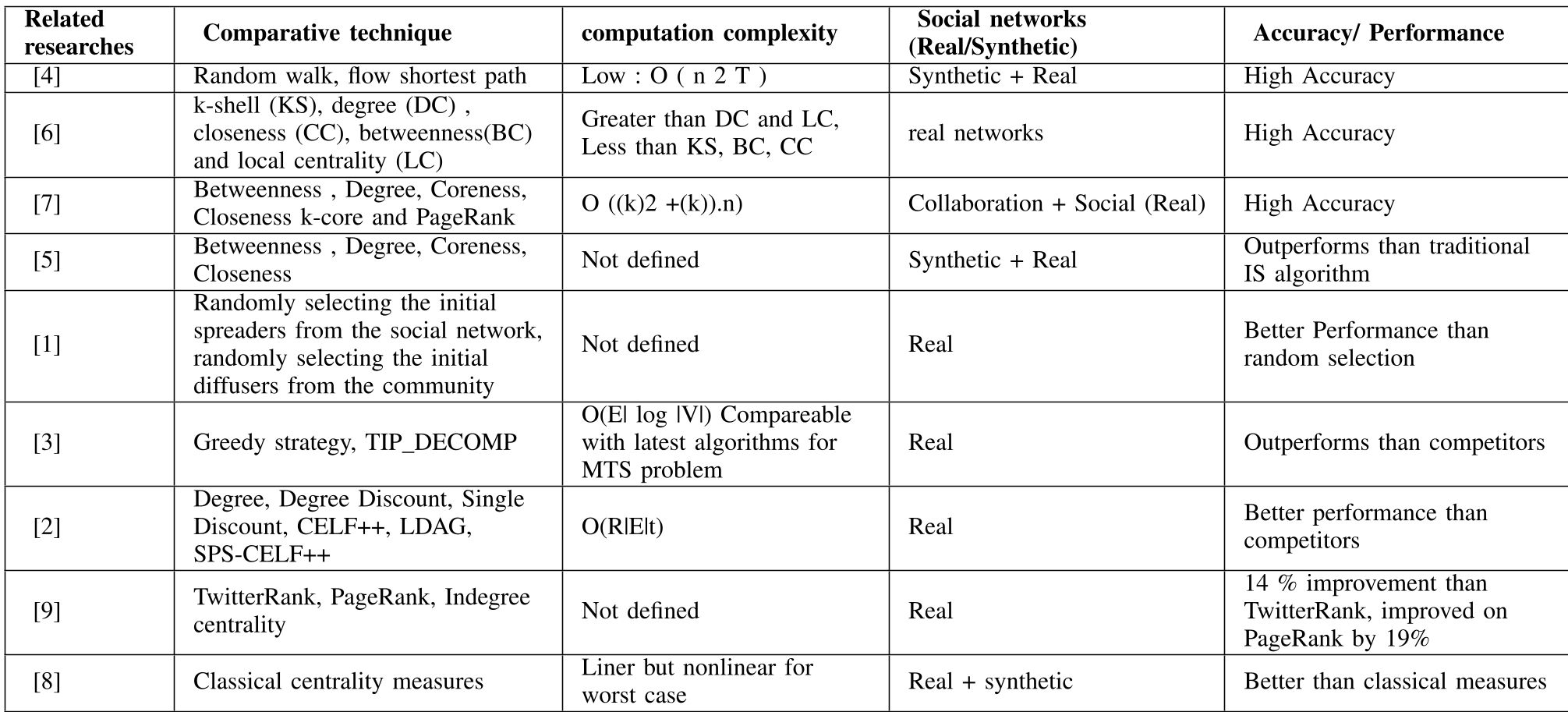
- Epidemic Betweenness: Outperforms traditional shortest-path measures by considering that information can flow through multiple paths simultaneously. It maintains an complexity, suitable for large-scale grids.
- Topic-Sensitive PageRank Extensions: Demonstrated a 14% improvement over TwitterRank and 19% over standard PageRank, proving that who you are in the network matters less than what you talk about.
- Community-Based Distributed Algorithms: These identify spreaders in overlapping communities, scaling significantly better than global greedy strategies.
Performance comparison of selected SIA techniques
Critical Analysis & Future Outlook
While the SLR provides a robust mapping of the 2014-2018 era, it identifies several glaring gaps:
- The "Cross-Platform" Blind Spot: Most studies focus on a single network (e.g., just Twitter or just Enron). In reality, influencers exist across a multi-type network (Facebook + LinkedIn + X). Combining these "layers" is the next frontier.
- Semantic Trust: Current models are often binary (active/inactive). Future models need to incorporate Mutual Trust and Political Factors, specifically for predicting high-stakes outcomes like election results.
- Inversion of Interaction: In large-scale networks, as the interaction percentage fluctuates, simple topology-based models lose their edge.
Conclusion
SIA is transitioning from a purely mathematical graph problem to a socio-technical one. This review serves as a roadmap for practitioners to choose the right algorithm based on their specific constraints—whether they prioritize the low complexity of Epidemic Betweenness or the high contextual accuracy of Topic-Based Diffusion Centrality.
Takeaway: If you are building a recommendation system or a marketing tool, don't just look for the most "connected" nodes; find the nodes that sit at the intersection of high global diversity and niche topic authority.