
Stateless Gateways: Slashing Cellular Traffic for Mobile Social Apps by 70%
Stateless Gateways - Reducing Cellular Traffic for Event Distribution in Mobile Social Applications
The paper introduces Stateless Gateways, a novel cellular offloading mechanism for mobile social applications and AR games. By extending location-based publish/subscribe systems, it leverages the cloud broker's global view to select mobile nodes as short-lived relays, achieving a 70% reduction in cellular traffic without maintaining state on the gateway devices.
TL;DR
Modern mobile social apps—like Pokémon GO or Ingress—suffer from a massive inefficiency: nearby users download the exact same "world state" events over expensive cellular links. Researchers from TU Darmstadt have solved this with Stateless Gateways, a system that uses the cloud's "God view" to turn smartphones into temporary, no-setup relays. The result? A staggering 70% reduction in cellular data with almost zero impact on latency.
The "Centralized Cloud" Bottleneck
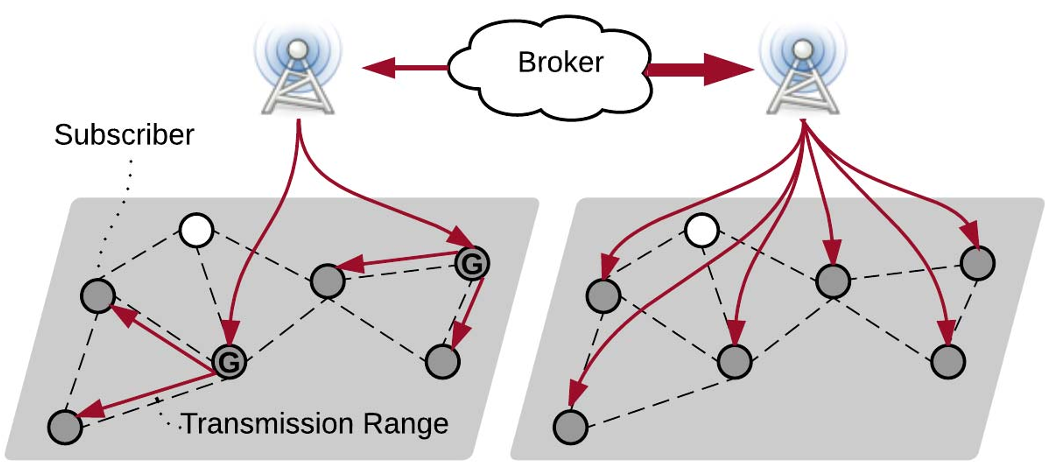
In the current mobile landscape, the cloud acts as a blind broker. Even if five players are standing in the same town square, the server sends five individual copies of a game event over the cellular network. This is not only a waste of bandwidth but also ignores the high-speed local connectivity (like Wi-Fi Direct or ad hoc modes) that these devices already possess.
Existing "proxy" solutions are often too heavy; they require mobile devices to maintain complex routing tables or act as long-term servers, draining the "lucky" gateway's battery while others get a free ride.
The Insight: Zero State, Per-Notification Selection
The authors suggest a shift in philosophy: don't make the mobile node smart; make the broker smarter.
Since the cloud-based Publish/Subscribe (Pub/Sub) broker already knows where everyone is (to filter location-based events), it can calculate the optimal distribution path on the fly.
How it Works:
- Selection: When an event occurs, the broker identifies the subscribers.
- Clustering: It groups nearby subscribers using algorithms like DBScan or Quadtrees.
- Instruction: Instead of sending to everyone, the broker sends the event to one "Gateway" node and attaches a list of local IP addresses.
- Relay: The gateway consumes the message and immediately forwards it to its neighbors via 1-hop broadcast or unicast.
Because there is no state (no long-term connection, no handshake), the broker can switch the gateway role for every single notification. This ensures perfect fairness—no single user's battery is sacrificed for the group.
Performance: 70% Less Traffic, 100% Reliability
The researchers tested this using SImonstrator, simulating a real-world AR game scenario in the city of Darmstadt.
- Offloading Efficiency: In dense areas, the system offloaded 70% of the traffic from the cellular network to local Wi-Fi.
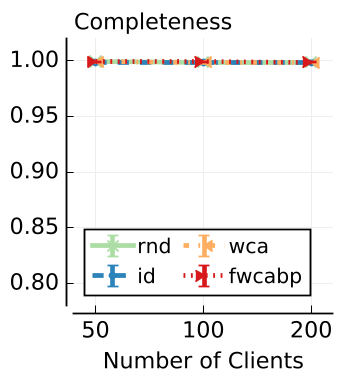
- Latency: You might expect relaying to slow things down. However, the average delay increased by only 2% (about 4ms in a 200ms window)—virtually imperceptible to the user.
- Fairness: Using the Weighted Clustering Algorithm (WCA), the system successfully distributed the "sender" burden across all participants, preventing any single device from being overworked.
Deep Insight: Why "Per-Notification" Matters
The most profound takeaway from this paper is the superiority of per-notification selection over global, time-based selection.
Static gateways often end up relaying messages they don't even need themselves, which feels "unfair" to the user. By selecting a gateway only from the list of people who are already subscribed to that specific event, the gateway is always a recipient too. It’s essentially "downloading for itself and sharing the extra copy," which maximizes efficiency and user acceptance.
Critical Analysis & Future Outlook
While the system is powerful, it currently assumes a reliable cellular upload. It also relies on the broker having a high-frequency update of user locations.
Future Directions:
- Incentive Mechanisms: How do we reward users for being gateways?
- Edge Computing: Moving the broker logic to "Cloudlets" or 5G MEC nodes could reduce the computational load on the main server.
- Energy Metrics: Future studies need to quantify the exact mAh saved by cellular radios vs. spent on Wi-Fi broadcasting.
Stateless Gateways provide a blueprint for the next generation of "social" networking—one where our proximity to others isn't just an application feature, but a core part of the communication infrastructure itself.