
Statelets: Orchestrating the Chaos of Cross-Platform Social Collaboration
Statelets: Coordination of Social Collaboration Processes
This paper introduces Statelets, a specialized coordination language and framework designed to orchestrate social collaboration processes across heterogeneous platforms like social networks and groupware. By integrating social and semantic contexts into a unified hypergraph model, Statelets enables automated decision-making through declarative rules.
TL;DR
Statelets is a domain-specific coordination language that solves the fragmentation of modern work. It allows developers to write rules that span across Facebook, LinkedIn, Jira, and Wikis by treating social networks and software artifacts as a single, searchable graph. It moves beyond simple "if-this-then-that" logic to support complex social dynamics like "I'll do X only if my team lead does Y" (collective actions).
The "Isolation" Problem in Modern Teams
In the current engineering landscape, expertise is on LinkedIn, code is on GitHub, and project management happens in Jira. These systems are isolated "silos."
The authors identify a major gap: Human coordination is inherently social. We don't just follow linear workflows; our actions are influenced by who our friends are, who we've worked with before (to avoid biased reviews), and what our peers are doing. Prior coordination languages (like BPEL) focus on "messages" between services, which makes querying a social graph or synchronizing a group of people a nightmare of "chatty" communications.
Methodology: High-Level Abstraction of States
The core innovation is the Statelet. Unlike a standard workflow step, a Statelet is a reactive construct that monitors a "Shared Space"—a hypergraph that integrates data from all connected platforms.
1. The Unified Hypergraph
The framework uses "Connectors" to pull data from various APIs and maps disparate identities (e.g., a GitHub username and a Facebook profile) to the same real-world entity. This data is presented as Relations.
2. Segregation of Concerns
Statelets distinguishes between:
- Queries (Read): Side-effect-free logic used to detect patterns in the social/semantic graph.
- Commands (Trigger): Actions that modify the external world (e.g., sending an email or assigning a ticket).
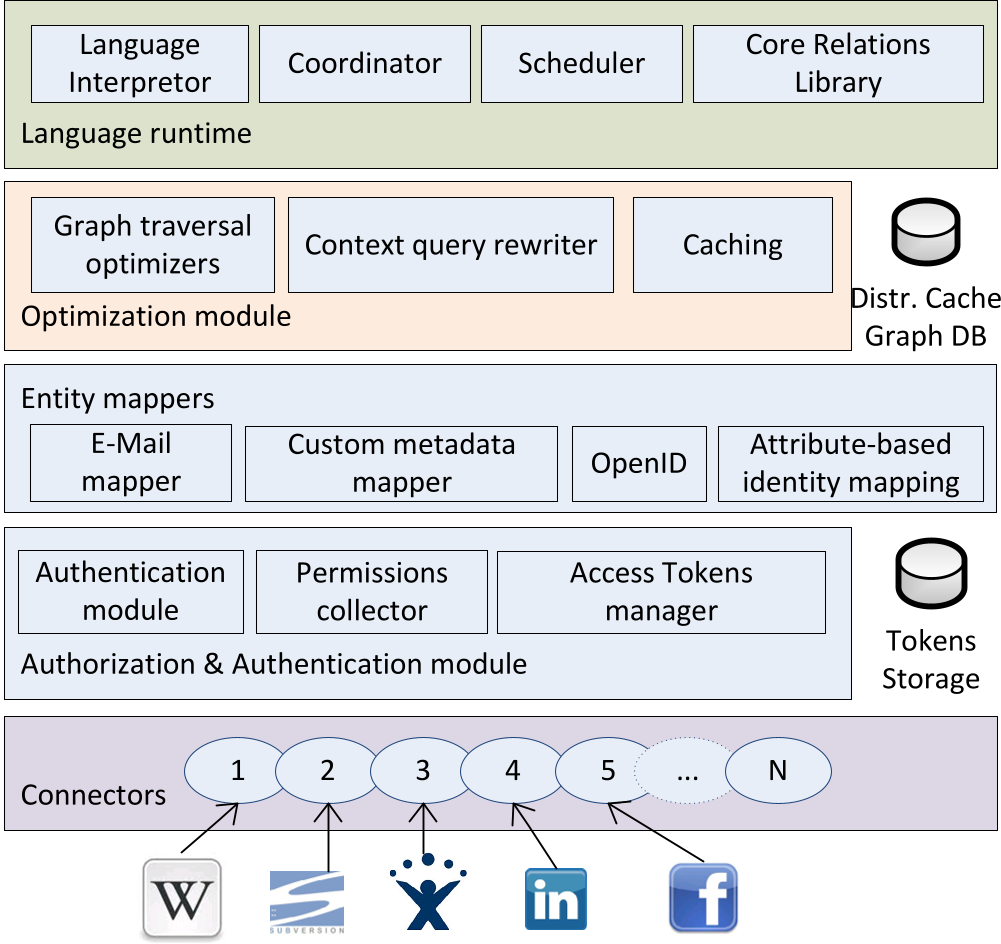 Figure 1: The Statelets Framework Architecture showing the multi-layer approach from Connectors to Language Runtime.
Real-World Hero Case: Finding the Unbiased Expert
One of the most compelling use cases in the paper is Expertise Discovery. Imagine you need a code reviewer for a sensitive project. You want someone who has the technical expertise but is not socially connected to the developer to ensure an objective review.
Using Statelets, this logic becomes a simple declarative query:
c // Simplified Statelet Logic wait ExpertiseFits(Profile, Story) && not SocialRelation(Developer, PotentialReviewer); trigger Assign(any PotentialReviewer);
This abstracts away the complexity of checking LinkedIn connections, Subversion commit histories, and project status simultaneously.
Comparative Analysis
The authors provide a rigorous comparison with existing paradigms:
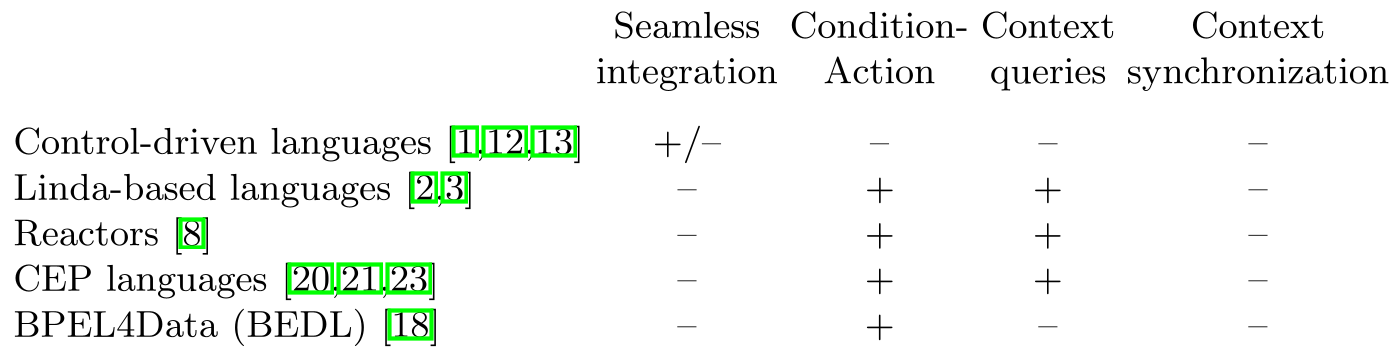 Table 1: Statelets vs. Control-driven and Data-driven languages. Note that Statelets is the only one providing native support for Context Synchronization and Seamless Integration.
Unlike Linda-based languages which rely on moving "atoms" in and out of a space, Statelets allows for Continuous Conditions (using the wait keyword), which handles the polling and event-matching of external APIs automatically.
Critical Insight & Future Outlook
While the current implementation of Statelets uses a C-based syntax and an F# interpreter, its true value lies in the Model of Coordination. By treating a "State" as something that can query its neighborhood, it allows for "Cellular Automata" style emergent behavior in organizations.
Limitations:
- Scalability: The paper acknowledges that hierarchical composition (states within states) is still in the works.
- API Latency: Querying real-time social graphs across multiple platforms can be slow; the framework will need robust caching and heuristic "optimistic" execution to feel seamless.
Summary
Statelets provides the "glue" for the modern decentralized workplace. It proves that by elevating social and semantic relations to first-class programming constructs, we can automate the nuanced coordination that currently requires human project managers to manually bridge different software tools.