
Beyond Homogeneous Mixing: Leveraging SEIQR Social Networks for Disease Dynamics
Statistical analysis and a social network model based on the SEIQR framework
This paper presents a Susceptible-Exposed-Infectious-Quarantined-Recovered (SEIQR) model integrated with a dynamic, adaptive social network to simulate disease transmission. By combining Ordinary Differential Equations (ODEs) and network topology, it explores how individual node degrees and contact radii influence outbreak dynamics, achieving a more realistic representation than homogeneous mixing models.
TL;DR
Current epidemic modeling is moving away from simplistic "everyone meets everyone" assumptions. This paper introduces an SEIQR network model that incorporates adaptive social structures and hub nodes (public places). By using Binary Logistic Regression, the researchers prove that an individual's "degree" (social connectivity) is a statistically significant predictor of infection risk, showing that a single extra contact can increase infection odds by nearly 10%.
Background: The Problem with Traditional ODEs
Standard epidemiological models use systems of Ordinary Differential Equations (ODEs) which assume a population is a well-mixed soup. However, humans aren't chemicals in a beaker; we have specific social circles and visit specific "hubs" like schools or malls. This paper addresses the gap by shifting from Homogeneous Mixing to Network Heterogeneity.
Methodology: The SEIQR-Network Hybrid
The authors propose a dual-layer approach. First, they define the five disease states:
- Susceptible
- Exposed (Latent)
- Infectious
- Quarantined
- Recovered
Instead of a bulk population, they generate 1,000 specific nodes (991 people, 9 hubs). The links between these nodes are dynamic (adaptive), changing based on a Contact Radius ().
The Core Innovation: Probability as a Function of Degree
The most significant contribution is the departure from a constant transmission rate (). The authors utilize a logistic regression model: Where is the degree of the node. This mathematically anchors the biological risk of infection to the social behavior of the individual.
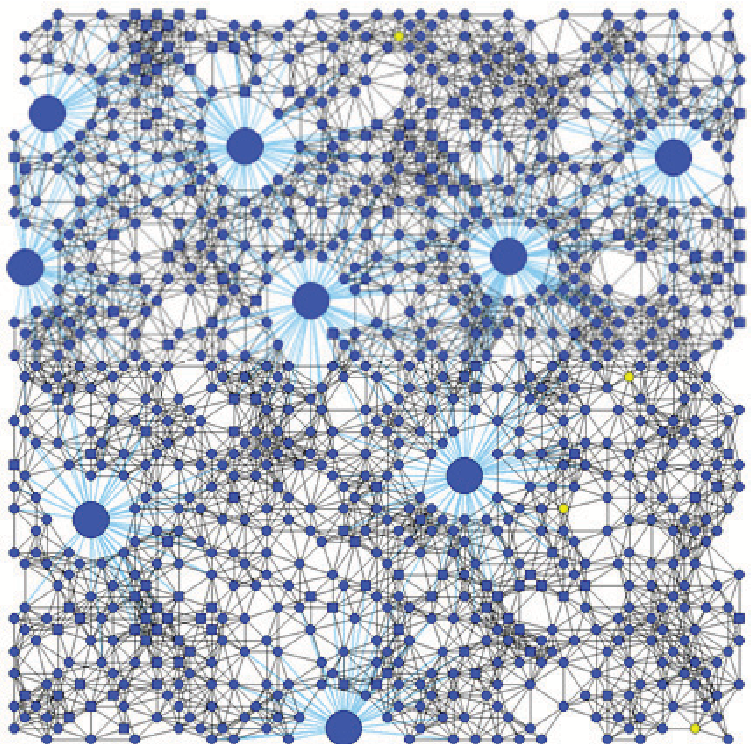 Fig 1: The adaptive network showing interactions between individual people nodes and central hub nodes.
Experiments & Statistical Insights
The study conducted simulations to observe how changing the Contact Radius and Node Degree affected the results.
1. The Power of the Radius
As the contact radius increases, the peak of the infectious curve spikes. A smaller radius not only lowers the peak but also stretches the outbreak period, providing a mathematical justification for "social distancing."
2. The Influence of the "Degree"
The statistical analysis yielded a p-value of 2e-16, indicating that the number of contacts is a massive factor in infection probability. The Odd Ratio (OR) of 1.097 suggests that every new person you add to your regular contact list increases your odds of becoming a "link" in the infection chain by 9.7%.
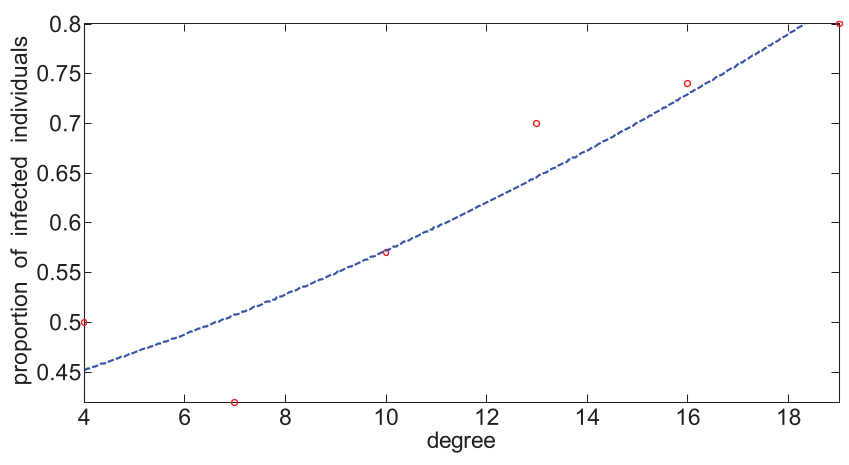 Fig 2: The SEIQR profile showing the progression of the outbreak over time under the degree-dependent model.
Critical Analysis & Conclusion
Key Takeaway
The "Super-spreader" phenomenon isn't just an anecdotal observation; it is a mathematical certainty when transmission is modeled as a function of node degree. The use of hub nodes (schools/hospitals) in the model allows for a more granular view of how public spaces drive community transmission.
Limitations & Future Work
While the model is robust, it assumes a square unit for node distribution, which may not perfectly reflect urban geography. Future iterations could integrate real-world GPS data or transportation networks. Additionally, the researchers suggest that this framework is perfect for testing targeted vaccination strategies—specifically, whether vaccinating high-degree "social butterflies" is more effective than random mass vaccination.
Final Thoughts
By merging statistical regression with network topology, this work provides a blueprint for more "human" disease modeling, moving us closer to being able to predict and intercept the next pandemic with surgical precision.