
Beyond Node Degrees: Mathematical Modeling of Higher-Order Structures in Social Networks
Statistical behavior of embeddedness and communities of overlapping cliques in online social networks
The paper investigates higher-order structural properties in Online Social Networks (OSNs), specifically edge embeddedness and overlapping clique communities. It introduces the "Random k-Tree" and "Random Partial k-Tree" models as rigorous mathematical frameworks that achieve SOTA performance in replicating the power law distributions of these higher-order structures.
TL;DR
While the "Power Law" of node degrees is a well-known staple of network science, it only tells half the story. This paper proves that higher-order features—like edge embeddedness (common neighbors) and clique community sizes—also follow power law distributions in real OSNs. The authors demonstrate that the Random k-Tree model is the first mathematical framework capable of rigorously recreating these complex social patterns where traditional BA models fail.
Problem & Motivation: The Failure of First-Order Models
For decades, the Barabási-Albert (BA) model has been the gold standard for explaining how networks grow through preferential attachment. However, BA models are "locally sparse." In a real social network like Orkut or Facebook, friends of friends are very likely to be friends (high clustering).
The authors point out that current models cannot explain:
- Embeddedness: The strength of a tie based on mutual friends.
- Overlapping Communities: How small, tightly-knit groups (cliques) merge into larger social clusters.
Without a model that accounts for these, we cannot accurately simulate information propagation, trust-based routing, or viral marketing.
Methodology: The Random k-Tree Evolution
The core innovation lies in the Random k-Tree process. Instead of connecting a new node to an individual high-degree node (as in BA), the k-Tree model connects a new node to an existing k-clique (a fully connected group of nodes).
Architecture of Growth
When a new vertex joins:
- It selects a -clique uniformly at random.
- It connects to all vertices in that clique.
- This creates new -cliques for future nodes to attach to.
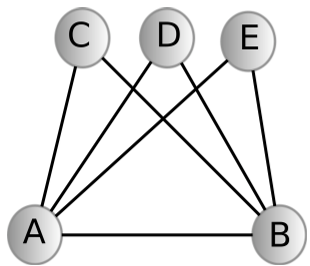 Fig 1: Illustration of edge embeddedness where link AB shares 3 common neighbors.
Through rigorous derivation using the Gamma function, the authors prove that the proportion of edges with embeddedness follows: This confirms that embeddedness isn't just a random occurrence; it is a structural byproduct of clique-based growth.
Experiments & Results: Real-World vs. Synthetic Models
The authors validated their theory against a sampled Orkut dataset consisting of 3 million users.
1. Embeddedness in the Wild
The Orkut data revealed a clear power law trend for embeddedness with an exponent of 2.91. When compared to the BA model, the difference was stark: the BA model produced almost no triangles, making it useless for studying local social density. In contrast, the Random k-Tree mirrored the Orkut distribution perfectly.
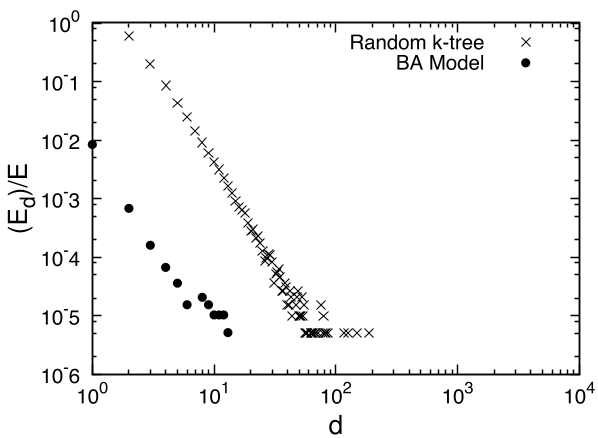 Fig 3: The Random k-Tree (red) maintains the power law, while the BA model (blue) fails to capture higher-order triangulation.
2. Clique Community Sizes
By introducing the Random Partial k-Tree (where edges are randomly removed to simulate more realistic, less rigid structures), the authors could model "Clique Percolation." Their model successfully generated power law distributions for the sizes of 5-clique communities, a task where previous SOTA models were computationally or structurally insufficient.
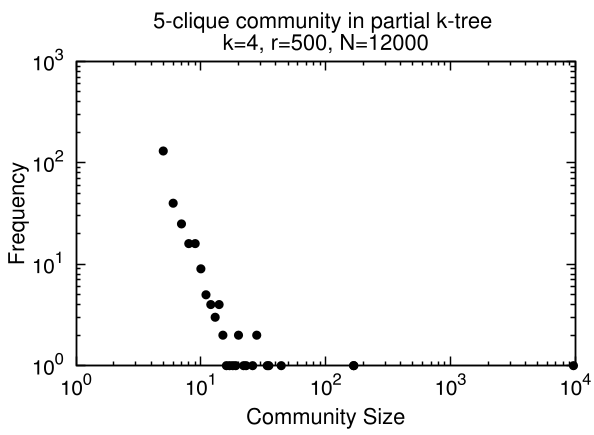 Fig 4: The power law distribution of overlapping k-clique communities generated by the Partial k-Tree model.
Critical Analysis & Conclusion
Takeaway
The Random k-Tree model provides the "missing link" between simple degree-based growth and the complex, clique-heavy reality of human interaction. It offers a mathematically tractable way to generate synthetic social graphs that are actually "social."
Limitations & Future Work
- Rigidity: The standard k-tree is a chordal graph, which is somewhat restrictive. The "Partial k-tree" variant helps, but finding the exact parameter (edge removal rate) to match specific real-world networks remains an empirical challenge.
- Temporal Dynamics: The model assumes a steady growth. Future research could investigate "active" versus "dormant" cliques to simulate how interests (and thus communities) shift over time in OSNs.
This work is essential for researchers building DHT routing algorithms (like SPROUT) or Sybil-defense systems that rely on the local density of social ties to verify identity.