
Unmasking the Shadows: A Statistical Infinite Feature Cascade Approach to Social Network Anomaly Detection
A statistical infinite feature cascade-based approach to anomaly detection for dynamic social networks
This paper introduces a novel statistical anomaly detection method for dynamic social networks based on an Infinite Feature Cascade framework. It leverages a non-parametric Bayesian approach using an Infinite Factorial Hidden Markov Model (IFHMM) and the Indian Buffet Process (IBP) to model the birth, death, and temporal propagation of latent node features to identify statistically unlikely links.
TL;DR
In the hyper-connected era of social media, "malicious actors" don't just exist—they evolve. This paper presents a sophisticated statistical framework that views social network dynamics as a cascade of microscopic latent features. By combining the Indian Buffet Process (IBP) with an Infinite Factorial Hidden Markov Model (IFHMM), the authors created a system that can detect anomalies by understanding not just how links form, but "why" they form based on the hidden characteristics of users and their neighbors.
The Core Problem: Static Views in a Dynamic World
Most existing anomaly detection systems suffer from a fatal flaw: they view the social graph as a series of snapshots rather than a continuous, evolving process.
- The "Feature" Blind Spot: Many models assume a fixed number of communities or features. In reality, human interests (features) are unbounded and transient.
- Ignoring the Cascade: If your friend joins a high-tech community, you are more likely to join it tomorrow. Most models ignore this "Feature Cascade," failing to capture the natural "flow" of social dynamics.
Methodology: The "Microscopic" Evolution
The authors break down network movement into three fundamental processes:
1. Birth, Death, and Lifetime of Features
Unlike previous models that used "unrealistic" geometric distributions, this paper utilizes a Poisson-based Indian Buffet Process. This allows the number of hidden features to be infinite, with the data revealing only a subset at any given time.
- Survival Function: Features have an exponential lifetime distribution, modeling the "rarity" of feature changes.
2. The Feature Cascade (The Secret Sauce)
This is the paper’s major innovation. A node's feature at time is not just a result of its own state at , but a weighted summation of its neighbors' states.
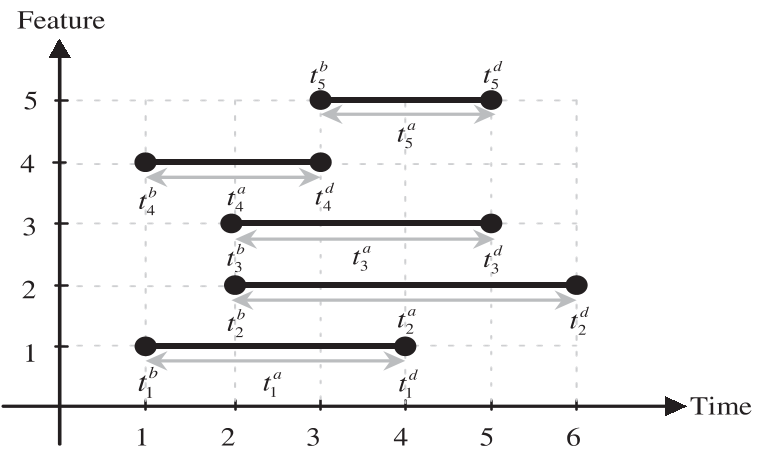 Fig 1. Graphical visualization of the feature birth, lifetime, and death processes.
3. Link Generation via Affinity Matrices
The probability of a link between node and is calculated using a Link Affinity Matrix (). If the observed link contradicts the predicted interaction probability derived from these cascading features, it's flagged as an anomaly.
Experiments: Real-World Performance
The model (referred to as LAD - Link Anomaly Detection) was pitted against heavyweights like DRIFT and DMMG using Google+ and Twitter data.
Key Breakthroughs:
- Sybil & Zombie Detection: The model excelled at identifying "Emulated Anomalous Nodes"—fake profiles created for malicious purposes that establish uniform links to random victims.
- Statistical Superiority: The LAD approach maintained high Sensitivity (TPR) even in noisy real-world environments where baselines like LFRM plummeted.
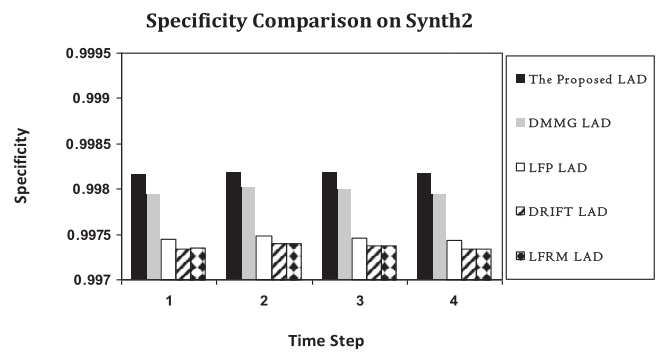 Fig 2. Sensitivity characteristics showing the proposed LAD approach outperforming DRIFT and LFP across different datasets.
Critical Insight: Why it Works
The "magic" lies in the IFHMM structure. By treating social dynamics as a factorial hidden Markov process, the model can track multiple independent feature chains for every single node. When an attacker (anomalous node) suddenly creates links that don't match the "cascaded" interest patterns of the surrounding neighborhood, the statistical deviation becomes massive, allowing for high-precision detection without manual labeling.
Conclusion & Future Outlook
This work pushes the boundary of unsupervised anomaly detection. It moves away from simple heuristic-based graph mining towards deep structural modeling.
Limitations: The model is currently optimized for undirected graphs and requires significant computational resources for MCMC sampling. Future Work: The authors suggest moving toward Anomaly Prevention—predicting an attack before it actually manifests by identifying the early markers of malicious feature cascades.
Keywords: Feature Cascade, Infinite Factorial Hidden Markov Model (IFHMM), Indian Buffet Process (IBP), Dynamic Social Networks, Link Anomaly Detection.