
Beyond Static Graphs: Statistical Modeling of Social Dynamics via DPMM
Statistical modeling of social networks activities
This paper introduces a novel Bayesian nonparametric framework for characterizing social network dynamics by modeling user activities as multidimensional statistical processes. The authors utilize Dirichlet Process Mixture Models (DPMM) to adaptively cluster user behaviors and link weights without predefined category limits, achieving effective community discovery and behavior prediction.
TL;DR
This research moves social network analysis from static "who-knows-whom" graphs to dynamic "how-they-interact" statistical models. By leveraging Dirichlet Process Mixture Models (DPMM), the authors provide a way to cluster users and predict associations based on the mathematical frequency of their interactions and the "thematic" weight of their responses.
Problem & Motivation: The Complexity of Digital Interaction
Most social network models treat connections as simple binary links or static weights. However, human interaction is multifaceted:
- Diversity of Content: Media can be educational, emotional, or financial.
- Asymmetric Influence: A link from User A to User B doesn't imply the same influence in reverse.
- Evolving Communities: Groups aren't fixed; they merge and split based on events.
The authors argue that we need a non-parametric approach—one that doesn't force users into a fixed number of boxes but rather allows the number of clusters to grow and change as the data dictates.
Methodology: The Gaussian-Gamma Engine
The core of the paper lies in its hierarchical Bayesian setup. It treats every user activity as a sample from a distribution, where the distribution's parameters are themselves drawn from a Dirichlet Process.
1. Modeling Responses (Gaussian)
User responses to specific media themes (like sports or music) are modeled as a Multivariate Gaussian Mixture. This allows the system to identifying clusters of users who share similar "penchants" or interests.
2. Modeling Connections (Gamma)
The strength of a connection (Link Weight) is modeled using a Gamma process. To discover "undeclared" ties, the authors use a clever trick: they decrement the shape parameter () of the Gamma likelihood as interaction frequency increases. Lowering effectively drives weights toward values indicating stronger association.
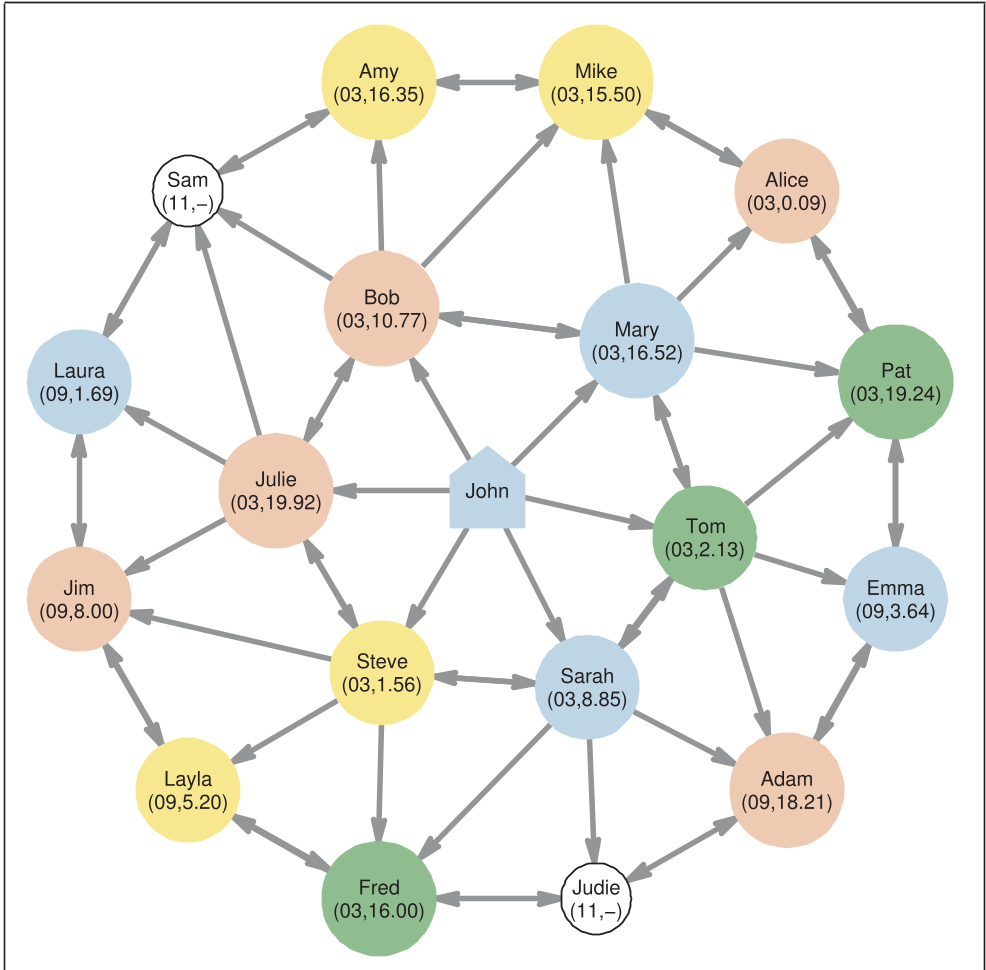 Fig 1: Clustering of "John's Network" where nodes are color-coded based on Gaussian interest components.
Experiments & Results: "John’s Network"
To validate the theory, the authors simulated a community centered around a user named John. Using the DPMM framework:
- Clustering Speed: The model converged to an optimal likelihood within just 10 Gibbs iterations, showing high efficiency for adaptive learning.
- Dynamic Adaptation: In the case of a user named Pat, the system observed 60 media "embracements," causing her link-likelihood shape to drop from 11 down to 5. This quantitative shift allowed the model to "predict" her as a high-affinity associate.
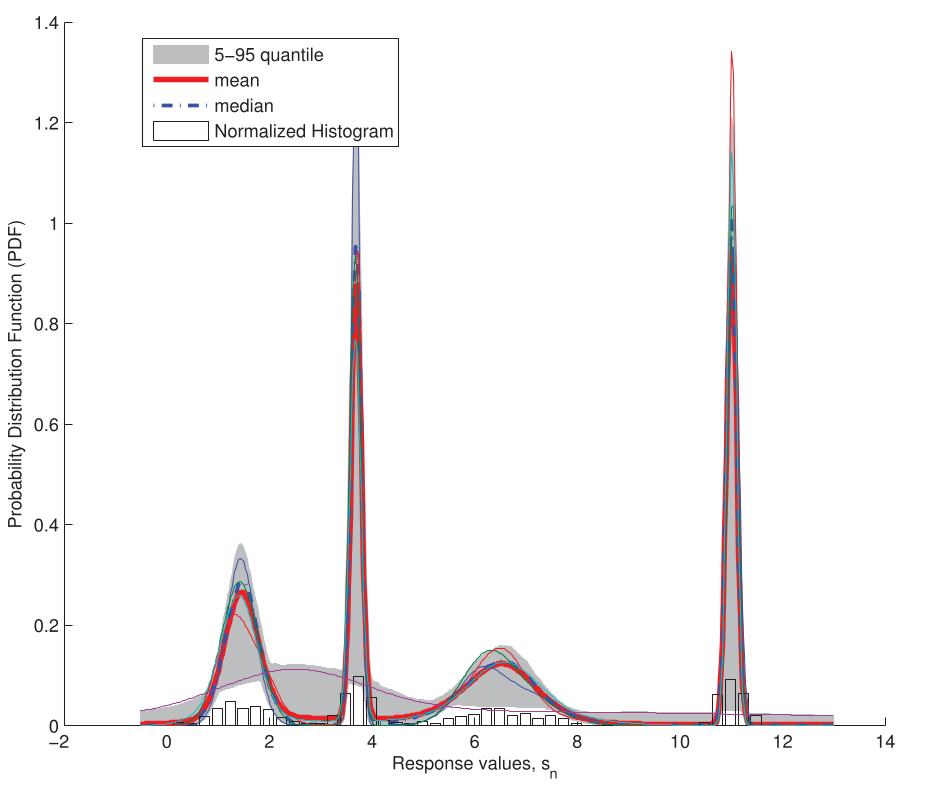 Fig 2: The evolution of user response clustering from priors (left) to refined posteriors (right) using Gaussian DPMM.
Critical Analysis & Conclusion
The true value of this work is its generality. Because it uses the Exponential Family of distributions, the framework can be adapted to almost any type of social data (discrete or continuous).
Key Takeaways:
- Inductive Bias: By choosing DPMM, the authors bake in the assumption that the world is composed of an unknown, potentially infinite number of groups.
- Limitations: While mathematically elegant, the paper relies on simulated data. Real-world social data is often much "noisier" and might require more complex kernels than standard Gaussian/Gamma mixtures.
- Future Work: The logical next step is applying this to Privacy-Preserving Analytics, where one can characterize community behavior without needing to see the raw text of the media exchanged.
In conclusion, this paper provides a rigorous mathematical platform to transform social networks from simple graphs into living, breathing statistical entities.