
The Architecture of Influence: How Status Shapes the Spanish Government Debt Market
The configuration of a status based model of economic actors: The case of Spanish government debt market
This paper presents a social network analysis (SNA) of the Spanish government debt market, specifically focusing on syndicated bond issuances from 2002 to 2015. It utilizes structural equivalence and centrality measures to identify a stable hierarchy of "market makers," revealing that top-tier banks like BBVA and Santander maintain dominant status positions that confer significant economic advantages.
Executive Summary
TL;DR: This research deconstructs the Spanish government debt market from 2002 to 2015, revealing that it is not an anonymous exchange but a highly stratified social network. By analyzing syndicated issuances, the authors demonstrate how a "financial aristocracy" of top-tier banks (e.g., BBVA, Santander, Barclays) leverages social status to secure dominant roles, leading to a concentration of debt ownership.
Background: Moving beyond neoclassical efficiency models, this work positions itself within Economic Sociology. It treats the market as an "embedded" system where status acts as a signal of quality and a gateway to privilege, proving that who you know is as vital as what you bid.
Problem & Motivation: The Myth of the Anonymous Market
Traditional economic models suggest that sovereign debt is auctioned to the most efficient bidder. However, the reality of syndicated issuance—where the Treasury hand-picks "Lead Managers" who then choose "Co-managers"—tells a different story.
The authors argue that existing research overlooks the micro-mechanisms of these relationships. They seek to understand why certain actors consistently occupy the center of the financial web and how this positioning creates a self-reinforcing cycle of rewards, often referred to as the Matthew Effect ("the rich get richer").
Methodology: Mapping Status with Pajek
The study utilizes Social Network Analysis (SNA) to transform 13 years of Thomson Reuters data into a relational map. The core methodology hinges on two distinct metrics of status:
- Influence (Outdegree): The power of Lead Managers to select their partners.
- Prestige (Indegree): The frequency with which a bank is chosen as a Co-leader.
Structural Equivalence and Hierarchy
Using the Ward hierarchical clustering method and Euclidean distance, the authors grouped banks into three clusters based on their tie patterns. This allowed them to identify "structurally equivalent" actors—those who perform identical roles in the market's social architecture.
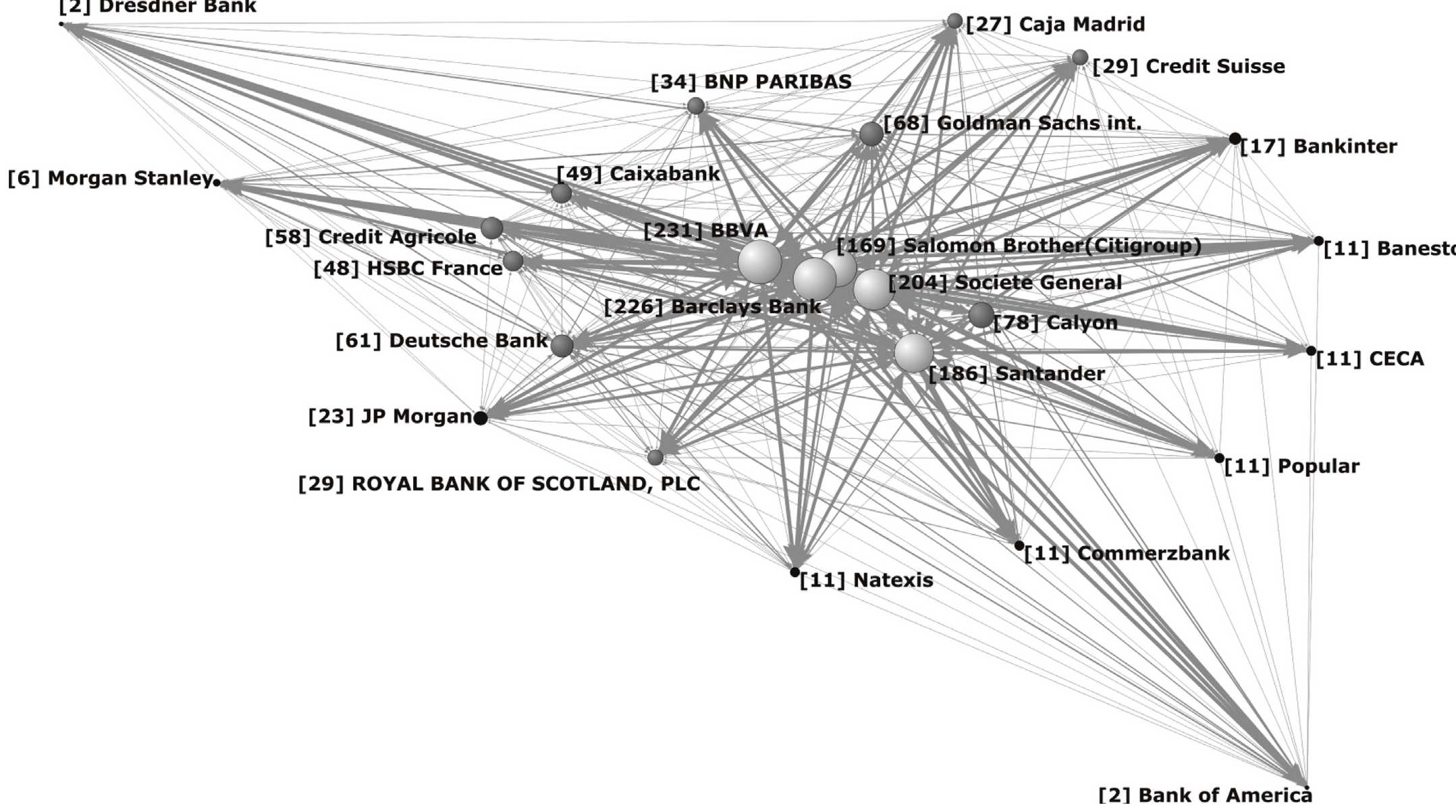 Note: The visualization shows the concentration of influence at the center (Cluster 1) versus the peripheral occasional participants (Cluster 3).
Experiments & Results: The Matthew Effect in Action
The data confirms a stark hierarchy. A small group of "Dominant Market Members" controls the lion's share of the market's activity.
Key Findings:
- The Matthew Effect: There is a 0.673 correlation between a bank’s status and the amount of debt it holds. High-status banks aren't just facilitating trades; they are accumulating bonds in their own portfolios due to the favorable terms of syndicated deals.
- Globalized Elite: Interestingly, Nationality (Cramer’s V = 0.0958, non-significant) does not determine status. The Spanish debt market is fully financialized, meaning a German or American bank is just as likely to occupy a "Spanish" core position as a local bank, provided they have the requisite market prestige.

Deep Insight & Conclusion: The "Financial Aristocracy"
The paper concludes that the Spanish Treasury has effectively institutionalized a system that rewards a select group of financial institutions. This "financial aristocracy" manages the state's access to credit, receiving high commissions and better-than-market interest rates in exchange for guaranteeing liquidity.
Takeaways for the Future
- State as a Producer of Status: The research highlights that the State is not a neutral observer but an active participant that "manufactures" status by choosing lead managers.
- Limitations: The study focuses on Spanish debt; however, the authors suggest this pattern likely repeats across the Eurozone, particularly in "debt states" where liquidity is a constant concern.
- Outlook: Future research should look at how entry and exit barriers (regulatory tweaks) can alter these social structures to prevent excessive debt concentration.