
PAWS: Using Gaussian Processes to Outsmart Poachers and Save Endangered Wildlife
Stay Ahead of Poachers: Illegal Wildlife Poaching Prediction and Patrol Planning Under Uncertainty with Field Test Evaluations (Short Version)
This paper presents an enhanced version of the Protection Assistant for Wildlife Security (PAWS), a machine learning and game-theoretic pipeline designed to predict illegal poaching and optimize ranger patrol routes. By integrating Gaussian Processes into an ensemble framework (iWare-E), the authors successfully quantify predictive uncertainty to create more robust, risk-averse patrol plans, achieving SOTA results across parks in Uganda and Cambodia.
TL;DR
Illegal poaching is pushing endangered species toward extinction, but ranger resources are thin. This paper introduces an end-to-end AI pipeline that uses Gaussian Processes to predict poaching risks and quantify uncertainty. By deploying this model in Uganda and Cambodia, researchers helped rangers find significantly more snares while avoiding wasting time in low-risk areas.
Problem & Motivation: The "Invisible" Adversary
Protecting a national park is a daunting task. Rangers must cover thousands of square kilometers to find hidden snares. From a Machine Learning perspective, this is a nightmare:
- Extreme Class Imbalance: In some parks, only 0.25% of patrolled areas contain poaching signs.
- Uncertain Negatives: If a ranger doesn't find a snare, does it mean the area is safe, or is the snare just well-hidden?
- Observational Bias: Historical data is clustered where rangers usually go, not necessarily where poachers are.
Previous versions of the Protection Assistant for Wildlife Security (PAWS) used ensemble methods, but they lacked a "confidence meter." The authors realized that to save the most animals, rangers need more than just a risk map—they need to know how much they can trust that map.
Methodology: Risk-Averse Intelligence
The core innovation is the integration of Gaussian Processes (GPs) into the iWare-E ensemble framework.
1. Uncertainty via Gaussian Processes
Unlike standard classifiers that only give a probability, GPs provide a mean (predicted risk) and a variance (uncertainty). In regions with little historical data, the variance is high.
2. The Robust Patrol Planner
The authors adjusted the patrol utility function to be "risk-averse." Instead of just chasing high probability, the new objective function penalizes high variance:
u_{v}(c_{v})$$ Where $\beta$ is a tuning parameter for robustness. This ensures that rangers aren't sent on "wild goose chases" in areas where the model is guessing blindly. 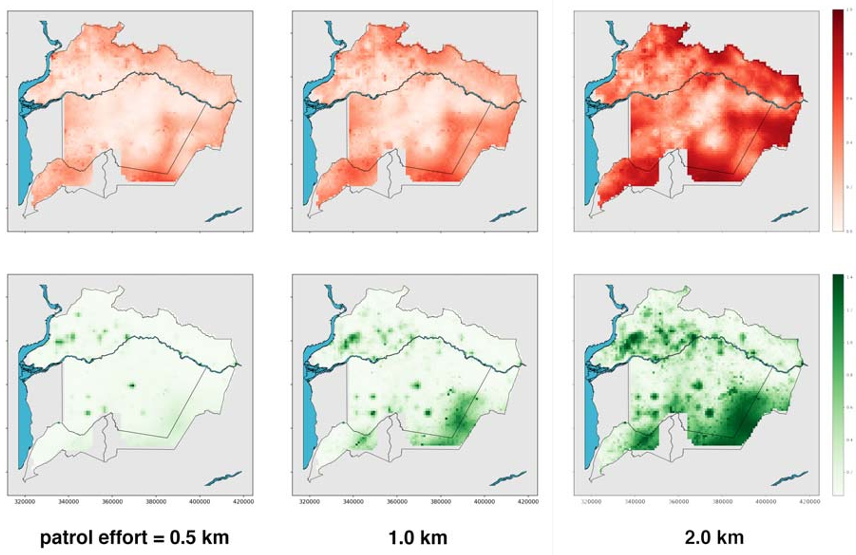 *Figure: The top map shows poaching risk, while the bottom map visualizes the uncertainty (GPs), showing higher doubt in sparsely patrolled regions.* ## Experiments: From Math to the Jungle The researchers didn't just stay in the lab; they conducted months-long field tests in **Murchison Falls (Uganda)** and **Srepok (Cambodia)**. ### Key Results: * **Predictive Power**: The iWare-E ensemble with GPs yielded an average AUC increase of 0.10 across all datasets. * **Field Validation**: In Srepok, rangers found **zero** poaching activity in areas labeled as "low-risk" by the model, confirming that the model effectively identifies safe zones for resource reallocation. * **Robustness**: Incorporating uncertainty increased the detection of snares by an average of **30%** in simulations. 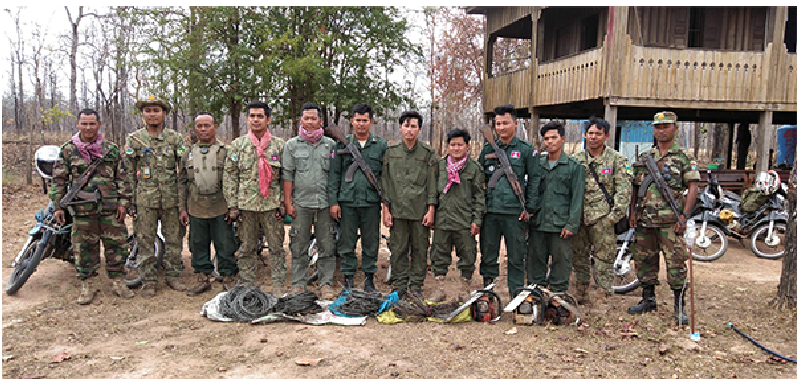 *Figure: Rangers in Cambodia with a massive haul of removed snares, guided by PAWS predictions.* ## Critical Analysis & Future Outlook This work is a masterclass in **Applied AI**. The shift from simple classification to **Uncertainty-Aware Planning** is the "secret sauce" that makes AI viable for high-stakes law enforcement. ### Takeaways: * **The Power of SMART**: By integrating PAWS into the **SMART** software (used in over 800 parks), this research has a direct path to global impact. * **Limit of Data**: The model still relies on static geospatial features. Incorporating dynamic data (like real-time satellite imagery or weather) could further refine predictions. * **Human-in-the-Loop**: The success of the field tests relied on local knowledge. AI is not replacing rangers but acting as an "intelligence officer" that maximizes their specialized skills. **Conclusion**: PAWS demonstrates that by embracing uncertainty rather than ignoring it, we can build robust systems that protect our planet's most vulnerable inhabitants.