
Steeler Nation and Boo Birds: Why "When" You Tweet Defines Who You Are
1293_Steeler nation, 12th man, and boo birds classifying Twitter user interests using time series.
This paper introduces a novel Twitter user classification framework that transforms tweet streams into numerical time series. By leveraging latent periodicity patterns in user behavior, the authors achieve SOTA results in classifying sports (NFL) and political interests using distance-based time series algorithms.
TL;DR
Researchers from Penn State and IBM have pivoted from traditional text-based Twitter classification to a Time Series domain. By mapping tweet frequencies to temporal signals, they achieved a massive 142% improvement in identifying which NFL team a user follows, proving that the rhythm of your social media activity is a dead giveaway of your interests.
Problem: The Limits of Static Text
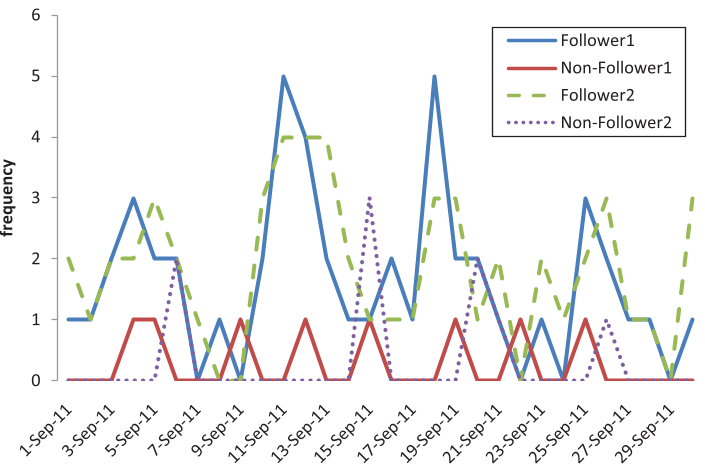
Most Twitter classifiers treat a user's history as a "bag of words." While effective for broad topics, this "static" view fails to capture the essence of being a fan. A New York Giants fan doesn't just use football keywords; they use them with a specific periodicity—peaking on Sundays and Mondays during the season and falling silent in May.
Prior works using TF-IDF or Latent Dirichlet Allocation (LDA) miss this "pulse." When you have 32 different NFL teams, the vocabulary overlap is so high that traditional SVMs often get confused. The authors hypothesized that the temporal signature of a fan is much more unique than their vocabulary alone.
Methodology: From Tweets to Signals
The core innovation is a two-stage transformation process:
- Keyword Harvesting: Extracting category-specific terms (e.g., "quarterback", "touchdown", or specific player names) from external sources like Wikipedia.
- Signal Transformation: Instead of a document vector, the user is represented as a numerical sequence , where is the frequency of keywords in a specific time window (daily or weekly).
The Architecture of Time Series Classification
The team utilized Dynamic Time Warping (DTW). Unlike Euclidean distance, which compares points at fixed timestamps, DTW "warps" the time axis to find the best alignment between two signals. This accounts for fans who might tweet about the same game but at slightly different times.
For multi-class hurdles, they proposed two strategies:
- One-Vs-All: Building a binary classifier for each team.
- All-At-Once: Comparing a user's signal against all team signals simultaneously.
Experiments: Dominating the Gridiron
The researchers tested their method on a dataset of 2.56 million tweets from 64,000 users.
Breaking the Baseline
The results were conclusive. While text-based SVMs achieved decent results in binary classification (Fan vs. Non-fan), they crumbled under the pressure of the 32-class team identification task.
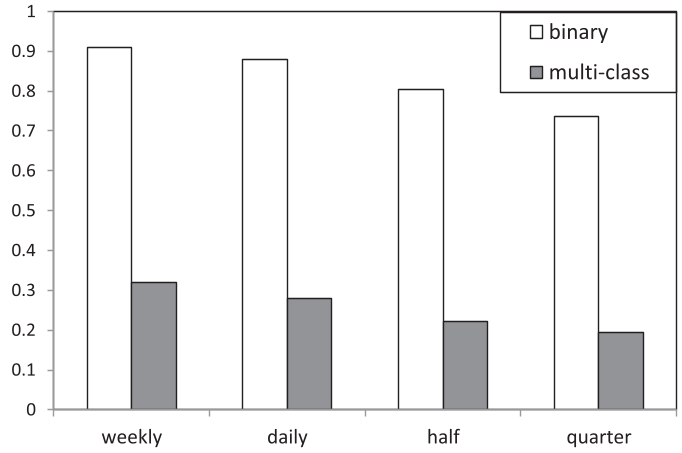
- Binary Task: Time-series (DTW) outperformed SVM+LDA by 15%.
- Multi-class Task: The "One-Vs-All" time-series approach achieved a 142% boost over the best baseline.
Why does it work?
As shown in the ablation studies, as the length of the time series increases (moving from 1 month to 4 months of data), the accuracy climbs. This confirms that the "periodicity" needs enough time to emerge as a stable pattern. Interestingly, even at smaller scales (half-day windows), the model remains robust.
Critical Analysis & Conclusion
This paper is a masterclass in domain-driven feature engineering. By recognizing that sports and politics are "event-driven" interests, the authors moved the problem from the noisy space of Natural Language Processing (NLP) to the structured space of Signal Processing.
Takeaways:
- Periodicity is a Signal: For targeted advertising or user profiling, the timing of engagement is a high-signal feature.
- Beyond Sports: The authors successfully extended this to politics (Democrat vs. Republican), showing that political "cycles" also generate unique temporal signatures.
Limitations: The method relies on high-quality initial keyword lists. If a user has a niche interest without a clear "event calendar," the temporal signal might be too weak to classify. However, for any interest tied to real-world schedules (TV shows, finance, sports), this method is a game-changer.
Future Work: Integrating these temporal signals into modern Deep Learning architectures (like Graph Neural Networks or Temporal Transformers) could potentially push these accuracies even higher, allowing for real-time interest detection as events unfold.